
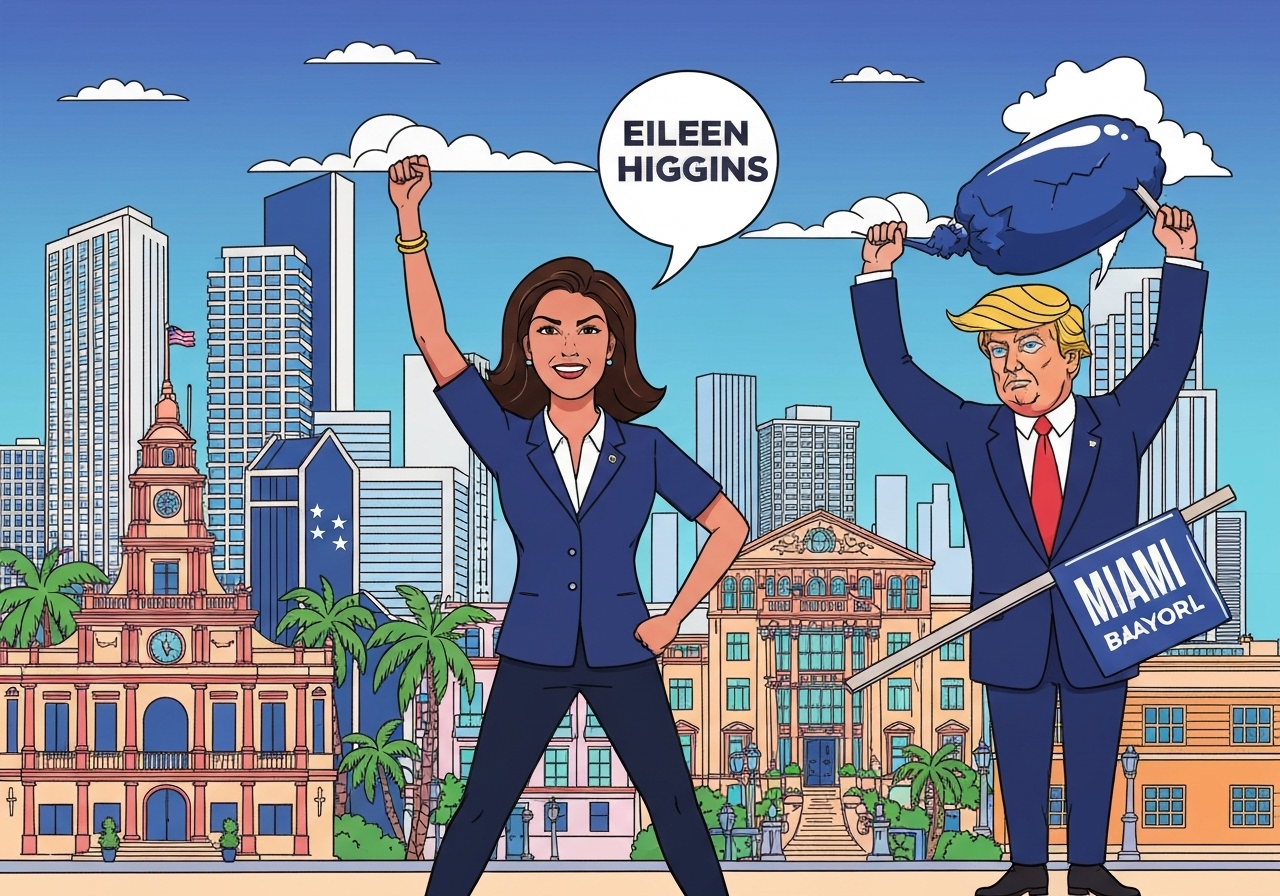
Lead: Democrat Eileen Higgins secured victory in Miami’s mayoral runoff on Tuesday evening, ending nearly three decades of Republican control of the city hall. The 61-year-old defeated Emilio Gonzalez, a Trump-endorsed former city manager, in a high-profile contest watched as a bellwether in Florida. Higgins campaigned on ethics, affordable housing and opposition to harsh immigration enforcement, and called the result historic for Miami. The win gives Democrats a rare municipal prize in a pivotal state ahead of the 2026 midterms.
Key Takeaways
- Eileen Higgins, 61, won the Miami mayoral runoff on Tuesday evening, becoming the city’s first woman mayor.
- The victory breaks a nearly three-decade stretch without a Democratic mayor in Miami, a symbolic reversal for the party locally.
- Higgins defeated Emilio Gonzalez, who was publicly endorsed by President Donald Trump; Gonzalez conceded and called to congratulate her.
- The race was officially nonpartisan, but Higgins campaigned as a Democrat on housing, transparency and immigration concerns.
- The outcome arrives after Trump carried Miami-Dade County last year, underscoring shifting and contested voter dynamics in South Florida.
- Higgins framed the result as a rebuke of ‘chaos and corruption’ and promised an ethics-focused administration and housing initiatives for residents.
Background
Miami is a Hispanic-majority city and a key gateway to Latin America; its electorate includes large communities with Cuban, Venezuelan and Nicaraguan heritage. Over recent cycles, those communities have been courted by Republicans who link some progressive Democrats to governments that residents fled. That dynamic helped the GOP perform strongly across parts of Florida in recent statewide and national contests.
Municipal elections in Miami are officially nonpartisan, but party labels and outside endorsements frequently shape voter perceptions. The mayor’s office in Miami is often described as more ceremonial than executive, yet the position carries symbolic weight and local policy influence. Affordable housing, public ethics and municipal spending have been central issues in recent city contests, and Higgins centered her campaign on those themes.
Main Event
On Tuesday evening, ballots in the runoff returned a win for Higgins over Emilio Gonzalez, who had received President Trump’s endorsement. Higgins declared the result historic and said the vote signaled a desire for change in the city’s leadership. Campaign remarks and post-election statements emphasized a platform of accountability and tangible local priorities such as identifying city land for affordable housing and cutting discretionary spending.
Gonzalez, a former city manager, acknowledged the result and told supporters he had called Higgins to offer his congratulations. His campaign had highlighted management experience and argued for fiscal discipline; the endorsement from the president amplified national attention on a municipal race that many expected to be a symbolic test of partisan sentiment in Florida.
Higgins repeatedly raised immigration enforcement in her outreach, saying many residents in Miami feared family separations tied to federal policies. She pledged to use the mayor’s public platform to press for humane, locally focused policies even as direct municipal authority over immigration is limited.
Analysis & Implications
At the local level, Higgins inherits a mostly ceremonial post but a high-profile platform from which to shape the public agenda and influence county- and state-level debate. Her stated priorities—affordable housing and ethics reforms—are directly actionable through city planning and budget oversight, though many structural housing solutions will require county or state cooperation and resources.
Politically, the result is a lift for Democrats in a state where party fortunes have fluctuated. Winning Miami’s mayoralty for the first time in nearly 30 years gives Democrats a talking point about competitiveness with Hispanic and urban voters. However, municipal outcomes do not automatically translate into statewide trends: turnout patterns, local issues and candidate profiles differ from federal and gubernatorial contests.
The fact that a Trump-endorsed candidate lost a high-profile municipal election will be interpreted differently across parties. For Democrats it is momentum and a narrative counter to recent Republican advances in the state; for Republicans the loss may prompt re-examination of messaging and outreach to urban Hispanic voters, particularly around economic and local governance themes.
Comparison & Data
| Election | Result |
|---|---|
| Miami mayoral runoff, Dec 2025 | Eileen Higgins (Democrat) |
| Miami-Dade county, 2024 presidential | Carried by Trump (Republican) |
The table highlights the split between municipal and recent presidential results in the county. Local contests can diverge from national patterns because voters evaluate municipal platforms and candidates on distinct issues such as housing and city services. Analysts will watch precinct-level shifts to see whether Higgins’ coalition differed from recent GOP gains in the county.
Reactions & Quotes
Higgins framed the result as a milestone and a mandate for change, pointing to public ethics and housing as immediate priorities.
Tonight, the people of Miami made history.
Eileen Higgins (Mayor-elect)
Gonzalez acknowledged the outcome publicly and indicated he would support a smooth transition while addressing his supporters directly about the phone call he placed to the winner.
I just got off the phone with our new mayor.
Emilio Gonzalez (former candidate)
National and party accounts quickly noted the race’s symbolic value: the Democratic Party celebrated the flip while some Republican observers expressed concern about local messaging and outreach.
Congrats, Mayor-elect!
Democrats (party social account)
Unconfirmed
- Whether Higgins’ win presages a broad, sustained shift among Hispanic urban voters across Florida ahead of 2026 remains unconfirmed and will depend on turnout and candidate quality in future races.
- Detailed precinct-level voting patterns and demographic shifts that explain the margin of victory are still being analyzed and have not been fully confirmed.
Bottom Line
Eileen Higgins’ election is both symbolic and practical: symbolic because it halts a nearly 30-year partisan drought for Democrats in Miami’s mayoralty, and practical because it places an ethics-focused, housing-centered agenda on a visible municipal stage. Her administration’s early moves—particularly on city land use and budget prioritization—will signal how much can be achieved from a largely ceremonial office.
For national politics, the result provides Democrats with a narrative of resilience in a key Florida city, but it is not by itself predictive of statewide outcomes. Observers should watch whether Higgins can translate symbolic momentum into measurable policy gains and whether the coalition that elected her can be sustained or scaled in suburban and statewide contests ahead of 2026.
Sources
- Al Jazeera (international news) — original coverage of the race and election night reporting.
- Miami-Dade County Elections (official election office) — official election resources and vote tallies.
- Associated Press (news agency) — reporting cited by candidates during the campaign and post-election comments.