
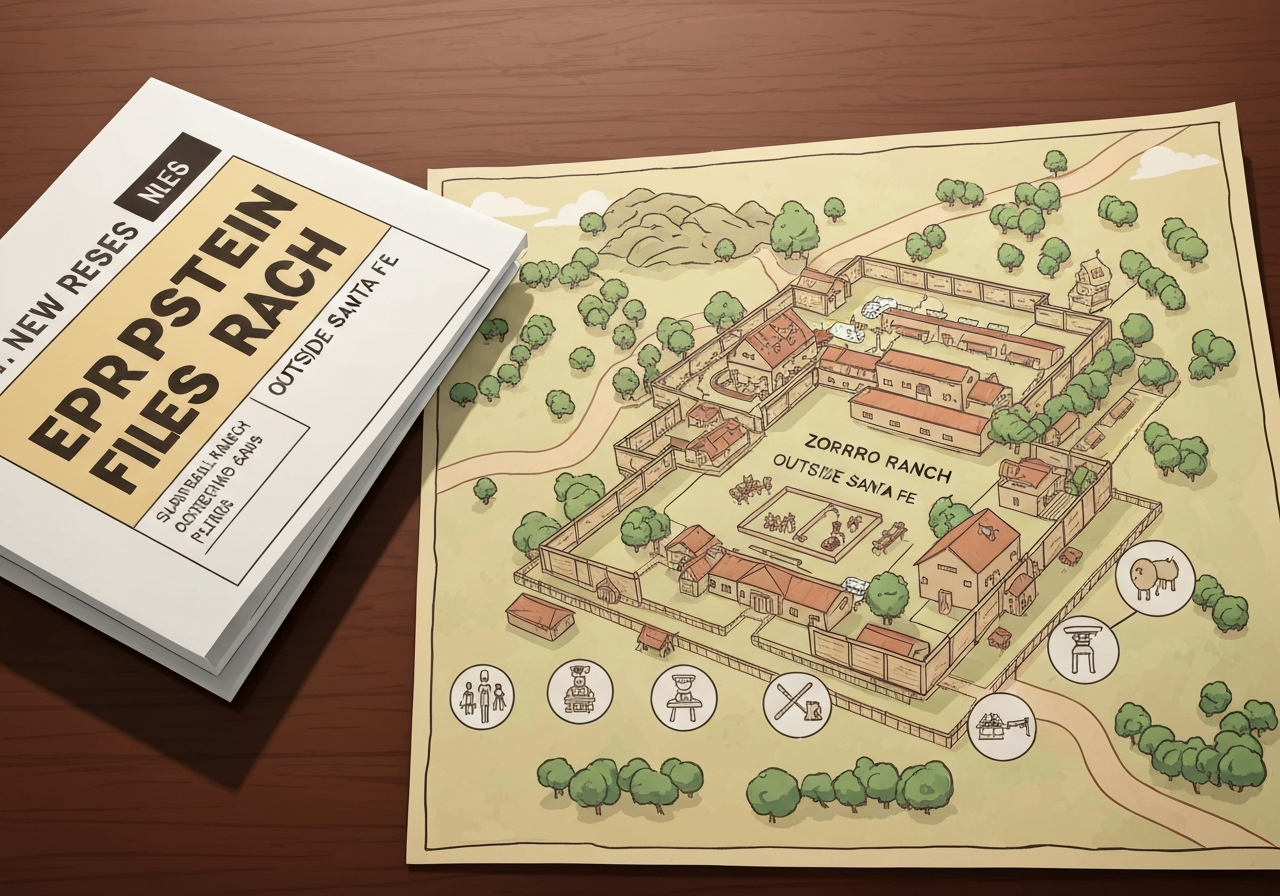
Lead: Newly released legal files and photos have cast fresh light on Jeffrey Epstein’s vast Zorro ranch outside Santa Fe, New Mexico, a property he owned from 1993 and where survivors say abuse took place. The 9,900–10,000 acre (about 4,000 hectare) estate included a 26,700 sq ft main house, a private runway and hangar, stables and wide grazing tracts. State and federal records show intermittent inquiries over two decades, but officials say a full federal search of the property did not occur around Epstein’s July 2019 arrest. Victims’ court testimony and the document cache together deepen questions about who knew what and when.
Key takeaways
- Epstein’s Zorro ranch comprised roughly 9,900–10,000 acres (≈4,000 hectares) and a 26,700 sq ft mansion, with a private runway and hangar on the site.
- The ranch purchase dates to 1993; the sale to San Rafael Ranch LLC closed in 2023, and about 1,200 acres had been leased state land used for grazing.
- Survivors including accusers who testified at Ghislaine Maxwell’s trial say they were abused at the New Mexico property as teens or young adults.
- New Mexico officials opened an investigation in July 2019 but paused some actions after federal prosecutors in Manhattan asked state authorities to defer while a multi‑jurisdictional federal case proceeded.
- Emails in the released batch state that Manhattan prosecutors had “not searched the New Mexico property” around late 2019; the DOJ deferred detailed inquiries to the FBI, which declined comment.
- Undated photos in the files show Epstein, his estate, guests and young women (faces redacted), and include images of figures who have not been accused of wrongdoing.
- State officials later canceled Epstein’s grazing leases in September 2019 and moved to reclaim public land; part of the former grazing acreage has been proposed as a memorial or wildlife refuge.
- Deutsche Bank pledged $4.95m in 2023 toward anti‑trafficking resources in New Mexico following an investigation into financial services’ roles related to Epstein’s operations.
Background
Jeffrey Epstein acquired the Zorro property in 1993 through an entity later identified as the Zorro Trust (which became Cypress Inc.), buying a large ranch that included both private residences and state‑leased grazing acres. The estate sat in desert scrub outside Santa Fe and was described in records as pastureland dotted with cholla cactus and Angus cattle, alongside residential structures and service buildings. Epstein’s outposts in New York, Palm Beach, the Caribbean and Paris drew law enforcement attention at different times, but public records and recently released Justice Department files suggest the New Mexico site received comparatively limited federal scrutiny before 2019.
After Epstein’s controversial 2008 Florida plea agreement, which resolved certain state prostitution charges, the Zorro ranch operated as a quiet retreat where, according to multiple survivors’ testimony, abuse occurred. Local and federal authorities had episodic contact with the ranch: an FBI interview with a ranch manager in February 2007 is reflected in the files, and county records show non‑sexual incident reports but few probes tied directly to trafficking allegations. In August 2010, Epstein was notified about Florida convictions and briefly registered with Santa Fe county as a sex offender before state authorities later said he did not meet New Mexico registration requirements under state law.
Main event
The document release—emails and photos produced by the Department of Justice in 2026—contains new details and previously unseen images of life on the ranch. Survivors who testified at Ghislaine Maxwell’s trial described being brought to Epstein’s New Mexico estate as teens and young adults, and recounted episodes of sexual abuse they say took place there. One accuser who testified as “Jane” said she met Epstein in 1994 and later traveled with him and Maxwell, eventually being taken to the ranch where abuse began when she was 14 and continued in subsequent years.
Other testimony included Annie Farmer’s account that Maxwell gave her a nude massage at the ranch when Farmer was 16, followed the next morning by contact with Epstein that Farmer described as unwanted and physically coercive. A separate woman identified as Jane Doe described being flown from a magic show to the ranch on Epstein’s plane and alleged an assault there involving a device, as she set out in court filings. Virginia Giuffre’s filings also include photographs placing her at the property; Giuffre has said Epstein trafficked her to powerful men there, an allegation a spokesman for the late Bill Richardson has denied.
Law enforcement records show state action in 2019: New Mexico Attorney General Hector Balderas opened an investigation in July 2019, and Stephanie Garcia Richard, then commissioner of public lands, provided hundreds of pages of lease documents and ultimately canceled state grazing leases in September 2019. Those cancellations cited misrepresentation and obstructed inspections and noted that some leases appeared to have been obtained for non‑agricultural purposes. Emails from Manhattan federal prosecutors in late 2019 and a December 2019 exchange with estate counsel indicate federal teams told estate lawyers they had not searched the New Mexico property at that time.
Analysis & implications
The Zorro ranch revelations underscore how physical isolation and layers of private governance can complicate detection and investigation of alleged abuse. A nearly 10,000‑acre estate with private air access creates logistical barriers to oversight; the ranch’s combination of leased state land and private holdings complicates jurisdictional lines between county, state and federal authorities. Where multiple agencies have overlapping authority, coordination is essential—but the 2019 exchanges show how federal requests to defer state actions can leave local investigators with unanswered questions.
For survivors, the fragmentary record is an enduring problem: affidavits, court testimony and redacted images present a partial archive rather than a comprehensive investigative account. That patchwork leaves significant evidentiary and historical gaps that lawmakers and victim advocates say should be addressed through public inquiries or truth‑seeking mechanisms. New Mexico legislators have proposed a bipartisan commission to compile records, interview witnesses and establish a public chronology of events tied to the ranch.
The financial and institutional fallout is also consequential. The sale of the estate’s remaining acreage, Deutsche Bank’s $4.95m pledge for anti‑trafficking resources in New Mexico, and earlier settlements by financial institutions tied to Epstein’s networks illustrate the wider accountability questions beyond criminal prosecutions. Civil claims, regulatory inquiries and public policy responses aimed at improving corporate due diligence and land‑use oversight are likely to continue as documents and testimony remain under review.
Comparison & data
| Item | Figure |
|---|---|
| Approximate total acreage | ~9,900–10,000 acres (≈4,000 ha) |
| State‑leased grazing acreage | ~1,200 acres (485 ha) |
| Main house footprint | 26,700 sq ft |
| Ranch listed for sale | 2021 (remaining ≈8,000 acres listed) |
| Property sale | 2023 (to San Rafael Ranch LLC) |
The table above summarizes key factual markers drawn from land records, court filings and the DOJ file release. The ranch’s scale—nearly 10,000 acres—contrasts with the 1,200 acres that were state‑leased and later reclaimed; that distinction mattered in later state decisions to cancel leases and propose alternative uses including memorialization or wildlife habitat. The listing and eventual sale of the property placed large tracts into private hands again, even as state officials sought reparative measures for public land used under lease.
Reactions & quotes
New Mexico officials expressed a mix of frustration and intent to produce a fuller record. The state’s former attorney general described the 2019 inquiry and subsequent federal requests to pause prosecutions as part of a complex multi‑jurisdictional investigation.
“We investigated activity that occurred in New Mexico that was still viable for prosecution… but were asked to hold further state investigation as federal authorities were leading a multi‑jurisdictional prosecution.”
Hector Balderas, then New Mexico Attorney General (statement)
The commissioner of public lands framed the lease cancellations as a step to reclaim public land and address obstructions to oversight.
“This land was no doubt used to protect the privacy of Epstein and his co‑conspirators, and today we took steps to take back this public land.”
Stephanie Garcia Richard, New Mexico Commissioner of Public Lands (2019)
Lawmakers pushing a truth commission emphasized the need for a public record to answer lingering questions about what officials knew and what may have gone unreported.
“There’s no complete record of what occurred… This commission will specifically seek the truth about what officials knew.”
Representative Andrea Romero (New Mexico state legislature)
Unconfirmed
- Whether federal agents ever physically searched the Zorro ranch before Epstein’s 2019 arrest remains disputed; federal emails state Manhattan prosecutors had not searched the property, but some local officials recall other contacts.
- Photographs in the DOJ files show public figures on the property, but presence in images is not evidence of knowing participation in criminal conduct and no criminal allegations attach to several individuals pictured.
- Reports that the ranch was used systematically to “recruit” or traffic specific groups of young women are supported by survivor testimony but not fully corroborated in the public record released to date.
Bottom line
The newly disclosed files on Epstein’s Zorro ranch add important documentary layers—photos, emails and records—that corroborate aspects of survivors’ accounts and highlight institutional gaps in oversight. The property’s size, private air access and mixed ownership structure complicated transparent monitoring and raise policy questions about how public‑land leases are vetted and inspected. For victims and advocates, the record remains incomplete; survivors’ testimony and partial archives demand fuller investigation and a public accounting.
State officials in New Mexico have moved to reclaim state land, propose memorial or conservation options for affected parcels, and seek funding and structural reforms to better prevent and prosecute trafficking. A proposed bipartisan truth commission aims to assemble the missing chronology and press for recommendations; whether it will secure cooperation and access to all relevant records is a key next step for accountability and historical clarity.
Sources
- The Guardian — investigation and document review (media)
- U.S. Department of Justice (official — DOJ document production referenced)
- Federal Bureau of Investigation (official — cited for investigative records and public inquiries)