
Lead
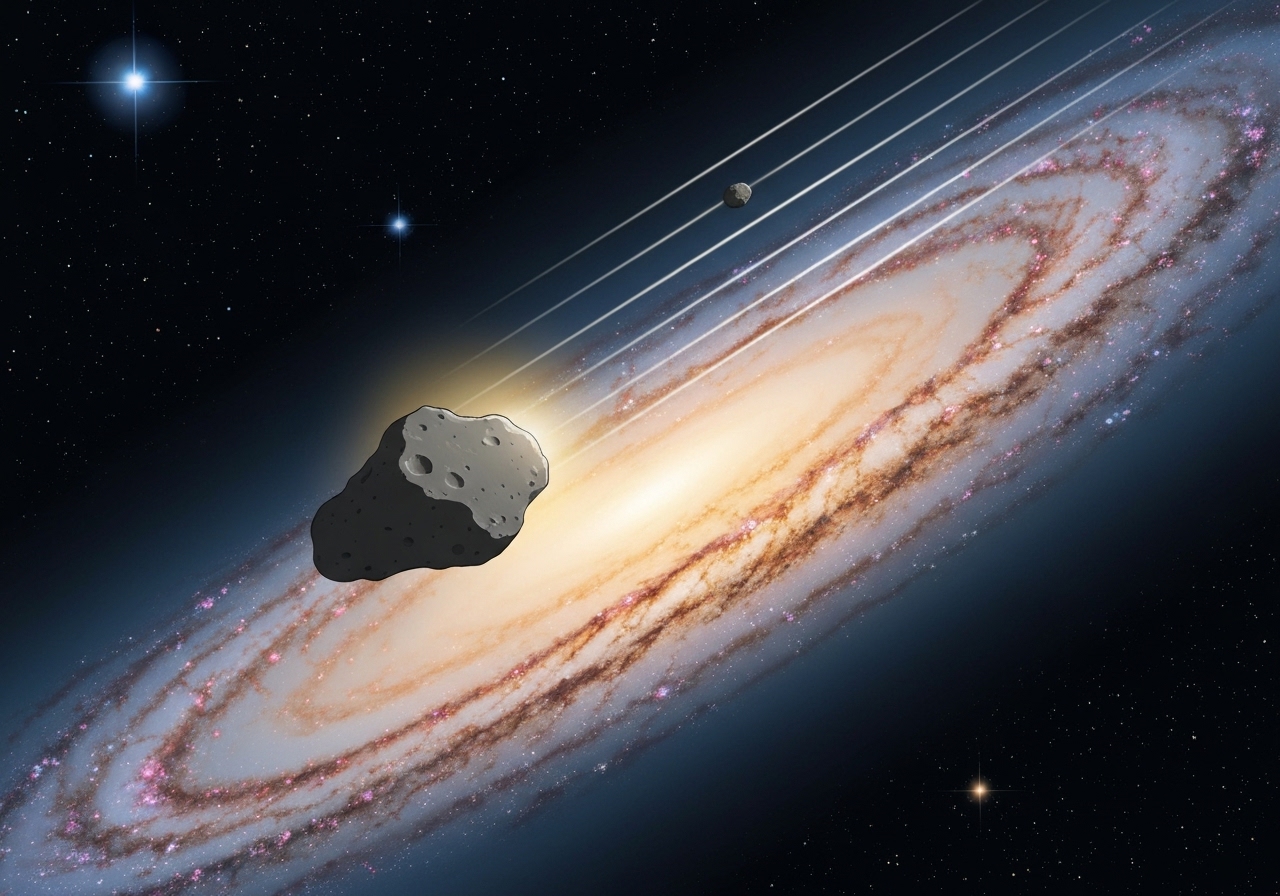
On Nov. 30 a livestream will show near-Earth asteroid 433 Eros passing within about two degrees of the Andromeda Galaxy (M31). The event is scheduled to begin at 3 p.m. EST (2000 GMT) and will feature commentary from Gianluca Masi of the Virtual Telescope Project with live images from the project’s wide-field robotic telescopes in Manciano, Italy, weather permitting. Eros will be roughly 37 million miles (60 million kilometers) from Earth at closest approach and will shine near magnitude 10, while Andromeda remains about 2.5 million light-years away. Observers on the evening of Nov. 30 can use Cassiopeia and simple optics to locate both objects above the eastern horizon after sunset.
Key takeaways
- Eros (asteroid 433) will pass about two degrees from the core of M31 on Nov. 30, 2025; closest-Earth distance at that time is ~37 million miles (60 million km).
- Eros is roughly 20 miles (33 kilometers) across and will be visible at about magnitude 10 for several weeks, making it reachable with small amateur telescopes or good binoculars under dark skies.
- The livestream begins at 3 p.m. EST (2000 GMT) and is hosted by the Virtual Telescope Project from Manciano, Italy, with expert commentary by founder Gianluca Masi.
- Andromeda (Messier 31) lies ~2.5 million light-years from Earth; the apparent proximity is a line-of-sight alignment, not a physical interaction.
- Eros was discovered in 1898 and was visited by NASA’s NEAR Shoemaker probe, which orbited the body and achieved the first asteroid landing on Feb. 12, 2001.
Background
433 Eros is one of the best-studied near-Earth asteroids. Discovered in 1898, it became a focus of planetary science because of its relatively large size for a near-Earth object (NEO) and its accessible orbits. NASA’s NEAR Shoemaker mission reached Eros in the late 1990s, spent months in orbit mapping its surface, and then descended to make the first controlled landing on an asteroid on Feb. 12, 2001. Those observations transformed scientific understanding of asteroid geology and composition.
The Andromeda Galaxy, cataloged as Messier 31, is a massive spiral galaxy about 2.5 million light-years away and is a familiar target in northern-hemisphere autumn and winter skies. From Earth the bright core of Andromeda is easy to find with basic star charts or mobile apps; the apparent nearness of a Solar System object like Eros is purely a perspective effect. Amateur and professional outreach groups often use such rare alignments to explain scale in the cosmos and to draw public attention to planetary-science topics.
Main event
The Virtual Telescope Project plans to stream live wide-field telescope images from Manciano, Italy, starting at 3 p.m. EST (2000 GMT) on Nov. 30, assuming clear skies. The feed will show simultaneous framing of the Andromeda Galaxy and the moving point of light that is Eros, with expert commentary by Gianluca Masi to explain what viewers are seeing. The projected separation on the sky is about two degrees — roughly four times the apparent diameter of the full Moon — so both objects can appear in the same wide-field view.
Because Eros is relatively bright for an asteroid of its class (around magnitude 10), it should be detectable through modest consumer optics. Masi notes that a small 60 mm refractor or standard binoculars under decent skies will reveal the asteroid, while larger amateur telescopes will track its motion easily and resolve field stars for reference. Observers should look high in the east after local sunset, first locating Cassiopeia to guide them toward Andromeda and then scanning the area indicated by finder charts or apps.
Weather and local seeing conditions will determine the practical detail visible in the live images. The Virtual Telescope Project uses a network of robotic instruments; if Manciano experiences poor conditions, remote instruments elsewhere or archival frames may be used to supplement the broadcast. The stream is intended for outreach and education rather than precision astrometry, though it will provide useful live context for both the asteroid and the galaxy.
Analysis & implications
The alignment has scientific and public-outreach value for different reasons. Scientifically, Eros’s approach poses no threat — its perigee of about 37 million miles places it safely outside Earth-impact risk thresholds — but the event offers a convenient opportunity to refine brightness estimates and to engage amateur observers in coordinated photometry. Repeated magnitude measurements from amateurs can support professional follow-up and help monitor surface-phase effects as sunlight angles change.
From an outreach perspective, juxtaposing a nearby minor planet with a distant galaxy provides a striking visual contrast that helps convey astronomical scale. Seeing a 33-kilometer object within a few degrees of a 2.5-million-light-year galaxy is an effective teaching moment about line-of-sight coincidence versus physical association. Groups like the Virtual Telescope Project deliberately stage such events to increase public interest in planetary science and skywatching.
In planetary-defense terms, Eros is well-characterized and not considered a hazardous object at this approach distance. Nevertheless, routine tracking and brightness monitoring of NEOs remain important; they refine orbit solutions, improve size or albedo estimates, and underpin impact-risk assessments for other bodies. The public visibility of this pass could motivate more coordinated observations by small telescopes globally, improving data coverage.
Comparison & data
| Parameter | Eros | Andromeda (M31) |
|---|---|---|
| Typical size / scale | ~20 miles (33 km) across | ~220,000 light-years diameter |
| Distance from Earth (Nov. 30) | ~37 million miles (60 million km) | ~2.5 million light-years |
| Apparent brightness | ~magnitude 10 | surface brightness dominated by central bulge |
| Discovery / first visit | Discovered 1898; NEAR Shoemaker landed 2001 | Cataloged millennia ago; Messier entry |
The table highlights why the alignment is visual rather than physical: Eros’s distance is measured in millions of miles, while Andromeda is millions of light-years away. The apparent magnitude of Eros (~10) makes it accessible to amateur equipment, and its motion against background stars will be readily noticeable over hours and nights.
Reactions & quotes
“Having such an important near‑Earth asteroid just a couple of degrees away from the legendary Andromeda Galaxy is a precious opportunity to share both the importance of these minor planets and the beauty of our cosmic neighbor.”
Gianluca Masi, Virtual Telescope Project (founder)
“NEAR Shoemaker’s 2001 descent onto Eros provided the first direct surface observations of an asteroid, transforming how we study these bodies.”
NASA mission archive (summary)
Both comments frame the event as a mix of historical perspective and public engagement: Masi emphasizes outreach, while NASA context underscores Eros’s scientific pedigree. Online stargazing communities and amateur networks have already circulated finder charts and viewing tips ahead of the Nov. 30 run.
Unconfirmed
- Live image quality depends on weather in Manciano, Italy; alternate feeds may be used if conditions are poor.
- Minor variations in reported brightness and exact sky coordinates can occur as ephemeris updates arrive during the observing window.
Bottom line
The Nov. 30 alignment of Eros and the Andromeda Galaxy is a rare and instructive visual event: a near-Earth asteroid will appear close to a distant galaxy on the sky, offering both outreach and opportunistic observing value. It presents no threat to Earth, but it does offer a convenient target for amateur and semi-professional observers to practice tracking and photometry.
Viewers should aim to catch the Virtual Telescope Project livestream at 3 p.m. EST (2000 GMT) or look high in the eastern sky after local sunset on Nov. 30; locating Cassiopeia first will simplify finding Andromeda and the nearby moving point that is Eros. Even modest optics and a clear night will reveal a tangible example of how perspective shapes our view of the cosmos.