
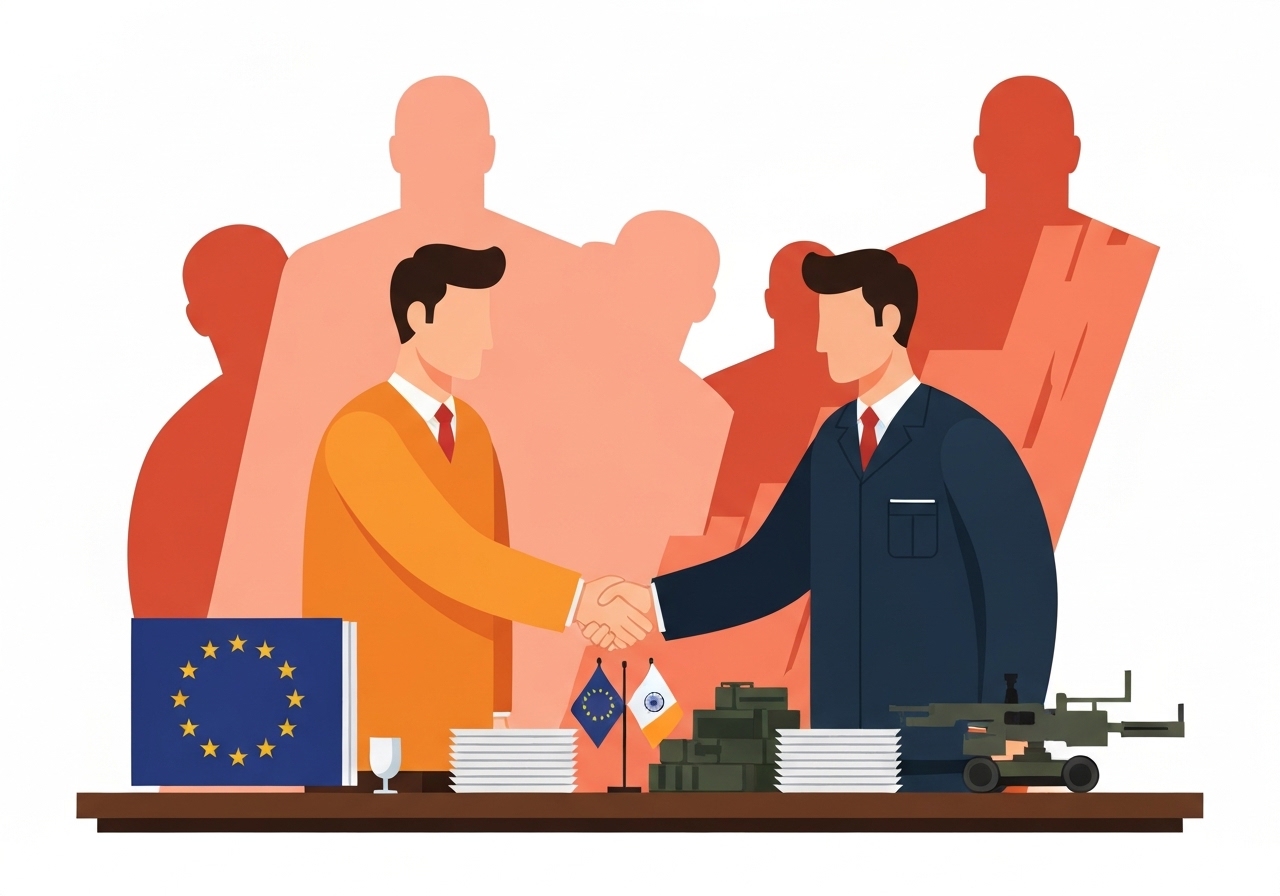
Leaders from the European Union and India are meeting in New Delhi this week to finalise a free trade agreement and a new security and defence partnership after a period of mounting economic pressure from US tariffs and geopolitical shifts following Russia’s invasion of Ukraine. The talks coincide with the presence of European Commission President Ursula von der Leyen and European Council President Antonio Costa as chief guests at India’s Republic Day celebrations. Negotiators aim to open a market spanning nearly 2 billion people and address immediate economic pain in sectors hit by US measures, while also expanding defence cooperation. If concluded, the accord would mark one of the biggest diplomatic and commercial steps between Europe and a major Asian power in recent years.
- Trade talks in New Delhi seek to create market access for almost 2 billion people, covering economies that together account for about a quarter of global GDP.
- EU-India goods trade reached €120 billion in 2024, amounting to 11.5% of India’s total trade, according to EU figures.
- India faces fallout from US tariffs imposed under President Donald Trump, which included up to 50% duties that cut some exporters’ revenues by about 25% last year.
- India’s vehicle import duties exceed 100% and tariffs on some imported wines run as high as 150%; these are key EU demands to curb protection for Indian industries.
- The EU plans new labour mobility rules to attract high-skilled and seasonal workers from India, aligned with European labour market needs.
- Defence cooperation could allow India limited access to elements of the EU’s €150 billion SAFE loan facility for joint procurement, according to analysts.
- Agriculture and steel remain major sticking points: the EU recently doubled certain steel tariffs and halved duty-free quotas, while both sides worry about protecting domestic farmers and producers.
Background
The momentum toward an EU–India rapprochement accelerated after Russia’s 2022 invasion of Ukraine and the imposition of punitive US tariffs that affected large swaths of Indian exports. Since then, New Delhi has balanced long-standing military and political ties with Moscow against growing commercial and strategic opportunities with the EU. The US tariffs, including a 50% levy referenced by exporters, have been cited by Indian traders as a material cause of revenue losses and a driver of urgency in finding alternative markets.
Historically, India has maintained protective trade policies to shield farmers and nascent industries, a stance underscored by the 2021 farmer protests that forced New Delhi to backtrack on sweeping reforms. The EU itself has struggled with domestic agricultural pushback in other major deals, such as the Mercosur negotiation, which constrains Brussels’ appetite for broad concessions on farm market access. At the same time, both Brussels and New Delhi see shared incentives: diversified supply chains, reduced trade dependencies, and cooperation to balance China’s growing economic footprint.
Main Event
The high-stakes summit in New Delhi brings senior EU officials to India’s Republic Day and shifts from ceremonial diplomacy straight into technical trade and security talks. Negotiators are expected to conclude an FTA text and to launch a formal security and defence partnership, the EU’s third with an Asian partner after Japan and South Korea. The deal would encompass goods, services, rules on investment, and new frameworks for labour mobility and research collaboration.
On trade specifics, the EU is pushing India to lower vehicle tariffs (currently above 100%) and to phase down steep duties on alcohol—tariffs that can reach 150% for some wines—to open European manufacturers to a rising Indian consumer base. India, for its part, seeks easier regulatory standards for pharmaceutical exports and parity in duty-free textile access comparable to what the EU grants Pakistan and Bangladesh.
Defence talks are advancing in parallel: India has diversified suppliers away from Russia, purchasing platforms such as 26 Rafale jets from France in a deal signed last April, and is negotiating for transports and submarines with other European firms. Brussels is exploring ways to integrate New Delhi into cooperative procurement and research, and analysts point to possible access to parts of the EU’s SAFE lending instrument for joint defence projects.
Analysis & Implications
An EU–India agreement would be geopolitical as well as commercial. For the EU, deeper ties with India open a partnership with a projected third-largest economy by 2030 and a fast-growing consumer market that can offset competitive pressure from China. For India, the deal offers diversification of export markets and a partial hedge against punitive measures from other trading partners, notably the US.
Economically, reduced Indian tariffs on cars and alcohol could boost European manufacturing and brands, while Indian demands on pharmaceuticals and textiles aim to protect large employment sectors at home. But such concessions carry domestic political risks: Indian farmers and local manufacturers could perceive liberalisation as a threat to livelihoods, and Brussels must manage its own farm lobbies wary of market disruptions.
On defence and strategic fronts, a formal EU–India partnership signals a pragmatic realignment: New Delhi retains ties with Moscow but is increasingly seeking European platforms, technology and financing for modernisation. If elements of the SAFE facility are made available for joint procurement, that could accelerate capability development in India and deepen interoperability with European industries.
Comparison & Data
| Issue | India (current) | EU (current) |
|---|---|---|
| Goods trade (2024) | — | €120 billion (11.5% of India’s trade) |
| Vehicle import tariff | >100% | Lower protective tariffs / market access sought |
| Wine/alcohol tariffs | Up to 150% | Market access for exporters desired |
| Share of EU imports from India | — | India accounts for ~2.5% of EU imports |
These figures show the asymmetry in current trade flows and the scale of potential market opening. The €120 billion goods figure for EU–India trade in 2024 underlines why Brussels sees India as a major commercial prize, while the high Indian tariffs on cars and alcohol illustrate the political hurdles ahead.
Reactions & Quotes
Indian small-business owners and exporters expressed cautious hope that a new EU market will offset losses linked to US measures. A gem merchant in New Delhi said reduced barriers could revive overseas sales that fell sharply after last year’s US tariffs.
“We have suffered massive losses since the tariffs, people in the US were our major clients — and we hope a deal with the Europeans will help us.”
Atul Mehra, Khan Market jeweller (retail sector)
European officials frame the talks as both economic opportunity and strategic necessity, emphasising shared interests in diversified supply chains and a stable international order.
“Europe wants to do business with the growth centers of today… this is the mother of all deals.”
Ursula von der Leyen, European Commission President (statement)
Analysts point out that Russia’s invasion of Ukraine and US tariff policy have been catalysts for faster movement toward an EU–India partnership.
“It was Russia’s invasion of Ukraine and Trump’s punitive tariffs that have brought momentum to the relationship.”
Praveen Donthi, International Crisis Group, Delhi (analysis)
Unconfirmed
- Whether India will receive direct, earmarked SAFE loans for joint defence projects remains unconfirmed and would require separate EU approvals.
- Reports that India will supply ammunition to European forces or directly to Ukraine are not independently verified and require official confirmation.
- The precise phased schedule for tariff reductions on cars and alcohol has not been published and remains subject to final negotiation.
Bottom Line
The EU–India summit in New Delhi is a potential turning point in Eurasian economic and strategic alignments: a concluded deal could open large consumer markets to European exporters, provide India with alternative export routes and deepen defence collaboration. However, the political sensitivity of agriculture, steel and industrial protection means concessions will be calibrated and phased to limit domestic disruption on both sides.
For traders and manufacturers hurt by US tariffs, the agreement offers a tangible alternative market, but the benefits will depend on the final tariff schedules and rules of origin. Strategically, a closer EU–India relationship would enhance diversification of supply chains and present a more multifaceted international axis beyond US-China and US-Russia dynamics.
Sources
- DW — German public broadcaster (news report)
- International Crisis Group — think tank (analysis)
- European Commission / EU trade statistics — official EU data (trade figures)