
Lead
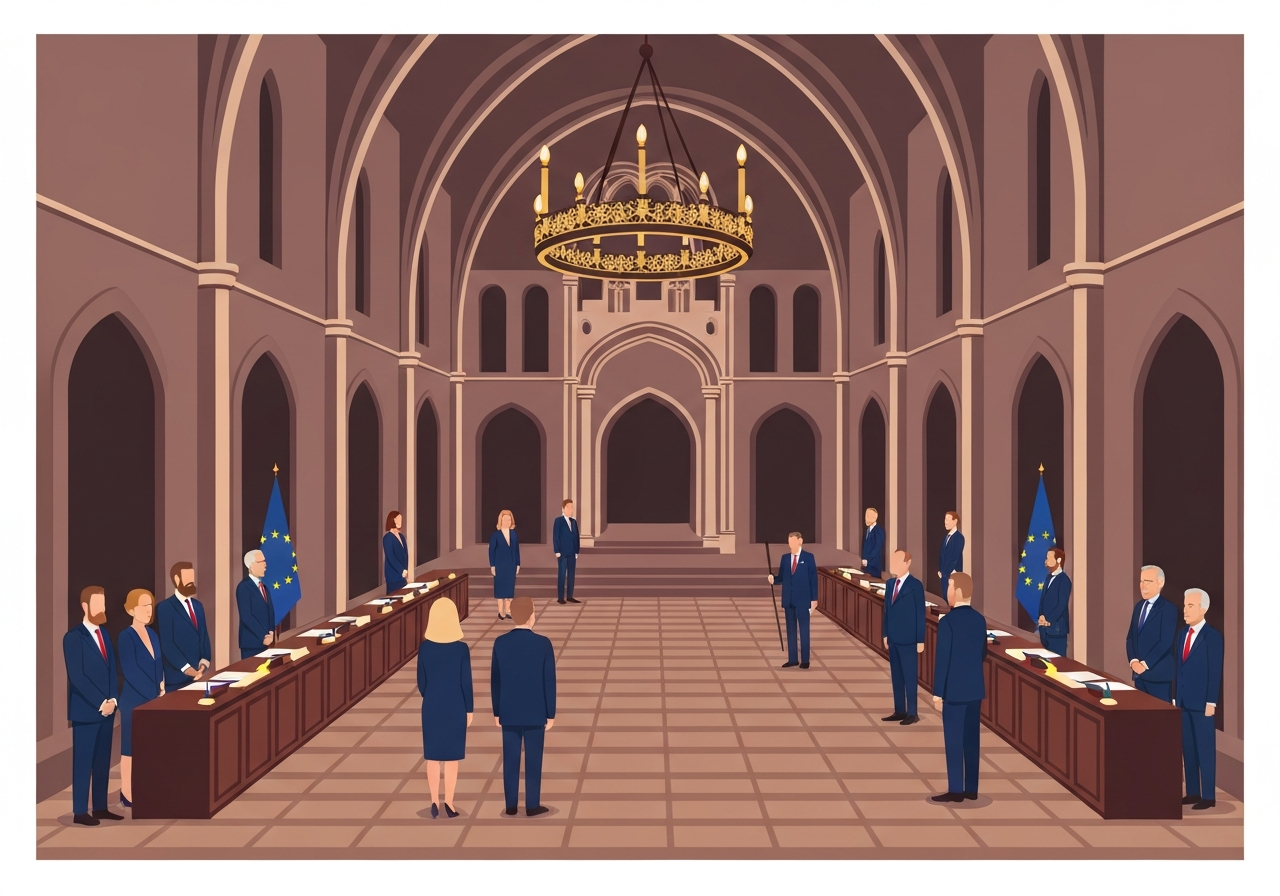
On Thursday, leaders from the 27-member European Union gathered at the 16th-century Alden Biesen castle in Bilzen-Hoeselt, Belgium to address intensifying external pressure from U.S. tariffs under President Donald Trump, economic coercion linked to China, and hybrid threats from Russia. The meeting, called to recalibrate trade and diplomatic strategy, produced urgent calls for policy shifts and a plan to inform a wider EU summit in late March. French and German leaders presented contrasting but outwardly unified gestures, while other capitals pushed for faster economic action. Participants signaled a mix of proposals ranging from deregulation to steps toward strategic autonomy.
Key takeaways
- The gathering brought heads of state from all 27 EU countries to Alden Biesen castle to prepare a late-March EU summit and to respond to geopolitical economic pressure.
- French President Emmanuel Macron backed measures to shield sectors such as cleantech, chemicals, steel, autos and defence from foreign competitive pressure.
- German Chancellor Friedrich Merz and Italian Prime Minister Giorgia Meloni argued for deregulation and wider trade engagement, including deals like the Mercosur agreement.
- Several leaders, led by Macron, renewed a proposal to allow EU-level borrowing, described as ‘Eurobonds for the future’, intended to strengthen the bloc economically and challenge dollar dominance.
- Former European Central Bank head Mario Draghi is slated to brief leaders on a 2024 stimulus-style plan favoring deregulation, infrastructure investment and expanded trade ties.
- European Commission President Ursula von der Leyen emphasised that global influence depends on economic strength, tying security and industry competitiveness to geopolitics.
- Eurobarometer polling indicates publics across the EU favor stronger, more unified leadership on defence, climate and economic resilience.
Background
The summit arises amid a shifting global landscape in which the EU faces pressure on multiple fronts. The Trump administration has pursued tariffs and trade measures that EU officials call coercive; China has tightened controls on critical minerals and exerted intense competitive pressure in strategic industries; and Russia continues to apply hybrid tactics including cyberattacks and information operations tied to its campaign in Ukraine. Those external pressures have exposed limits in the EU’s capacity to act collectively on trade, industrial policy and defence.
Inside the bloc, leaders are divided over the path forward. One camp, driven by figures such as Merz and Meloni, advocates cutting red tape and pursuing market-friendly policies alongside new trade deals. Another, led by Macron and supported by some in France’s political establishment, calls for greater strategic autonomy that prioritises European supply chains and targeted protections for key industries. These domestic cleavages reflect longer-running tensions over sovereignty, economic policy and relations with Washington.
Main event
The Tuesday arrivals set a symbolic scene: Macron and Merz walked side by side across a drawbridge into the castle, portraying unity even as their policy prescriptions diverge. Officials said the gathering was deliberately compact to allow candid exchanges on defence spending, industrial policy and how to respond to American and Chinese pressure. Discussions ranged from short-term measures to protect vulnerable industries to broader institutional changes intended to speed EU decision-making.
Macron stressed the need to defend sectors he called ‘particularly under threat’ and argued that European procurement and investment should favour regional suppliers where security or industrial capacity is at stake. Merz and Meloni countered that outright protectionism risks weakening competitiveness and argued purchases should remain open to qualified foreign firms, provided rules are enforced fairly. Roberta Metsola, president of the European Parliament, pushed for faster implementation of reform and capital mobility inside the single market.
Economic instruments were central to the talks. Macron repeated his case for joint EU borrowing to bankroll strategic investments, while several leaders referenced a Draghi-influenced plan for 2024 that blends deregulation, infrastructure spending and new trade relationships. Participants also discussed possible tools to shield the bloc from tariffs and export restrictions, including contingency funds and sector-specific shields for critical industries.
Analysis & implications
If implemented, a move toward pooled borrowing would mark a significant step in EU fiscal integration and could alter global financial balances by reducing reliance on the US dollar for strategic investment. However, legal, political and market hurdles remain: member states differ on debt mutualisation, and markets would quickly test any new instrument’s credibility. Even proponents acknowledge that euro-denominated borrowing requires strict governance arrangements to be acceptable domestically.
The debate between protection and openness matters for industrial competitiveness. Targeted safeguards could buy time for European cleantech and defence firms to scale up, but prolonged protection risks insulating industries from competition and slowing innovation. Conversely, rapid deregulation and trade expansion could attract investment but leave critical capacities exposed to external leverage, notably in supply chains for minerals and advanced components.
Geopolitically, moves toward ‘strategic autonomy’ would reshape EU relations with Washington and Beijing. Greater emphasis on independent procurement and defence production could complicate transatlantic cooperation on some fronts while strengthening Europe’s bargaining position. At the same time, tougher stances versus China could provoke reciprocal measures affecting EU exporters and supply lines, forcing Brussels to balance security gains against economic fallout.
Comparison & data
| Pressure source | Reported actions | EU policy options discussed |
|---|---|---|
| United States (Trump) | Tariffs and tariff threats, trade coercion | Retaliatory tariffs, trade diplomacy, diversification |
| China | Export limits on critical minerals, aggressive industrial competition | Supply chain shielding, strategic stockpiles, investment screening |
| Russia | Hybrid threats and military aggression in Ukraine | Increased defence spending, industrial resilience for defence supply |
The table summarises the primary external pressures discussed and the policy levers on the table. EU leaders are weighing a mix of immediate defensive measures and longer-term structural changes in industrial policy, finance and trade rules. Any package will require political compromises and technical design to reconcile differing member-state priorities.
Reactions & quotes
Several succinct public lines captured the meeting’s tone and stakes. Belgian Prime Minister Bart De Wever framed the gathering as a necessary course correction for the bloc.
We all know we must change course, and we all know the direction
Bart De Wever, Belgian Prime Minister
De Wever’s remark was delivered the day before the session and underlined the urgency many delegates expressed about moving from discussion to implementation. Macron emphasised sectoral protection and economic resilience while standing with Germany’s leader.
We share this sense of urgency that Europe must take action
Emmanuel Macron, President of France
Roberta Metsola pressed for immediate operational steps rather than continued debate, signalling parliamentary impatience with slow reform.
No more words, but more action
Roberta Metsola, President of the European Parliament
Unconfirmed
- Whether the summit produced any binding decision on EU-level borrowing remains unresolved; leaders debated proposals but no formal approval was reported.
- Claims that member states have agreed to buy exclusively from European producers are not confirmed and appear to reflect a policy preference voiced by some leaders rather than a consensus.
- Details and timelines for any new financial instruments or sector shields were not finalised at the meeting and remain subject to technical design and member-state negotiation.
Bottom line
The castle meeting crystallised an EU at a crossroads: leaders recognise multifaceted pressure from Washington, Beijing and Moscow and are signalling readiness to adapt policy tools. The principal contention is how to combine openness and competitiveness with measures that protect strategic sectors and reinforce collective resilience. Success will depend on political compromise, credible implementation frameworks and careful assessment of economic trade-offs.
Next steps include technical work on proposed financing mechanisms, Draghi’s presentation to leaders, and negotiations ahead of the late-March summit that the meeting was intended to shape. Observers should watch for concrete proposals on joint borrowing rules, procurement adjustments and trade enforcement measures that could redefine Europe’s posture on the global stage.
Sources
- Associated Press (news report summarising the Bilzen-Hoeselt summit and leader statements)
- Eurobarometer (official EU public opinion polling referenced on citizen support for stronger EU action)
- European Commission (official statements on economic security and industrial policy)
- HEC Paris (academic affiliation for Alberto Alemanno, expert commentary)