
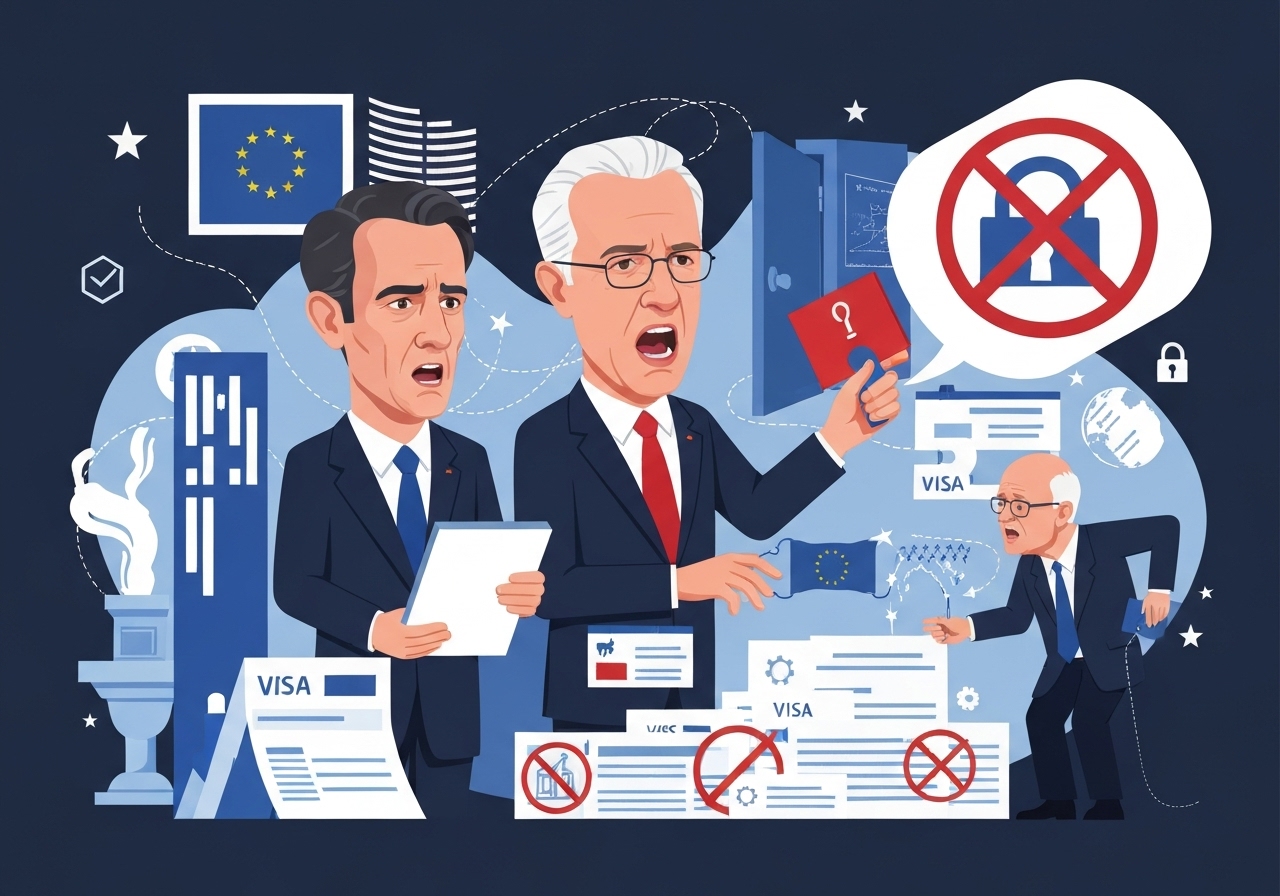
European presidents and ministers moved quickly to condemn a set of US visa restrictions this week after Washington barred five high-profile Europeans involved in campaigns and policymaking around online harms. The measures — announced on Tuesday — targeted Thierry Breton and four civil-society figures who have been active in pushing for regulation of major US platforms. Paris, Berlin, Madrid and Brussels called the step coercive and warned it risked undermining European digital sovereignty; US officials framed the move as a response to what they described as transatlantic pressure to curb American viewpoints. The episode has intensified a growing confrontation over how to govern platforms, with the bloc citing lawmaking and the US saying the rules amount to censorship.
Key takeaways
- Five individuals were placed under US visa restrictions: Thierry Breton and four anti-disinformation or platform‑accountability advocates — Imran Ahmed, Anna‑Lena von Hodenberg, Josephine Ballon and Clare Melford.
- The measures were announced on Tuesday and framed by US statements as a response to organised efforts in Europe to influence US platforms.
- European leaders, led by President Emmanuel Macron, called the bans intimidation and said Europe would defend its regulatory autonomy and digital sovereignty.
- The EU’s Digital Services Act (DSA), adopted in 2022, is central to the dispute; it requires large platforms to address illegal content, hate speech and disinformation risks.
- Earlier this month the X platform (formerly Twitter) was fined €120m (£104m) by EU regulators over transparency and access issues, a development cited in Washington’s critique.
- Brussels signalled it could respond “swiftly and decisively” if it deems the US action unjustified, raising the prospect of reciprocal measures.
Background
The Digital Services Act, approved in 2022, represents the EU’s most comprehensive effort to force large online platforms to manage illegal content, hate speech and the manipulation of information, including risks to elections. European officials argue the law was adopted by democratic processes across EU institutions and is narrowly targeted at platforms operating within the single market rather than at third countries. For critics in Washington, certain provisions — or their enforcement — look like pressure on US companies and potentially on US speech outside Europe.
Tensions over digital rules have been building amid broader US–EU strains under the current US administration, where trade, security and tech policy have become frequent sources of dispute. Regulators and watchdogs that press platforms on content moderation have long been polarising figures: to some they defend vulnerable groups and democratic processes, to others they are ideological actors seeking to shape global content rules. In this case the dispute draws together a serving EU commissioner-turned-target, civil-society organisers and national governments across Europe.
Main event
On Tuesday the US announced visa restrictions on five European figures. Thierry Breton, who served as European commissioner for the internal market from 2019 to 2024 and helped steer the DSA, was singled out alongside civil-society leaders from the UK and Germany. US statements characterised some campaign activities as attempts to coerce platforms into curbing viewpoints disliked in Washington; European leaders rejected that portrayal.
French president Emmanuel Macron denounced the step on social media, calling it intimidation aimed at undermining European digital sovereignty and stressing that EU rules were adopted through democratic processes by the European Parliament and the Council. Macron said he had spoken to Breton and thanked him for his work, adding that France and the EU would protect their independence.
Brussels’ executive, led by Commission president Ursula von der Leyen, echoed those concerns and warned of a forceful response if needed to defend regulatory autonomy. In national capitals, Germany’s justice ministry and foreign minister expressed solidarity with the German campaigners and described the US move as unacceptable. Madrid’s foreign ministry framed a safe digital space free of illegal content as a European democratic priority and rejected the censorship charge.
The US justification included public posts by senior American figures arguing that European campaigners and rules had sought to pressure US platforms to remove or suppress certain viewpoints. US officials pointed to the recent €120m fine imposed on X for transparency failures as evidence of EU enforcement activity that affects US platforms. European defenders replied that the DSA applies within the EU to ensure fair competition and to make illegal offline harms illegal online, not to direct foreign speech policy.
Analysis & implications
The immediate diplomatic effect is a deepening rift between Brussels and Washington on tech governance. By targeting a former commissioner and civil-society leaders, the US action converts a policy dispute into a bilateral political incident that could prompt retaliatory measures or legal confrontations. The prospect of reciprocal sanctions or travel restrictions is now part of the calculation in capitals across Europe.
Substantively, the clash highlights the unresolved problem of extraterritoriality in digital regulation: when a jurisdiction sets rules for platforms with global reach, other states may see effects on their citizens and companies. The EU maintains the DSA is a domestic safety and competition framework; the US response treats enforcement pressure and advocacy as a threat to free expression and to American business interests. That fundamental disagreement complicates any near‑term harmonisation effort.
Economically, heightened friction could influence platform behaviour and market access. US firms operating in Europe may face tougher enforcement and scrutiny, while transatlantic cooperation on AI safety, content moderation and platform transparency could be weakened. Politically, the dispute feeds into a larger narrative of US–Europe divergence under the current US administration, where trade policy, sanctions and foreign‑policy alignments are already contested ground.
Comparison & data
| Measure | Year | Key figures |
|---|---|---|
| DSA adoption | 2022 | European Parliament approval (~90% support reported), 27 member states involved |
| X (Twitter) fine | 2025 | €120m (£104m) |
| Visa bans announced | 2025 | 5 named Europeans |
The table summarises the central data points at the heart of the dispute: the DSA’s passage in 2022, the recent enforcement action against X, and the five-person visa restriction announced this week. Those figures capture why both sides see high stakes: the DSA represents wide legislative backing in Europe, while the US cites concrete regulatory and advocacy activity that it views as hostile to American platforms.
Reactions & quotes
European governments and institutions emphasised democratic procedure and sovereignty when responding. Presidents, ministers and commission officials framed the measures as disproportionate and warned of political and practical consequences for transatlantic relations.
“These measures amount to intimidation and coercion aimed at undermining European digital sovereignty.”
Emmanuel Macron
Macron’s post framed the bans as an attack on Europe’s right to set its own digital rules. He reiterated that the DSA was adopted through EU democratic bodies and said Europe would not accept external determination of its online legal space.
“Freedom of speech is the foundation of our strong and vibrant European democracy.”
Ursula von der Leyen, European Commission
Von der Leyen and commission spokespeople stressed the EU’s commitment to free expression while defending the DSA as a regulatory framework aimed at illegal content and unfair platform practices. Brussels also warned it would respond if measures were judged unjustified.
“For far too long, ideologues in Europe have led organised efforts to coerce American platforms to punish American viewpoints they oppose.”
Public post by an American official
US statements characterised some European advocacy and regulatory pressure as hostile to US platforms and free expression of US viewpoints. Washington framed the visa measures as a tool to deter what it described as extraterritorial coercion.
Unconfirmed
- Some public descriptions of individual US officials’ government titles in social posts were inconsistent; attribution of an exact US cabinet title to a named commenter requires confirmation from official records.
- Claims that the DSA has been enforced with explicit extraterritorial intent against specific non‑EU citizens have been asserted in statements but are subject to legal interpretation and further verification.
Bottom line
The US visa restrictions on five Europeans turn a policy disagreement into a diplomatic flashpoint. At stake are competing views of how platform governance, free expression and national sovereignty intersect when large tech companies operate across jurisdictions. European leaders present the DSA as a domestically legitimate safety and competition regime; Washington describes parts of the broader pressure campaign as intolerable interference.
Expect a period of heightened rhetoric and potential reciprocal steps while legal experts and diplomats parse the limits of extraterritorial influence. For companies and advocacy groups, the dispute raises acute compliance and operational questions: how to meet divergent regulatory demands without getting caught between capitals. Ultimately, the episode is likely to harden positions on both sides and make pragmatic cooperation on platform governance more difficult in the near term.
Sources
- The Guardian — Media report summarising the measures and reactions (primary reporting used for this article).
- European Commission press corner — Official EU statements and press briefings (official).
- HateAid — German non‑profit defending victims of digital hate (NGO).
- Center for Countering Digital Hate — UK‑based NGO working on online harms (NGO).
- Global Disinformation Index — Organiser and researcher on disinformation risks (NGO).
- U.S. Department of State — US government statements and policy pages (official).