
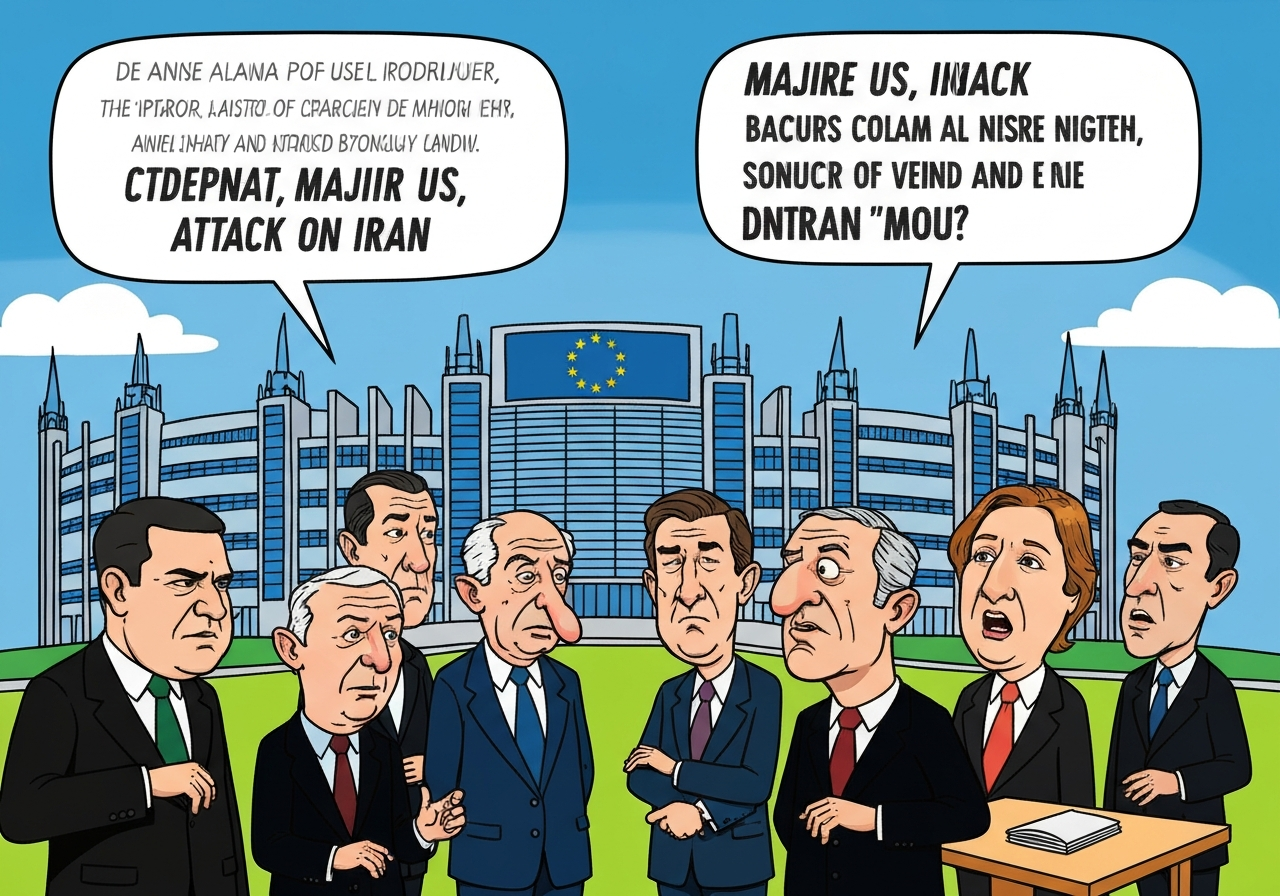
Lead: European governments reacted with caution on Saturday after coordinated U.S. and Israeli strikes on Iran, holding emergency meetings and taking steps to protect citizens in the Middle East. Key EU capitals urged de-escalation and a resumption of diplomacy even as Australia and Canada signaled clearer support for the military action. Russia and China criticized the strikes, while Britain, France and Germany stopped short of endorsing the attacks and called for renewed nuclear talks. The moves have heightened fears of a wider regional conflict and prompted contingency planning across Europe.
Key Takeaways
- U.S. and Israeli strikes on Iran on Saturday prompted emergency meetings in Brussels, London, Paris and Berlin and immediate protective measures for European citizens in the region.
- Britain, France and Germany issued a joint statement saying they did not join the strikes but are in close contact with the U.S., Israel and regional partners and urged a return to negotiations.
- Australia and Canada voiced stronger support for the strikes; Australia cut diplomatic ties with Iran in August and Canada called Iran the principal source of regional instability.
- Russia called the strikes a pre-planned act of aggression and accused Washington and Tel Aviv of seeking regime change, while China urged an immediate halt and respect for Iran’s sovereignty.
- NATO said it was closely monitoring developments; individual governments reported limited advance notice, with Germany saying it was informed Saturday morning.
- Civilian protection and international law were central concerns for EU leaders, who urged restraint and regional diplomacy to prevent escalation.
- Humanitarian and proliferation risks were highlighted by disarmament advocates warning the strikes could increase the danger of nuclear spread or further military escalation.
Background
The strikes take place against a backdrop of months-long tensions over Iran’s nuclear program and regional behavior. European powers have for years pursued diplomatic channels aimed at curbing Tehran’s enrichment capacity, seeking negotiated limits while condemning violent acts attributed to Iranian proxies. Recent months have seen intermittent military actions and a string of incidents that have raised alarm in Western capitals about the risk of broader confrontation.
European leaders face a complex calculation: they oppose Iran’s nuclear ambitions and some of its regional tactics but are generally reluctant to back unilateral military measures that could violate international law or trigger open war. Past U.S. strikes and controversial operations elsewhere, including actions by Washington last June and a recent arrest of Venezuela’s Nicolás Maduro noted by observers, have left allies wary of sudden escalations without transparent multilateral consultations.
Main Event
On Saturday, U.S. and Israeli forces carried out strikes on Iranian targets, prompting immediate reactions from capitals worldwide. London, Paris and Berlin issued a joint message saying they did not participate in the strikes but stressed close coordination with the U.S. and Israel. Leaders in those countries reiterated calls for negotiations and condemned Iranian attacks on neighboring states, while urging Iran to refrain from indiscriminate military action.
European capitals convened emergency committees: U.K. Prime Minister Keir Starmer chaired his government’s emergency committee, France called for an emergency U.N. Security Council meeting, and Germany activated its crisis management team after receiving notification on Saturday morning. NATO officials said the alliance was monitoring developments closely and standing by to advise members on security implications.
Outside Europe, Australia and Canada publicly supported the strikes, framing them as efforts to prevent Iran from acquiring nuclear weapons and to counter what they described as Tehran’s destabilizing behavior. Conversely, Russia labeled the strikes an unprovoked act of aggression and accused the U.S. and Israel of pursuing regime-change objectives, while China called for an immediate cessation of hostilities and respect for Iran’s sovereignty.
Analysis & Implications
The strikes introduce a strategic dilemma for European policymakers balancing security, legal norms and public sentiment. Endorsing military action risks eroding long-standing European commitments to multilateral diplomacy and international law, but distancing themselves too strongly from Washington and Tel Aviv could strain defense and intelligence ties. This tension is heightened by the geopolitical competition among major powers, with Russia and China using the crisis to criticize Western policy and assert their own regional influence.
Regionally, the strikes could accelerate proxy confrontations and complicate fragile diplomatic channels. A further deterioration would raise the probability of retaliatory strikes, interruptions to maritime traffic through critical chokepoints, and increased threats to civilians. European governments are especially wary of spillover effects that could draw NATO assets or personnel into a wider confrontation.
Economically, renewed hostilities risk spikes in energy prices and disruption to trade routes, which would have knock-on effects for inflation and fiscal planning in Europe. Politically, leaders in Berlin, Paris and London must manage domestic audiences skeptical of new military entanglements while signaling that they will act to protect citizens and uphold international norms.
Comparison & Data
| Country | Public Stance | Immediate Action |
|---|---|---|
| United Kingdom | Did not join strikes; urged restraint | Chaired emergency committee |
| France | Did not join; called U.N. meeting | Requested U.N. Security Council emergency session |
| Germany | Did not join; sought information | Activated crisis management team |
| Australia | Supported strikes | Cut diplomatic ties with Iran in August |
| Canada | Supported strikes | Issued public support statement |
| Russia | Condemned strikes | Accused U.S./Israel of aggression |
| China | Criticized strikes; called for halt | Urged return to negotiations |
The table summarizes public positions and immediate actions reported by governments. While three European powers emphasized diplomacy and civilian protection, Canberra and Ottawa framed the strikes as necessary to stop Iran’s nuclear advances. Moscow and Beijing used the incident to press for de-escalation and to criticize Western tactics, highlighting a fractured international response that complicates coordinated crisis management.
Reactions & Quotes
European leaders combined caution with calls for renewed negotiation, framing their responses around restraint and international law.
“We condemn Iranian attacks on countries in the region in the strongest terms… We call for a resumption of negotiations and urge the Iranian leadership to seek a negotiated solution.”
Keir Starmer, Emmanuel Macron, Friedrich Merz (joint statement)
The three leaders emphasized they did not participate in the strikes while stressing contact with allies and the need to prevent further escalation. Their joint wording underscored a preference for diplomacy as the path to a sustainable resolution of nuclear and regional security concerns.
“These attacks are totally irresponsible and risk provoking further escalation as well as increasing the danger of nuclear proliferation and the use of nuclear weapons.”
Melissa Parke, International Campaign to Abolish Nuclear Weapons
The disarmament group highlighted the humanitarian and proliferation risks of military strikes, urging restraint and renewed arms-control talks. Such warnings reinforce European leaders’ public focus on civilian protection and legal constraints.
“The strikes were a pre-planned and unprovoked act of armed aggression against a sovereign and independent U.N. member state.”
Russian Foreign Ministry (statement)
Moscow’s response framed the incident as an unlawful intervention and accused the attackers of seeking regime change, a narrative that Moscow and Beijing have promoted to challenge Western policy. These contrasting frames deepen diplomatic divides among major powers.
Unconfirmed
- Whether European allies were given full advance notice of the strikes remains unclear; Germany said it received notice Saturday morning but details of any prior consultation are unconfirmed.
- Precise casualty figures and the full list of targets struck in Iran have not been independently verified and remain subject to official accounting.
- Assertions that the strikes were intended to effect regime change are reported by some ministries but lack corroborating evidence made public at this time.
Bottom Line
The U.S. and Israeli strikes on Iran have put European governments in a delicate position: affirming opposition to Iran’s nuclear ambitions while avoiding endorsement of unilateral military action that could broaden the conflict. Most EU capitals have prioritized calls for restraint, protection of civilians and a return to diplomacy, signaling that they view negotiated limits as the most viable path to reduce long-term risk.
Going forward, the crisis will test transatlantic ties, NATO’s readiness to manage spillover effects, and Europe’s capacity to lead diplomatic efforts amid competing great-power narratives. Key indicators to watch are whether negotiations resume, the scale of any Iranian reprisals, and the degree of coordination among U.S., European and regional partners to prevent a wider war.
Sources
- Associated Press (news)