
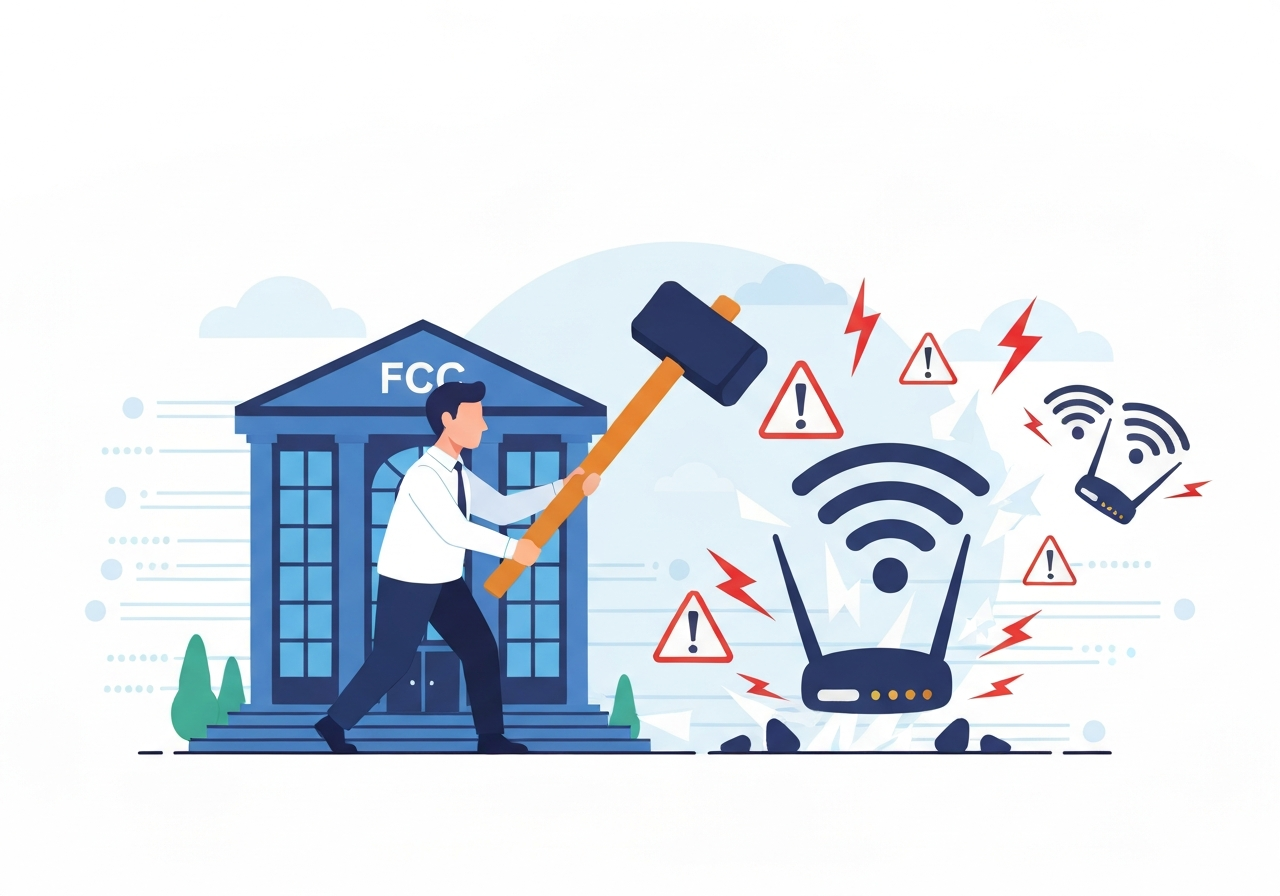
On March 23, 2026 the Federal Communications Commission ordered a ban on the importation of new models of foreign-produced consumer wireless routers after an interagency panel concluded those devices pose national security risks. The Commission said companies may petition for case-by-case exemptions, but the directive takes aim at equipment that connects homes and businesses to Wi‑Fi networks. The move, revealed in filings published March 23 and updated March 24, could quickly reshape a market that relies heavily on overseas manufacturing and global supply chains.
Key Takeaways
- The FCC issued an order on March 23, 2026 restricting imports of new models of foreign-made consumer wireless routers on national security grounds.
- Companies may apply for exemptions; the FCC indicated an administrative process will review such petitions.
- The ban targets new router models entering the U.S. market, not necessarily existing devices already in use.
- Consumer routers are predominantly manufactured overseas, so import restrictions could affect retail inventory, enterprise procurement and ISP equipment orders.
- Industry observers expect potential price increases and supply pressures for routers and related home-networking gear in the near term.
- The decision follows prior U.S. actions aimed at equipment from certain foreign vendors and reflects growing regulatory focus on supply chain and firmware security.
Background
Consumer wireless routers serve as the gateway between wired internet lines and local Wi‑Fi networks for phones, computers, TVs, security cameras and other connected devices. Because routers run firmware and handle network traffic, regulators and security officials have for years cited them as potential vectors for surveillance, exploitation or supply-chain compromise. The U.S. government has previously restricted telecommunications equipment tied to national adversaries; this latest action extends scrutiny to widely distributed consumer hardware.
Manufacturing for consumer routers is concentrated across multiple countries and global suppliers, so import controls intersect with international trade, logistics and retail inventory strategies. Internet service providers, retailers and original equipment manufacturers (OEMs) have built procurement practices that assume steady cross-border flows; a sudden bar on new models could force buyers to seek alternative suppliers, delay product launches or accelerate moves toward domestic production and certification. Policymakers have balanced national-security objectives against potential market disruption in past equipment restrictions, but the scale of consumer-router usage adds new complexity.
Main Event
According to FCC filings published March 23 and updated March 24, 2026, an interagency panel reviewed technical and intelligence inputs and concluded that certain foreign-produced consumer wireless routers present risks that warrant an import ban on new models. The FCC framed the restriction as a preventative step aimed at devices entering U.S. networks. The agency also stated that manufacturers and importers could submit exemption requests for specific models or vendors, initiating an administrative review to weigh security concerns against economic or operational hardships.
Industry participants immediately noted the practical implications: retail channels that stock routers for consumer sale and ISPs that include customer premises equipment in service bundles both rely on steady shipments of new hardware. Distributors may need to assess inventory that qualifies as “existing stock” versus prohibited new models, and customs enforcement will have to operationalize the order with guidance on classification and documentation. The FCC did not in its public filings list every affected model or vendor, leaving the market temporarily uncertain about the scope and timing of enforcement.
Retailers and online marketplaces face a near-term compliance challenge in determining which listings and shipments fall under the ban. Some firms will likely expedite shipments already in transit or submit exemption petitions, while others may pause new orders pending regulatory clarification. The aggregate effect will hinge on administrative timelines for exemptions and the degree to which major OEMs can demonstrate mitigations or transfer production to non‑covered supply chains.
Analysis & Implications
The ban signals heightened U.S. regulatory willingness to extend supply-chain and device-security controls beyond core telecom infrastructure to consumer networking gear. If enforced broadly, the measure could incentivize manufacturers to harden firmware, improve provenance documentation and pursue third-party security certifications to qualify for exemptions. Conversely, the policy may accelerate supplier diversification or onshoring of certain manufacturing steps to ensure market access to the U.S.
For consumers and small businesses, the most immediate impacts are likely to be price and availability. Routers are low-margin, high-volume products; restrictions that reduce the pool of eligible suppliers tend to raise costs or elongate delivery windows. ISPs that subsidize customer premises equipment may face higher procurement costs or logistical delays, potentially transferring some expense to subscribers or deferring upgrade cycles.
Geopolitically, the decision underscores an intensified link between technology policy and national-security doctrine. Export and import controls are now a common lever for managing perceived technical vulnerabilities and foreign influence. International trade partners and manufacturers will watch the U.S. administrative process closely; lengthy exemption reviews or opaque criteria could prompt legal challenges or diplomatic friction, while clearly articulated mitigation pathways could preserve some commercial continuity.
Comparison & Data
| Policy Action | Target | Primary Aim |
|---|---|---|
| 2019–2020 FCC restrictions | Telecom infrastructure (selected foreign vendors) | Mitigate risks to critical networks and national security |
| March 23, 2026 FCC order | New imports of foreign-made consumer wireless routers | Prevent security risks associated with consumer network gateways |
The table contrasts the earlier FCC focus on core telecom infrastructure with the 2026 decision to cover consumer routers. While past measures targeted backbone and carrier-grade equipment, the current order broadens the perimeter to devices installed at scale in homes and small businesses. Quantitative impacts—such as the share of U.S. router imports affected, expected price changes or the number of exemption petitions—are not yet public and will shape final market outcomes as enforcement proceeds.
Reactions & Quotes
“threaten national security”
Interagency panel / FCC (as reported by Bloomberg)
The phrase above captures the rationale attributed to the panel whose findings prompted the FCC order; the agency characterized the devices as posing security risks that justify import restrictions.
“companies could apply for exemptions”
Federal Communications Commission (as reported by Bloomberg)
The FCC explicitly opened an administrative pathway for affected parties to request exemptions, indicating that enforcement will include case-by-case reviews rather than an absolute, untethered prohibition.
Unconfirmed
- The precise list of models and vendors covered by the ban has not been published in full; scope remains to be clarified by the FCC.
- The timeline and criteria the FCC will use to adjudicate exemption petitions were not detailed in the initial filings and remain uncertain.
- The magnitude of near-term price increases or supply shortages for consumer routers is not yet quantifiable.
Bottom Line
The FCC’s March 23, 2026 order to bar new imports of foreign-produced consumer wireless routers marks a notable expansion of U.S. device‑security policy into mass-market home networking equipment. By creating an exemptions pathway, the agency left room for case-by-case assessments, but the decision nonetheless injects uncertainty into a supply chain that has long relied on cross-border manufacturing.
Watch for rapid administrative guidance from the FCC clarifying scope and procedures, and for industry responses in the form of exemption petitions, inventory adjustments, and potentially accelerated moves to diversify suppliers or bolster device security. The ultimate impact will depend on how narrowly the ban is applied and how quickly manufacturers can demonstrate mitigations acceptable to regulators.