
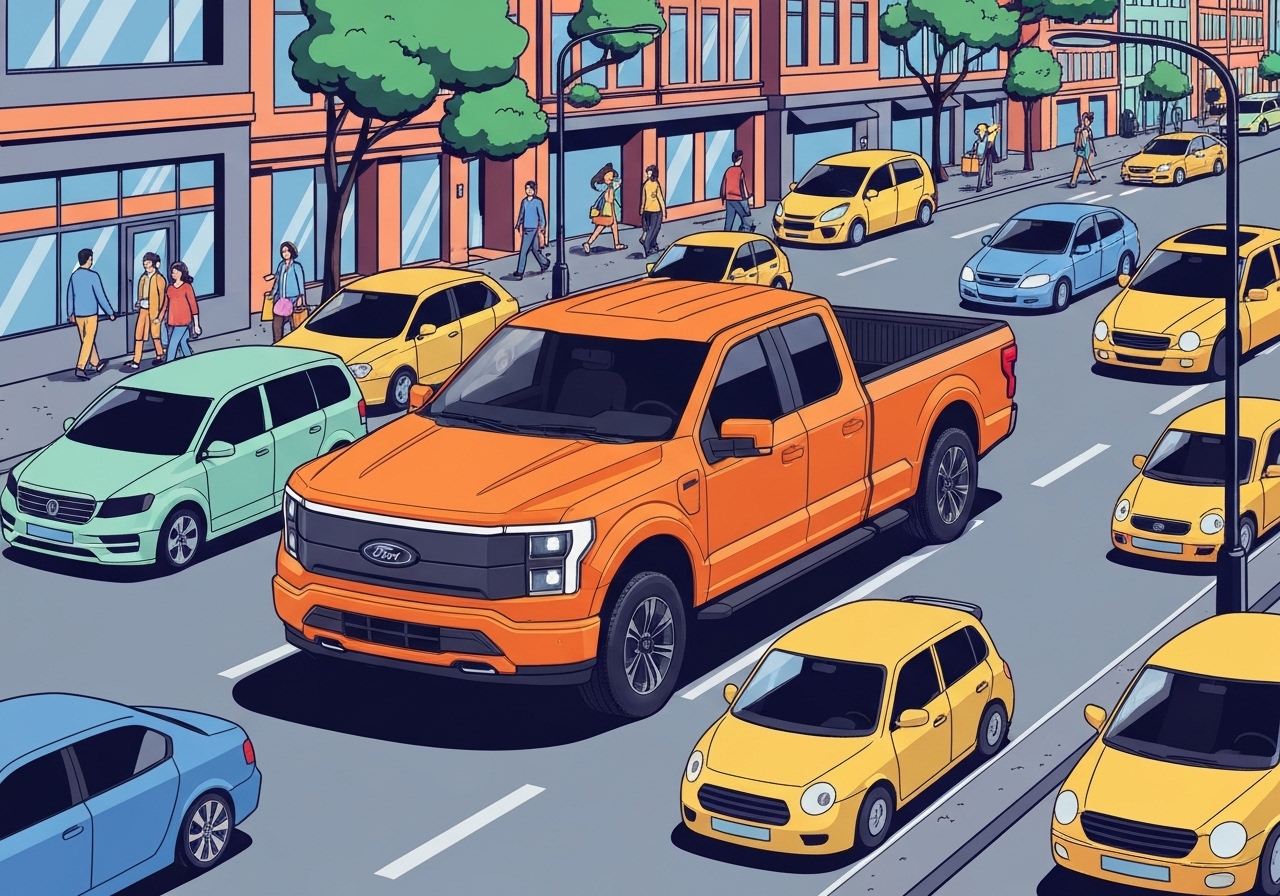
Ford Motor Company has stopped production of the all‑electric F‑150 Lightning, announcing a strategic pivot on Dec. 15, 2025 that prioritizes hybrids, lower‑cost EVs and stationary battery products. The company says consumer demand and persistent losses on the Lightning left the model without a viable path to profitability. Battery factories once intended for truck cell output will be refitted to produce storage batteries for the grid and industrial customers. Ford also confirmed plans for an extended‑range, plug‑in version of the F‑150 that reintroduces a gasoline generator to extend driving range.
Key Takeaways
- Ford has halted production of the all‑electric F‑150 Lightning as of mid‑December 2025 and will end that vehicle’s current electric program.
- The decision follows persistent financial losses: Ford says it lost money on each Lightning and concluded the model had no clear route to profitability at scale.
- Ford will redirect investment toward hybrids, a future line of smaller and cheaper EVs (including a targeted $30,000 midsize pickup), and an extended‑range plug‑in F‑150 with an onboard gasoline generator.
- Planned battery capacity for truck production will be repurposed for stationary storage and industrial customers, with a Kentucky plant earmarked for the conversion.
- Policy changes — including the removal of a $7,500 federal EV tax credit and relaxed fuel‑economy rules under the current administration — are cited by Ford as part of the decision’s wider context.
- The Lightning earned critical acclaim (MotorTrend’s 2023 Truck of the Year; Kelley Blue Book’s 2024 top electric truck) but faced consumer concerns about towing range and reliability.
- Ford expects write‑offs and cash charges in the billions this year as it winds down the program and retools factories.
- Ford reports the Lightning was the best‑selling electric truck in the U.S. last quarter, even as the segment underperformed broader expectations.
Background
The F‑150 Lightning was introduced in 2021 as Ford’s flagship attempt to electrify its most profitable nameplate, promising a competitive price point and familiar truck functionality. Ford initially marketed the Lightning with a base price near $40,000, positioning it as an accessible electric version of America’s best‑selling truck. Production realities, however, pushed the market price higher: by the 2025 model year the Lightning’s starting price was roughly $55,000, well above the launch figure.
Beyond price, the Lightning offered features aimed at mainstream truck buyers: conventional pickup proportions, numerous onboard outlets for jobsite tools and home backup power capabilities. The model won industry accolades — including MotorTrend’s unanimous 2023 Truck of the Year and recognition from Kelley Blue Book — which elevated expectations even as technical and market challenges emerged. Those included towing‑range limitations and reliability concerns that affected buyer confidence in the truck’s “workhorse” credentials.
Main Event
On Dec. 15, 2025, Ford announced it would cease production of the all‑electric F‑150 Lightning. Company executives told reporters the move reflects customer preferences for affordability and a business reality in which the Lightning was losing money on each unit. Andrew Frick, president of Ford Blue and Ford Model e, said the company will reallocate capital toward products and segments with higher expected returns.
As part of the shift, Ford said it will develop an extended‑range plug‑in variant of the F‑150 that incorporates a gasoline generator to recharge the battery and extend operational range during long tow or remote‑work scenarios. The company framed this as a way to preserve the functional benefits customers sought while addressing range anxiety tied to heavy towing and remote usage.
Ford also detailed a major reconfiguration of planned battery output. Cells and modules once slated for Lightning assembly will instead be produced for stationary energy storage systems and industrial customers such as data centers. The Kentucky facility originally intended to supply truck batteries will be repurposed to manufacture stationary storage packs that can charge when renewable generation is abundant and discharge when demand rises.
Executives warned the strategic pivot will generate significant near‑term costs. Ford expects billions in write‑downs and cash expenditures this fiscal year but said it believes those losses will be offset over time by more profitable product lines and a lower‑cost EV architecture aimed at a roughly $30,000 price point for future midsize models.
Analysis & Implications
Ford’s decision underscores how quickly automakers’ EV plans can be reshaped by market reception and policy shifts. The Lightning’s critical acclaim did not translate into a profitable, scalable business model once production realities and higher customer prices hit the balance sheet. The example highlights the risk of translating legacy vehicle platforms into electric variants without achieving expected economies of scale.
Policy has played a decisive role. The removal of the $7,500 federal tax credit and the rollback of stricter emissions and fuel‑economy standards removed incentives that had encouraged both consumers and manufacturers to favor EVs. For Ford and peers, that regulatory retreat reduces the penalty for continuing to sell conventional internal‑combustion trucks and diminishes the urgency to tolerate unprofitable EV models for compliance reasons.
Economically, Ford’s pivot represents a reallocation of capital toward higher‑margin products and toward grid services enabled by battery storage. Turning idle battery capacity into stationary storage supply could create new revenue streams and help stabilize intermittent renewable generation — but it also signals automakers’ need to find complementary markets for battery investments when vehicle demand falters.
Strategically, the move may accelerate the industry’s bifurcation: automakers focusing on affordable, mass‑market EVs while shelving expensive, large EV trucks that struggle to meet cost and range expectations. For suppliers, this introduces uncertainty: battery cell mix, form factors and contractual volumes may change rapidly as manufacturers rebalance vehicle and storage portfolios.
Comparison & Data
| Item | Announced / Historical | Recent / Current |
|---|---|---|
| Launch price (promised) | $40,000 (announced 2021) | — |
| 2025 model starting price | — | ~$55,000 |
| Federal EV tax credit | $7,500 (previously available) | Removed (policy change in 2025) |
| Industry awards | MotorTrend 2023 Truck of the Year | Kelley Blue Book 2024 top electric truck |
| Ford’s near‑term charge | — | Billions of dollars in write‑offs (company estimate) |
The table summarizes key numeric and categorical data points from Ford’s announcement and industry records. The gap between the original advertised entry price ($40,000) and the 2025 starting price (~$55,000) illustrates the cost and pricing pressures that affected demand. Policy changes removing the $7,500 credit directly reduce consumer incentives and can materially shift purchase economics in mass segments.
Reactions & Quotes
“The American consumer is speaking clearly and they want the benefits of electrification like instant torque and mobile power,”
Andrew Frick, Ford (company statement)
Frick framed the decision around affordability and a need to reallocate capital toward higher‑return areas. He acknowledged regulatory shifts and market demand as combined factors in the company’s decision.
“Changes in the regulatory environment” have altered the landscape for large‑scale EV investments,
Andrew Frick, Ford (press call)
Ford executives cited the rollback of incentives and emissions standards as influencing the profitability calculus for large electric trucks, allowing the company to reprioritize product investments.
“Unanimous 2023 Truck of the Year,”
MotorTrend (industry award)
Industry recognition underscored the Lightning’s technical and design achievements even as commercial outcomes proved challenging. Awards contrasted with buyer concerns over towing range and reliability that affected mainstream adoption.
Unconfirmed
- Exact total of Ford’s expected write‑offs and cash charges remains unspecified beyond the company’s description of “billions” in costs.
- The long‑term market demand for the planned $30,000 midsize EV and the timeline for broad rollout are stated as targets but could change with market or policy developments.
- How rapidly retooled battery factories will secure commercial contracts for stationary storage product volumes is not yet verified and depends on competitive market dynamics.
Bottom Line
Ford’s discontinuation of the all‑electric F‑150 Lightning marks a notable recalibration in the auto industry’s approach to electrifying large trucks. The move balances product reputation and awards against hard financial results: critical acclaim did not prevent persistent losses or overcome consumer concern about range and towing performance.
The pivot toward hybrids, smaller and lower‑cost EVs, and stationary battery markets reflects both strategic risk‑management and recognition of shifting policy incentives. For policymakers, energy planners and investors, the episode underscores how regulatory signals and consumer economics can rapidly reshape manufacturers’ investment choices.
Sources
- NPR — major news organization reporting on Ford’s announcement (Dec. 15, 2025)
- Ford Media Center — official company press releases and statements
- MotorTrend — automotive industry publication (award source)
- Kelley Blue Book — automotive valuation and editorial (industry recognition)