
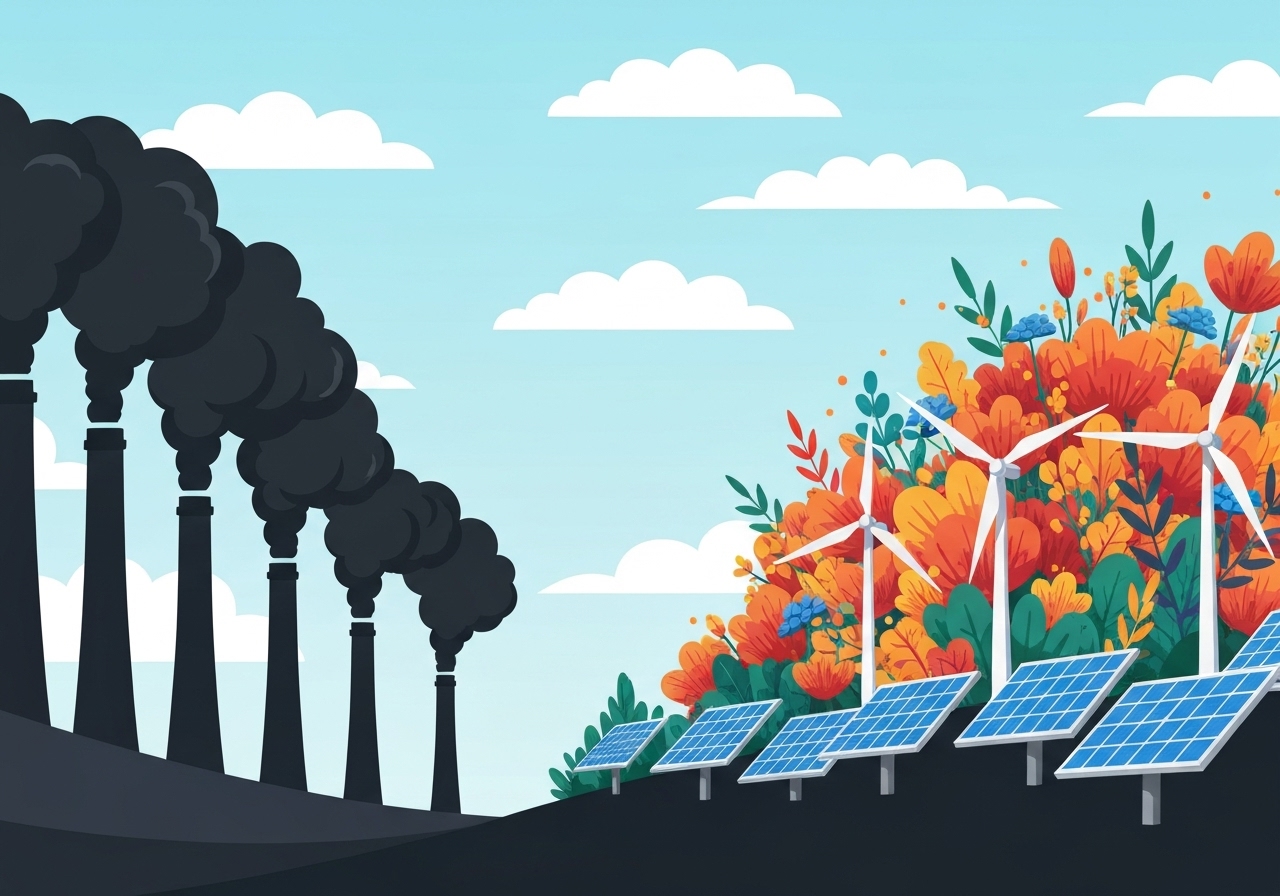
New 2025 estimates released as governments meet at COP30 in Brazil show that CO2 from fossil fuels and cement is expected to reach 38.1 billion tonnes this year, up 1.1% on 2024, while total human-caused emissions edge slightly lower to 42.2 billion tonnes. The Global Carbon Budget team and independent groups including Ember and the IEA present a mixed picture: long-term emission growth has slowed thanks to an unprecedented expansion of renewables, especially solar, yet current policies still risk well above 2C of warming. Electricity-sector emissions appear to have flattened in 2025 despite rising demand, a sign that the power transition is beginning to take effect. The figures underscore both the progress of clean energy deployment and the urgency at COP30 to turn slower growth into sustained declines.
Key Takeaways
- Global CO2 from fossil fuels and cement is forecast at 38.1 billion tonnes in 2025, an increase of 1.1% over 2024.
- Total CO2 emissions from all human activities are expected to be 42.2 billion tonnes in 2025, slightly down from 42.4 billion tonnes in 2024.
- Annual average growth in emissions over the past decade slowed to about 0.3% per year, versus 1.9% per year in the prior decade.
- Thirty-five countries reduced fossil-fuel emissions while expanding their economies in the last ten years, nearly double the number in the previous decade.
- Ember reports that fossil-fuel generation emissions have flatlined in 2025 even as electricity demand rose, driven primarily by a rapid expansion of solar and wind capacity.
- The International Energy Agency and Ember suggest energy-system emissions could peak within a few years under current policies, though timing remains uncertain.
- Climate Action Tracker warns that, on current policy trajectories, global warming could reach about 2.6C above pre-industrial levels by 2100.
Background
The Global Carbon Budget is an annual scientific assessment compiled by more than 130 researchers across 21 countries; its 2025 provisional estimate separates emissions into fossil fuels and cement, and into land-use changes such as deforestation. Land-use emissions are forecast to be lower in 2025 than in 2024, in part because the recent El Niño event has ended—El Niño years tend to increase forest loss—and because of longer-term reductions in deforestation in some regions. Over the past decade the global energy mix has shifted markedly: deployment of wind and especially solar has accelerated worldwide, led by major build-outs in China, Europe, and parts of the United States. That rapid deployment is now altering the trajectory of electricity-sector emissions, a development analysts say is essential because the power sector is the largest single source of CO2 and is central to future electrification of transport and heat.
Cement production is included with fossil-fuel emissions because its manufacturing processes emit CO2 directly, and it remains a significant industrial source that is harder to abate than power generation. Policymakers meet at COP30 in Belém, Brazil, amid this mixed evidence: cleaner electricity provides a pathway to reduce emissions at scale, but current national policies and pledges are not yet sufficient to deliver net-zero trajectories required to stop further warming. Analysts emphasize that a peak in emissions, while meaningful, would not by itself stop warming unless it is followed by rapid declines to net zero.
Main Event
The central finding reported by the Global Carbon Budget team is that CO2 from fossil fuels and cement in 2025 is projected at 38.1 billion tonnes, representing a modest rise of 1.1% compared with 2024. When emissions from land-use change are added, the provisional total for 2025 falls slightly to 42.2 billion tonnes, versus 42.4 billion tonnes in 2024. Scientists stress that the 2025 estimate remains provisional until the year is complete, but the pattern of slower growth over the last decade is robust across datasets.
Independent analysis from the clean-energy think tank Ember shows that CO2 from fossil-fuel generation has flattened in 2025, notable because electricity demand increased rather than fell. Ember attributes this to record deployment of solar photovoltaic capacity and strong additions of wind generation, which supplied the extra electricity demand without proportionate increases in coal and gas generation. Ember’s analysts point out that this is the first year since the Covid-19 period in which the power-sector emissions pattern decoupled from demand growth in this way.
Researchers and commentators at COP30 have highlighted both the signal in power-sector data and the continuing policy gap. The IEA has similarly suggested that energy-related emissions could peak within a few years if governments follow current stated policies, but it warns that a peak under existing policies falls short of what is needed for 1.5C-compatible pathways. Independent groups such as Climate Action Tracker continue to estimate median warming around 2.6C by 2100 under current policies, signaling a substantial shortfall between the pace of technology deployment and the policy steps required to halt warming.
Analysis & Implications
The slowing of emission growth to roughly 0.3% per year over the past decade reflects structural changes in the global energy system, notably the steep fall in the levelized cost of solar and wind and rapid capacity additions in many countries. That trend makes the idea of a near-term peak in global emissions plausible: if power-sector emissions start declining permanently and electrification of transport and heat accelerates using low-carbon power, total emissions could follow. However, a peak is not the same as a decline to net zero; without aggressive policy, fossil fuels could remain entrenched in some regions, prolonging cumulative CO2 additions to the atmosphere.
Economically, the data show that decoupling is possible: 35 countries reduced fossil-fuel CO2 while growing GDP over the past ten years. This indicates that emissions reductions and economic growth are not inherently opposed, and that investment in clean electricity and energy efficiency can allow continued development with lower emissions intensity. Yet global equity and access considerations remain critical: many lower-income countries require investment, technology transfer, and finance to adopt low-carbon infrastructure at pace.
Politically, COP30 faces a twofold test. First, negotiators must convert the momentum from technological change into policies that accelerate coal-to-clean retirements, scale up grid integration and storage, and prevent new long-lived fossil infrastructure. Second, they must address methane, land-use emissions, and industrial sources such as cement and steel that are more difficult and slower to abate. Without coordinated action across these fronts, a power-sector turning point will reduce but not eliminate the climate risk embedded in current trajectories.
Comparison & Data
| Metric | 2024 | 2025 (forecast) |
|---|---|---|
| Fossil fuels + cement CO2 (GtCO2) | 37.7 | 38.1 |
| Total anthropogenic CO2 (GtCO2) | 42.4 | 42.2 |
| Decadal avg growth rate | 1.9% (2009–2019) | 0.3% (2015–2025) |
| Countries cutting emissions while growing | ~18 (previous decade) | 35 (last decade) |
The table above condenses the headline numbers and recent trends to show the modest year-on-year rise in fossil-related CO2 alongside a small decline in total emissions when land-use gains are included. The decadal rates summarize the structural slowdown: energy-system transformation and more efficient economies have reduced the pace of emission growth even as absolute levels remain far above net-zero pathways.
Reactions & Quotes
Scientists involved with the Global Carbon Budget and independent analysts emphasized both progress and risk. They stress that slower growth is real but insufficient without deeper cuts. Below are representative statements and the surrounding context.
Corinne Le Quéré, who helped lead the Global Carbon Budget assessment, highlighted the contrast between slower emissions growth and the gap to targets. She underlined that renewable expansion has been a key driver of the change in trajectory but warned reductions are still too slow.
We’re not yet in a situation where emissions go down as rapidly as they need to, but there are a lot of positive developments.
Corinne Le Quéré (University of East Anglia / Global Carbon Budget)
Ember analysts framed the flatlining of power-sector emissions as evidence that solar and wind can meet increased electricity demand without higher CO2. Their commentary points to technology deployment as the lever that could turn a plateau into a decline.
Solar power is growing at a record pace, faster than any electricity source in history, allowing electricity demand increases to be met without matching fossil-fuel growth.
Nicolas Fulghum (Ember)
Climate policy researchers cautioned that even a near-term peak would not prevent further warming unless followed by sustained declines to net zero. Their analysis stresses the policy gap reflected in current national commitments.
We have never had a better chance to do this, and we’ve also never been in a worse situation — the choices at this COP matter for whether warming heads toward 2.5–3C or lower.
Dr Bill Hare (Climate Action Tracker)
Unconfirmed
- The precise timing of any permanent global emissions peak remains uncertain and depends on policy implementation and economic developments beyond 2025.
- The 2025 numbers are provisional while the calendar year is not fully complete and subject to later revision as final data arrive.
- The extent to which land-use emissions will remain lower depends on regional forest-management decisions and weather patterns, which can change rapidly.
Bottom Line
The latest assessments present a nuanced picture: fossil-fuel CO2 is modestly higher in 2025 at 38.1 billion tonnes, but the dramatic rise of renewables—especially solar—has slowed emission growth and appears to have stabilized power-sector emissions even as demand rose. That combination creates a plausible path to a near-term peak in global emissions if governments and financiers accelerate policies that retire coal and curb new long-lived fossil infrastructure.
However, a peak alone will not stop warming: sustained and deep cuts across power, industry, transport, and land use are required to drive cumulative CO2 down toward net zero. COP30 is therefore a crucial test of whether technological momentum can be matched by policy, finance, and international cooperation to convert a hopeful signal into a durable reversal of global emissions.
Sources
- BBC News (news report summarizing the new assessments)
- Global Carbon Project / Global Carbon Budget (scientific consortium producing annual CO2 budgets)
- Ember (clean-energy think tank analysis on power-sector emissions)
- International Energy Agency (IEA) (international energy watchdog, policy analysis)
- Climate Action Tracker (independent research group assessing warming under current policies)