
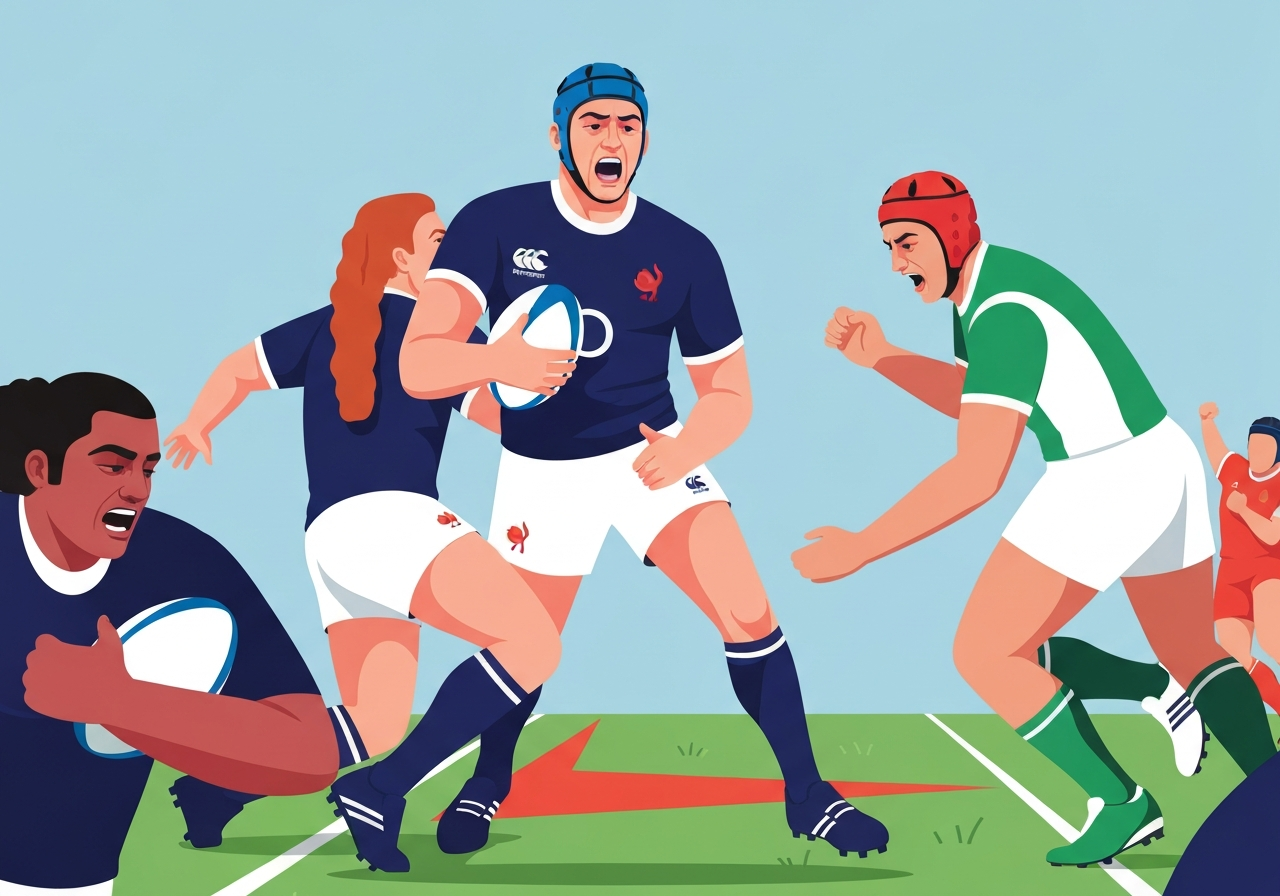
Lead: France began their Six Nations title defence with a dominant 36-14 victory over Ireland at the Stade de France, taking the game 22-0 into the interval and finishing with a bonus point. Antoine Dupont returned as captain and orchestrated a powerful first-half display that included two tries from Louis Bielle-Biarrey. Ireland, hampered by injuries, mounted a second-half response with scores from Nick Timoney and Michael Milne but could not overturn the margin. The result leaves France top of the table and Ireland facing a difficult regrouping ahead of their trip to face Italy.
Key Takeaways
- Final score: France 36, Ireland 14; France secured a bonus-point win by scoring five tries to Ireland’s two.
- Half-time was 22-0 to France, reflecting a one-sided opening 40 minutes that featured three home tries.
- Try scorers for France: Louis Bielle-Biarrey (2), Matthieu Jalibert, Charles Ollivon and Theo Attissogbe; Thomas Ramos added four conversions and a penalty.
- Ireland replied through replacement forwards Nick Timoney and Michael Milne, with Sam Prendergast converting both kicks for 14 points.
- Antoine Dupont returned to Test captaincy and was central to France’s attacking tempo and chance creation.
- Bielle-Biarrey improved an exceptional strike rate, taking his Test total to 22 tries in 23 caps.
- Ireland’s match-day squad was significantly weakened at prop and missing key backs, a factor cited by coaches after the game.
- Next fixtures: Ireland host Italy on 14 February; France travel to Wales on 15 February.
Background
France entered the 2025 Six Nations as reigning champions and were widely tipped to be among the front-runners again. Their sustained investment in a fast, expansive backline has paid dividends and raised expectations that Les Bleus can defend the title. Ireland, meanwhile, arrived in Paris with an injury list that included personnel at both prop positions and the absence of potential gamebreakers such as Hugo Keenan and Mack Hansen, limiting Andy Farrell’s selection options.
The match carried extra narrative weight: Ireland had returned to the Stade de France after an agonising World Cup quarter-final defeat to New Zealand in 2023, while France were aiming to build on last year’s decisive victory in Dublin that dented Ireland’s title hopes. The fixture has historically been a high-stakes, emotionally charged meeting between two top-five nations, and the early Six Nations encounter was framed as both a test of depth and a statement of intent.
Main Event
France stamped their authority early. After a disallowed Ollivon try from a knock-on in the second minute, Louis Bielle-Biarrey opened the scoring with a lively finish that followed a break and a fast support sequence; the move was notable for a suspected forward pass in the build-up. Dupont’s influence grew as the first half progressed, feeding Matthieu Jalibert for a well-taken try shortly after pressure forced an Irish scrum in their in-goal.
Charles Ollivon extended the lead with a powerful surge through the midfield, and Ramos’s reliable kicking kept momentum with goals from touch. At half-time, France led 22-0, having combined high tempo and clinical finishing while Ireland struggled to find continuity defensively. The first half also featured moments of controversy over the legality of phase play that produced France’s opening score.
The second half began in the same attacking spirit for France as Dupont and Ramos combined to create Bielle-Biarrey’s second try, which secured the bonus point seven minutes after the break. Ireland responded with character: Stuart McCloskey’s line breaks created space and replacements Nick Timoney and Michael Milne both crossed, the latter marking his Six Nations debut with a try. Despite a spell of sustained Irish pressure late on, France held firm and Theo Attissogbe finished in the corner to seal the victory.
Analysis & Implications
For France, the win reinforced their status as title favourites and underlined the depth in their backline even without established veterans such as Uini Atonio, Gregory Alldritt, Damian Penaud and Gaël Fickou. The combination of Dupont’s control and the pace of players like Bielle-Biarrey poses selection headaches for opponents and suggests France can score freely if allowed time and space. Their ability to convert pressure into points—five tries in the match—will be a key metric through the tournament.
Ireland’s challenges are structural as much as tactical. Injuries at set-piece positions and the absence of key attacking threats narrowed their game plan, forcing Andy Farrell into reactive substitutions rather than progressive adjustments. The psychological impact of a heavy home defeat last autumn, followed by this reverse, may compound selection and morale issues heading into the Italy fixture. Rapid recovery of personnel and clarity on front-row options will determine whether Ireland can arrest a potential downward run in form.
On a tournament level, France’s bonus-point win gives them an early edge in the standings and scoreboard advantage that could prove decisive in a tight table. The match also reignites discussion about refereeing interpretations in fast, unstructured play; disputed phase entries and marginal calls may influence VAR/TMO protocols and future officiating emphasis. Internationally, the result reiterates the high quality at the top of the game and elevates expectations for a competitive Six Nations season.
Comparison & Data
| Metric | France | Ireland |
|---|---|---|
| Score | 36 | 14 |
| First-half | 22 | 0 |
| Tries | 5 | 2 |
| Conversions | 4 | 2 |
The table shows a clear margin in points and tries. France’s five-try return contrasts with Ireland’s two, and the 22-0 half-time deficit proved decisive. Louis Bielle-Biarrey’s season tally now reads 22 tries in 23 Tests, an exceptional strike rate that highlights an elite finishing edge for Les Bleus.
Reactions & Quotes
“There’s a ‘hell of a lot of work to do’.”
Andy Farrell, Ireland head coach
Farrell used the post-match moment to underline the scale of Ireland’s recovery task amid injuries and form concerns. His remark framed the immediate focus on selection, repair and tactics before the next round.
“Ruthless France inflicted more pain on Ireland.”
BBC Sport (match report)
The media reaction emphasised the clinical nature of France’s performance and the psychological blow to Ireland after a comprehensive night at the Stade de France.
Unconfirmed
- The initial scoring move included an apparent forward pass in the build-up; final TMO clarification on the exact passing angles has not been publicly released.
- The long-term fitness status of several injured Irish forwards and backs has not been confirmed and will depend on medical assessments in the coming days.
Bottom Line
France’s 36-14 victory was comprehensive and signalled that, when firing, Les Bleus can combine tempo, creativity and finishing power to overwhelm elite opposition. Antoine Dupont’s return and Louis Bielle-Biarrey’s finishing made the result emphatic and gave France an early tournament advantage.
Ireland leave Paris with clear issues to address: a stretched squad, key absences and the need to rebuild confidence before hosting Italy. The next two rounds will test both teams’ depth and temperament, and the Stade de France performance has set a high bar for France’s title defence.