
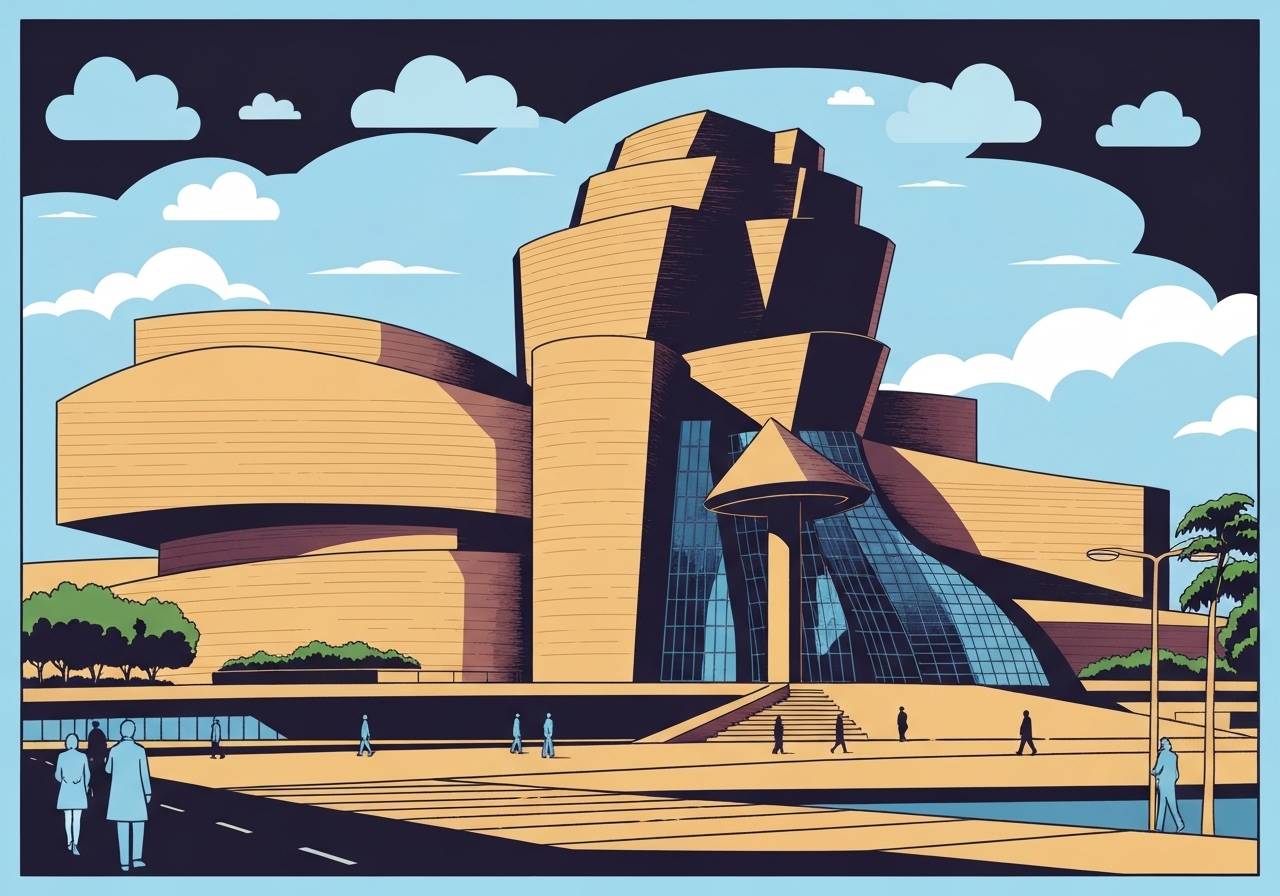
Frank Gehry, who has died aged 96, leaves a body of work that remade how cities, audiences and clients imagine contemporary architecture. Across six decades he advanced a highly expressive, maximalist language — from his titanium-clad Guggenheim Bilbao (1997) to the stainless steel Walt Disney Concert Hall (2003) — that produced immediate landmarks and recurring controversy. His designs combined hand-built models with aerospace-era digital modelling to create buildings that read as sculptures as much as functioning civic spaces. The tangible result was both urban renewal in places like Bilbao and a new global appetite for ‘iconic’ architecture.
Key Takeaways
- Frank Gehry died aged 96 after a 60-year career that made him one of the era’s most recognisable architects.
- His Guggenheim Museum Bilbao (1997) is clad in roughly 33,000 thin titanium panels and drew about 1.3 million visitors in its first year.
- The Walt Disney Concert Hall in Los Angeles opened in 2003; its stainless-steel volumes house a timber-lined auditorium praised for acoustic intimacy.
- Gehry used hand-made models digitised with aerospace-derived software (notably CATIA) to translate sculptural ideas into buildable structures.
- Later works — including the Fondation Louis Vuitton (2014) and long-running Guggenheim Abu Dhabi commission (2006) — have attracted mixed reviews and disputes over cost, timing and workmanship.
- His early practice in Los Angeles, including the transformed 1977 Santa Monica house, connected bricolage materials to an experimental, populist sensibility.
Background
Born in Toronto and raised in North America, Gehry moved with his family to Los Angeles when he was 17, a city whose low-rise sprawl and culture of improvisation provided fertile ground for his experiments. Trained amid modernist doctrine, Gehry reacted against canonical restraint — he and contemporaries embraced a postmodern freedom summarized by Robert Venturi’s quip, “less is a bore.” That cultural shift allowed form and ornament to return as central ingredients of architectural meaning.
Gehry’s practice matured through houses and small commissions in the 1970s and 1980s where corrugated metal, plywood and found materials met handcrafted interventions. Over time those methods scaled into large public commissions, and his working method evolved: tactile study models were digitised with software originally developed for aerospace, enabling complex, doubly-curved surfaces to be engineered and constructed. This technical pathway made possible buildings that read as kinetic sculptures rather than boxes.
Main Event
Gehry’s international profile crystallised with the Guggenheim Museum Bilbao, opened in 1997 on the Nervión riverfront. Sheathed in an array of titanium tiles that catch and fragment light, Bilbao’s composition of interlocking volumes refused a neutral display role; galleries were as deliberately staged as the art they contained. The museum’s arrival helped catalyse a surge in visitors — about 1.3 million in year one — and the term “Bilbao effect” entered policy conversations about cultural-led regeneration.
In Los Angeles, the Walt Disney Concert Hall (completed 2003) became another instant emblem of Gehry’s aesthetic. The exterior’s rolled stainless-steel plates sit above a warm, timber-lined auditorium; Gehry pushed materials and detailing to produce an intimate listening space, even influencing the internal organ’s sculptural presence. The project marked a local culmination for an architect who had relocated to Los Angeles as a teen and long cultivated ties to the city.
Across Europe, Asia and the Americas Gehry’s hand produced other signature works: the Dancing House in Prague (a collaboration with Vlado Milunić), the Jay Pritzker Pavilion in Chicago and the Fondation Louis Vuitton in Paris (2014). Yet several high-profile later projects exposed tensions. The Abu Dhabi Guggenheim commission, begun in 2006, has been stalled for years and is widely reported as opening only next year; the Fondation Louis Vuitton drew criticism over cost and execution in some quarters.
Late in his career Gehry also licensed design work for smaller commercial objects — furniture, yachts and consumer goods — the kind of cross-genre practice that commentators said diluted the singularity of his architectural output. Still, many clients and public audiences continued to prize his capacity to make buildings that functioned as civic spectacles.
Analysis & Implications
Gehry’s work reframed architecture’s civic role by demonstrating how a single, highly visible building can alter a city’s economic and cultural trajectory. Bilbao’s transformation is the clearest example: the museum became a tourist magnet and a shorthand case study for cultural regeneration. Policymakers and developers now look to landmark architecture as a lever for urban investment, sometimes without the supporting cultural infrastructure that made Bilbao’s revival sustainable.
Technically, Gehry’s adoption of CAD tools such as CATIA changed practice across the profession. Where once complex geometries were impractical, the coupling of sculptural intent with industrial fabrication opened new formal possibilities. That shift has been widely imitated, producing a generation of architects and clients for whom sculptural novelty is an explicit goal — and occasionally, a spectacle pursued without commensurate attention to program, maintenance or long-term cost.
Critics argue that later large-scale commissions reveal the limits of spectacle-driven architecture: budgets balloon, schedules slide and constructed realities can disappoint local expectations. Advocates counter that such projects create places of meaning, tourism, and pride. The tension between cultural ambition and economic realism will shape how future civic commissions are evaluated and funded, especially in markets sensitive to cost overruns and operational sustainability.
Comparison & Data
| Project | City | Open/Year | Notable material/figure |
|---|---|---|---|
| Guggenheim Bilbao | Bilbao, Spain | 1997 | ~33,000 titanium panels; 1.3M visitors in year one |
| Walt Disney Concert Hall | Los Angeles, USA | 2003 | Stainless steel exterior; timber-lined auditorium |
| Fondation Louis Vuitton | Paris, France | 2014 | Glass ‘sails’; contested workmanship and cost |
| Maggie’s Centre (Dundee) | Dundee, UK | 2003 | Simple, folded-metal roof in a cottage form |
These figures demonstrate both the scale of Gehry’s most visible successes and the uneven reception of later projects. The table is selective but highlights recurring trade-offs: expressive exterior skin, complex construction inputs, and divergent operational legacies.
Reactions & Quotes
Official and critical responses to Gehry’s death and legacy capture the ambivalence his work provoked: admiration for bold formal invention alongside debates over cost and context. Below are representative remarks framed by brief context.
“In the world we live in 98% of what is built and designed today is pure crap.”
Frank Gehry
Gehry voiced this blunt assessment at a 2014 award ceremony, signaling both his impatience with commonplace construction and his self-positioning as a designer of exceptional, if polarising, forms.
“The huge budgets had raced past a clear idea of what the building would mean culturally.”
Christopher Hawthorne, Los Angeles Times
Writing about global museum commissions, the critic Christopher Hawthorne warned that big budgets sometimes outpaced cultural planning, a critique applied by some to later museum projects Gehry undertook or inspired.
“The Guggenheim changed Bilbao’s fortunes; it became an argument for cultural investment.”
Cultural policy researcher (paraphrase)
Scholars and local officials have frequently cited Bilbao as a case study in cultural-led regeneration; the statement above paraphrases a common view in urban policy literature that large cultural projects can catalyse economic activity when paired with broader strategy.
Unconfirmed
- The precise opening date and final budget figures for the Guggenheim Abu Dhabi remain fluid, with official schedules described as “slated” rather than fixed.
- Allegations of poor workmanship on some projects are reported in multiple outlets but vary in specificity and remain the subject of contractor and client dispute.
Bottom Line
Frank Gehry’s architecture reframed what public buildings could look and feel like in the late 20th and early 21st centuries. At his best — Bilbao, Disney Hall, select civic works — he produced spaces that fused spectacle with program, altering city narratives and visitor behaviour. Those successes also created imitators and a market for landmark buildings that sometimes prioritized form over longevity or civic fit.
Gehry’s legacy will be assessed in multiple registers: as technical innovation that expanded architectural possibility; as cultural commerce that could lift city fortunes; and as a cautionary tale about the limits of spectacle. For cities, funders and architects today, the challenge is to distil the constructive lessons from his career: how to pair formal ambition with clear cultural purpose, realistic budgets and durable stewardship.