
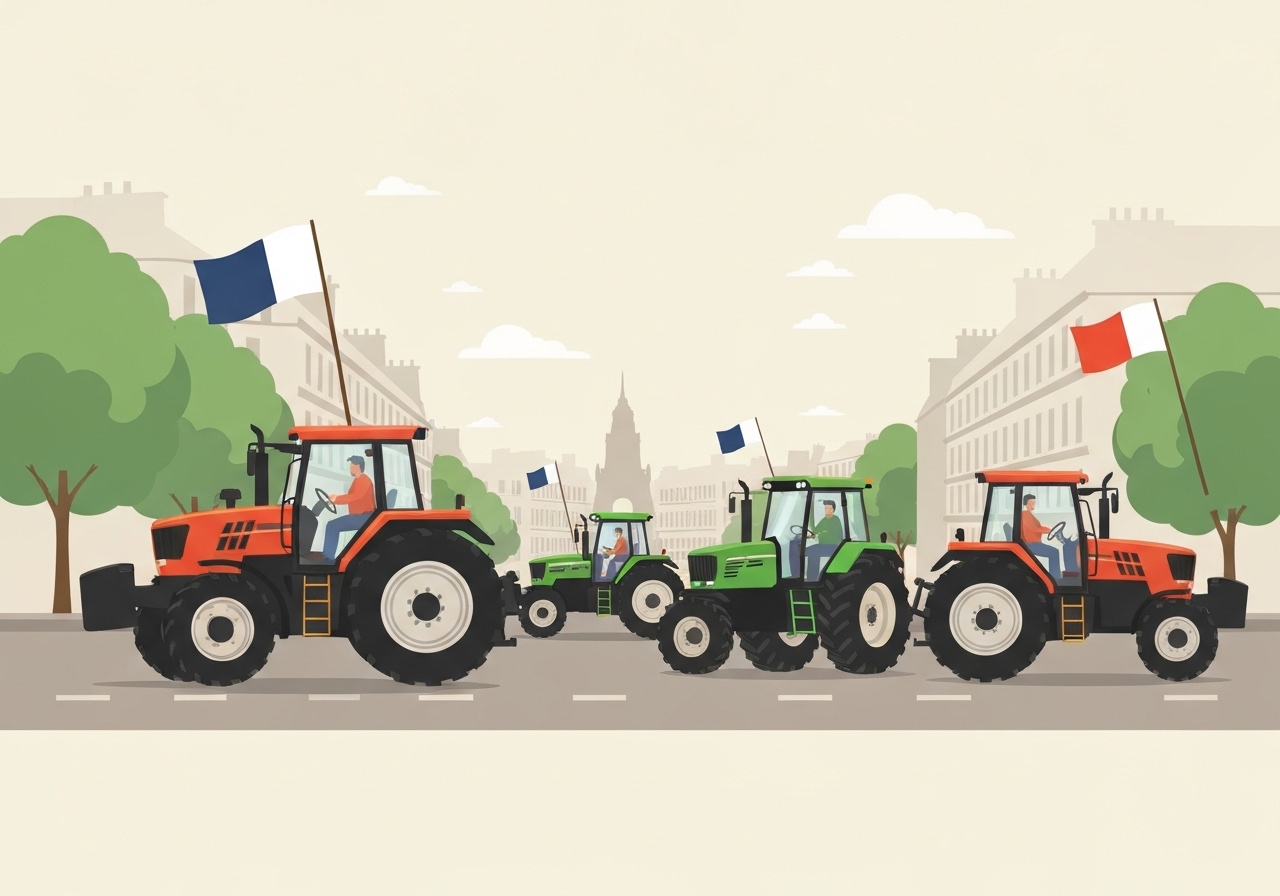
Dozens of French farmers drove tractors into Paris on Thursday to press the government over renewed European Union talks on a free-trade agreement with five South American countries. Demonstrators gathered near the National Assembly after convoys brought roughly a hundred tractors toward the capital, while the Interior Ministry reported about 20 machines reached central sites such as the Arc de Triomphe and the Eiffel Tower neighborhood despite a ban. The Rural Coordination union organized the action to escalate pressure on officials it says have not done enough to block the Mercosur deal. Protesters also linked their demonstration to anger over sanitary measures related to a bovine disease.
Key Takeaways
- Organizers: The Rural Coordination union staged Thursday’s protest, citing threats to farm livelihoods from a proposed EU–Mercosur free-trade agreement.
- Tractor convoys: Activists said roughly 100 tractors entered Paris; the Interior Ministry said about 20 were in the city center while many were stopped at major ring roads.
- Geography: Tractors reached high-profile locations including near the Arc de Triomphe and the Eiffel Tower neighborhood under heavy police supervision.
- Negotiations: The EU has renewed internal talks on the Mercosur deal this week, with speculation a signature could be attempted in Paraguay on Jan. 12.
- Political split: Germany is reported to lead supporters of the deal, while France and Poland have registered objections that previously stalled approval.
- Sector risks: French officials warn the agreement could threaten domestic production of beef, chicken, sugar, ethanol and honey.
- Union links: Rural Coordination has documented ties to the far-right; its statement demanded quick, effective government measures to protect farmers.
Background
The proposed agreement covers trade between the EU and Mercosur members: Brazil, Argentina, Bolivia, Paraguay and Uruguay. Negotiations over the past decade have been contentious in Europe as member states weigh market access against domestic agricultural protections and environmental and sanitary standards. French opposition has been particularly vocal; last month fierce resistance from France helped derail progress, and Paris has repeatedly pushed for stronger safeguards for farmers and food standards.
On the domestic scene, farmers face parallel grievances: economic pressure from cheaper imports and stricter sanitary rules introduced to curb bovine disease transmission. The Rural Coordination union, which represents farm interests in several regions including Lot-et-Garonne, uses high-profile disruptions to force political debate. Many farmers see the Mercosur deal as a tipping point for already tight margins in livestock and crop sectors, prompting cross-regional mobilization including participants who traveled from Corsica.
Main Event
Convoys brought tractors into the capital early Thursday, aiming for the National Assembly to deliver a visible demonstration of opposition. Police established cordons and stopped many vehicles at the city’s thoroughfares; nevertheless, the Interior Ministry reported that some tractors reached key tourist and symbolic sites in central Paris. Authorities said convoys “bypassed and forced their way” around restrictions, while organizers framed the move as a symbolic visit to put farmers’ concerns directly in front of lawmakers.
Rural Coordination figures said the march was meant to compel clearer political action from President Emmanuel Macron and his government, whom some protesters accuse of failing to oppose the deal strongly enough. Local leaders explained that the protest combined trade concerns with frustration over sanitary controls, which they say compound farmers’ burdens. The demonstration remained under tight policing and caused traffic disruptions at major arteries marking the city limit.
Officials from the Agriculture Ministry and other government offices responded by reiterating objections to elements of the Mercosur package, arguing it could undermine several French agricultural sectors. The EU’s internal discussions this week have revived the possibility of moving the deal forward; diplomats have suggested Germany and other proponents may press ahead despite French reservations. The prospect of a signing in Paraguay on Jan. 12 has become a focal point for opponents seeking last-minute concessions.
Analysis & Implications
Economically, the dispute centers on market access and price competition: Mercosur agricultural exports, particularly beef and sugar, could enter the EU at lower cost, putting downward pressure on domestic producers’ prices and margins. French producers argue that lower-cost imports, even in limited quotas, would distort local markets and erode rural livelihoods that depend on protected prices and subsidies. Policymakers must weigh these sectoral impacts against broader gains proponents cite, such as increased EU export opportunities to South America and diplomatic benefits of a long-standing political agreement.
Politically, the protests amplify pressure on President Macron and his centrist administration. Paris has leverage in EU ratification processes and can negotiate trade safeguards, but doing so risks friction with Germany and other member states that favor concluding the deal. Domestic unrest from farmers is potent in France, where rural mobilizations have historically influenced electoral politics and policy. Ministers, including Agriculture Minister Annie Genevard, have publicly restated opposition, underscoring the government’s need to balance national agricultural protection with EU-level commitments.
Diplomatically, a signed agreement could strain relations between EU capitals with divergent priorities and complicate interactions with Mercosur governments that expect market access. If the EU moves forward without robust transitional measures, French exporters could face longer-term structural shifts, while consumers in Europe may see lower prices for certain products. Sanitary concerns add another layer: any perception that standards are being relaxed could galvanize further protests and legal challenges from producers and consumer groups.
Comparison & Data
| Sector | French concern | Mercosur exposure |
|---|---|---|
| Beef | Price competition; production decline risk | Large export capacity from Brazil, Argentina |
| Chicken | Competition on poultry imports | Growing poultry exports regionally |
| Sugar | Lower-cost imports could reduce domestic market | Significant sugar output in Brazil, Paraguay |
| Ethanol | Competition affecting biofuel-linked markets | Brazil’s large ethanol industry |
| Honey | Price and quality control concerns | Regional honey exports to global markets |
The table summarizes the sectors French authorities have flagged as vulnerable. It does not assign numeric projections but clarifies the channels—price competition, market share loss and sanitary standard disputes—through which the Mercosur deal could affect French production. Policymakers typically model such impacts with tariff-rate quotas and safeguard mechanisms; absent specific compensating measures, producers expect immediate competitive pressure following liberalization.
Reactions & Quotes
Organizers and participants framed the action as a bid to force clearer commitments from national leaders, while authorities emphasized public-order limits. Below are direct, concise statements from key actors.
“The goal today is to come to Paris to express our demands closer to those who have the power.”
José Perez, President, Rural Coordination (Lot-et-Garonne)
Perez framed the protest as symbolic pressure on lawmakers and the executive to prioritize farmers’ demands in EU-level decisions.
“We want President Macron to stand by the side of farmers. He needs to clearly tell it out loud and to impose it, too.”
Ludovic Dupeux, Rural Coordination (Corsica)
Dupeux traveled from Corsica and urged the president to take a firmer public position against the deal, reflecting grassroots impatience with perceived government inaction.
“Convoys bypassed and forced their way”
French Interior Ministry (official summary)
The Interior Ministry used this phrasing to describe how some tractor convoys reached central Paris despite restrictions, underscoring law-enforcement concerns about route violations and public order.
Unconfirmed
- Whether the EU–Mercosur deal will indeed be signed in Paraguay on Jan. 12 remains speculative and subject to late-stage diplomatic decisions.
- The exact total number of tractors originally reported (organizers’ claim of about 100) versus the Interior Ministry’s central-city count (about 20) has not been reconciled publicly.
- The precise extent and nature of Rural Coordination’s ties to far-right groups are referenced by commentators but vary by source and have not been exhaustively documented in this report.
Bottom Line
Thursday’s tractor protest was a calibrated escalation by French farmers designed to dramatize the domestic stakes of an EU–Mercosur agreement. Beyond traffic disruption and a tense day under police supervision, the action highlights persistent domestic resistance that could complicate any EU move to finalize the deal without new concessions or safeguard mechanisms for vulnerable sectors.
For policymakers, the incident underscores the need to reconcile EU-level trade ambitions with national political realities: negotiators face pressure to protect producers while proponents push for the broader economic and diplomatic gains of concluding the pact. In the short term, the Jan. 12 date cited by negotiators remains a focal point for opponents seeking further guarantees; in the longer term, the episode signals that agricultural protections and sanitary standards will remain central bargaining chips.
Sources
- ABC News / AP wire (news wire)
- French Interior Ministry (official)