
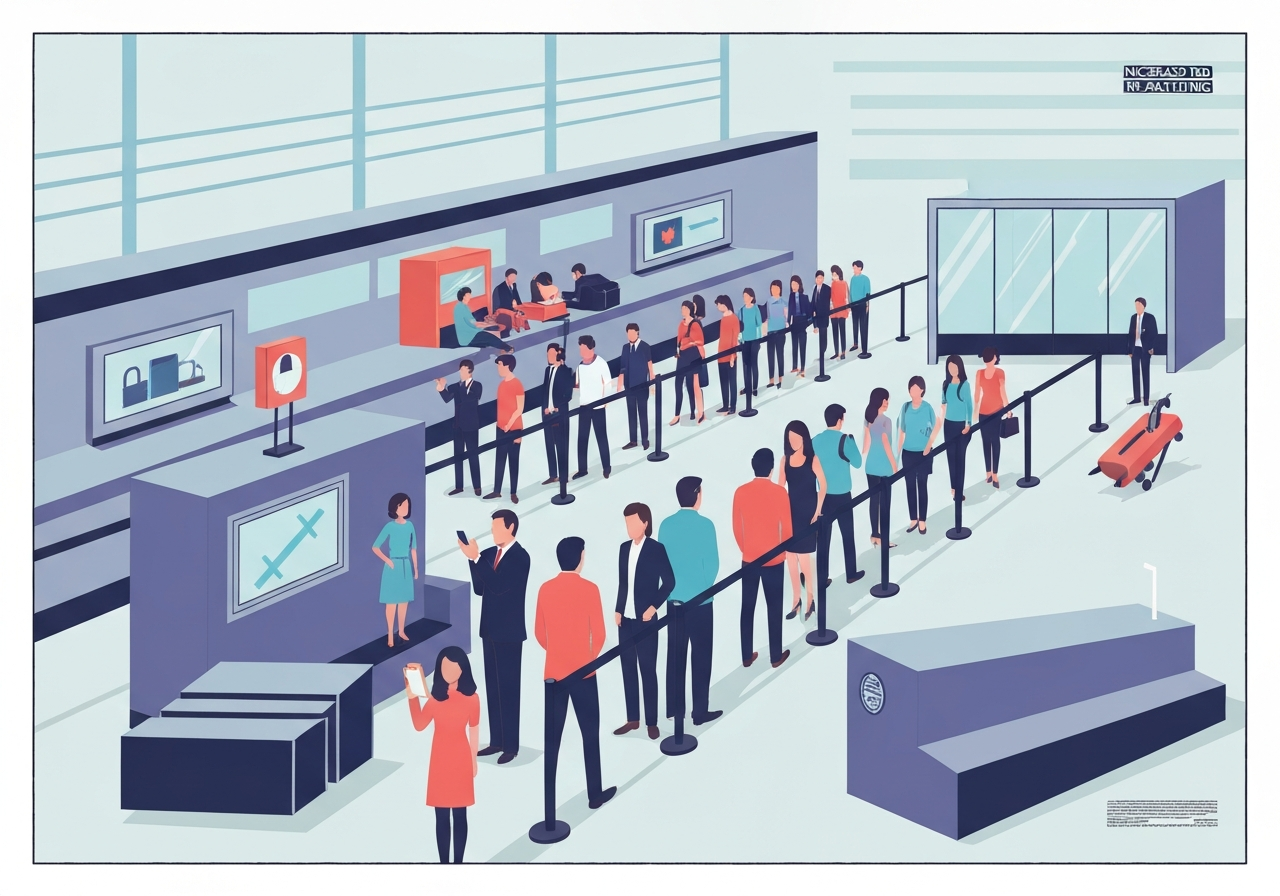
Federal funding moves this week aim to restore pay for Transportation Security Administration officers, but airport security waits are unlikely to normalize immediately. The partial government shutdown that began February 14 left roughly 61,000 TSA employees working without pay and pushed call-out rates at some airports from about 4% to 40–50%. Although a presidential directive and a unanimous Senate step to fund most of the Department of Homeland Security were announced in late March 2026, union leaders and agency officials say days or weeks may be needed to rebuild staffing and ease hours‑long lines.
Key takeaways
- About 61,000 TSA employees were required to work without pay after the shutdown that began February 14, 2026.
- By March 27, 2026, missing paychecks for TSA topped $1 billion, testimony to a House hearing said.
- Call-out rates rose from a pre-shutdown average of roughly 4% to as high as 40–50% at some airports.
- TSA reported nearly 500 employees quit during the funding lapse, and unions warn attrition may continue.
- Many officers face acute financial distress—missed bills, evictions, repossessions and lost child care—hindering their ability to report to work.
- Federal law guarantees back pay after a shutdown ends, but payroll restoration and staff recovery can take days or weeks.
- Several legislative proposals exist to pay critical workers during funding lapses, but none were enacted as of late March 2026.
Background
The partial shutdown that began on February 14, 2026, left many Department of Homeland Security components operating on authority that did not include pay for a large share of frontline staff. TSA officers—tasked with daily passenger screening at hundreds of airports—continued to work under that lapse, producing strains on retention and attendance. Historically, prior shutdowns have also taken time to resolve operational shortfalls: during the most recent full shutdown in the fall, TSA employees waited 14 to 30 days to see back pay arrive, according to union leadership.
Policymakers have periodically proposed targeted fixes—such as the Shutdown Fairness Act and the Keep America Flying Act—to ensure some categories of workers receive pay during lapses, but those measures had not advanced through Congress before late March 2026. Meanwhile, agencies and unions warned that prolonged pay interruptions shift experienced screeners into private-sector jobs that pay reliably, increasing hiring and training burdens for TSA when funding resumes.
Main event
In the final days of March 2026, President Donald Trump directed the Homeland Security secretary to move quickly to get pay to TSA agents. Hours after that directive, the Senate unanimously voted to fund most of DHS, including TSA, although the measure left out Immigration and Customs Enforcement and parts of Customs and Border Protection. House Republican leaders had not settled on a plan to pass the Senate bill immediately, leaving timing uncertain.
Union officials cautioned that even if pay is authorized promptly, station-level staffing will not rebound instantly. Johnny Jones, secretary‑treasurer of AFGE’s TSA Council 100, told reporters that many workers will not be able to return until they see a direct deposit—because of childcare, fuel and other cash constraints. Aaron Barker, president of AFGE Local 554, similarly warned that passenger lines would remain long until pay hits accounts.
Operational consequences were visible across the country: airports reported hours‑long waits as financially strained officers called out in greater numbers, and TSA logged nearly 500 resignations during the lapse. Testimony at a House hearing described widening personal hardship among employees—missed bill payments, evictions and repossessions—that complicate immediate workforce recovery even if funds flow soon.
Analysis & implications
Restoring pay is necessary but not sufficient to erase the backlog and staffing shortfalls. Payroll actions require administrative steps—authorization, funding transfers and processing through payroll systems—that can take multiple business cycles. Even after pay posts, some workers will need time to resolve personal crises (child care, housing, transportation) before returning consistently to duty.
High call-out rates and recent resignations also mean that TSA will face recruitment and training demands. Many officer positions begin at roughly $40,000 in locations such as Ithaca, New York; Alexandria, Louisiana; and Dothan, Alabama, with higher starting wages in larger cities (about $45,000 in Chicago) and remote locations (roughly $75,000 in places like Nome, Alaska). While 2024 pay increases improved retention, competition from steady private-sector roles remains a risk if pay disruptions recur.
The operational ripple effects extend beyond airports. A sustained shortage of experienced screeners raises public‑safety and efficiency concerns and increases pressure on other transportation stakeholders—airlines, airports and air-traffic control—to adjust schedules or staffing. Economically, passenger delays translate into missed connections and cascading costs for carriers and travelers, which can be measurable over the course of a sustained staffing gap.
Comparison & data
| Metric | Pre-shutdown | During shutdown |
|---|---|---|
| TSA call-out rate | ~4% | 40–50% in some airports |
| Employees working without pay | n/a | ~61,000 |
| Recorded resignations during lapse | n/a | ~500 |
| Missing paychecks (by Mar 27, 2026) | n/a | > $1 billion |
The table shows the scale of operational change: call-out rates ballooned tenfold in some locations, and financial exposure exceeded $1 billion by March 27, 2026. Replacing lost screeners requires hiring, background checks and training that typically take several weeks to months, indicating a lag between restored wages and restored service levels.
Reactions & quotes
Union leaders emphasized the immediacy of workers’ financial needs and the practical consequences for attendance and morale.
“Folks are going to need money. People are not going to be able to come to work until they get a deposit,”
Johnny Jones, AFGE TSA Council 100
TSA and advocates described severe personal hardships that have resulted from missed pay, underscoring why immediate deposits matter for operational recovery.
“Many workers have missed bill payments, received eviction notices, had their cars repossessed and lost child care,”
Ha Nguyen McNeill, testified to House Committee
Local union officials at major airports reiterated that visible line reductions will lag until funds actually reach employees’ accounts.
“Until that paycheck hits that account, you can expect the same,”
Aaron Barker, AFGE Local 554
Unconfirmed
- Which administrative route will deliver pay first—an executive order implementation or the Senate funding measure—and how quickly it will post to accounts remains uncertain.
- The precise timeline for staffing to return to pre-shutdown levels is unclear; unions estimate days to weeks, but local variation could be significant.
- The long-term attrition rate and how many additional employees will leave before stability returns are not yet verifiable.
Bottom line
Securing funding and directives to pay TSA officers is a critical first step to stabilizing airport security operations, but it does not produce an immediate fix for passenger delays. Administrative payroll actions, workers’ personal financial recovery and rehiring/training for departed screeners all introduce time lags that can extend lines for days or weeks after pay is restored.
Policymakers face a practical choice: accept episodic operational disruption tied to funding fights, or enact rules that protect pay for critical public‑safety employees during lapses. For travelers and industry stakeholders, the near-term priority is rapid payroll processing and targeted staffing relief at the most affected airports while longer-term legislative solutions are debated.
Sources
- CNN — news reporting with union and congressional hearing testimony