
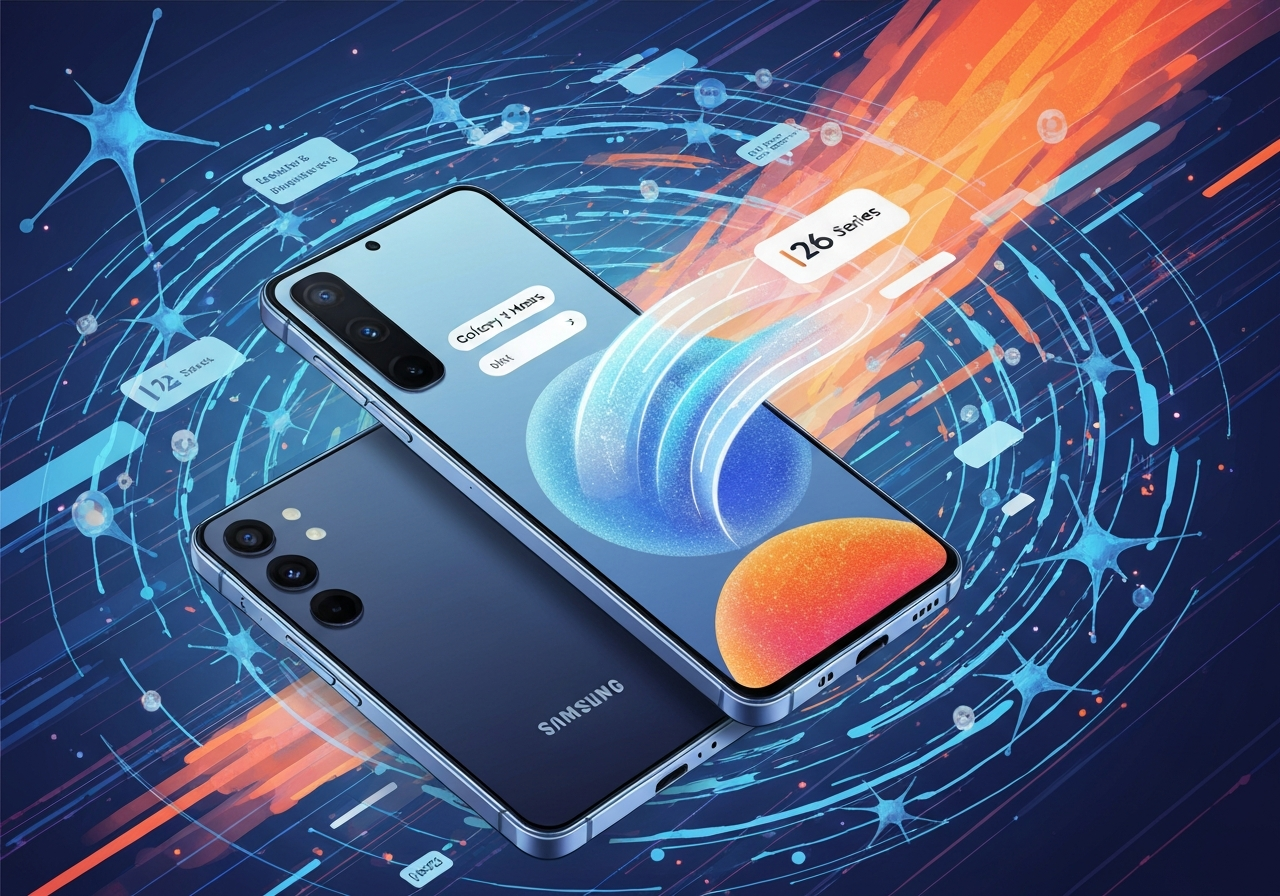
Lead: On February 25 in San Francisco, Samsung Electronics revealed the Galaxy S26 series at Galaxy Unpacked 2026, presenting the company’s third-generation Galaxy AI phones. The new lineup pairs the most powerful Galaxy S hardware to date with expanded, context-aware AI features designed to simplify everyday tasks. Samsung highlighted design refinements, a debut Privacy Display on the Ultra model, and AI-driven camera and editing tools as marquee improvements. Early hands-on impressions emphasized portability, on-device intelligence and more accessible creative controls for users of all skill levels.
Key Takeaways
- Announcement: Samsung unveiled the Galaxy S26 series on February 25, 2026, at Galaxy Unpacked in San Francisco.
- Design: Galaxy S26 Ultra is 0.3 mm thinner than its predecessor and weighs 214 grams, with a rounded curvature and unified color palette across the lineup.
- Privacy Display: The S26 Ultra debuts a built-in Privacy Display that narrows side-angle visibility without a screen protector and can be mapped to a double-press side-button.
- Core AI features: Galaxy AI introduces Now Nudge for contextual prompts and expands Circle to Search to handle multi-element queries.
- AI ecosystem: The phones integrate Bixby, Gemini and Perplexity agents to interpret intent and suggest settings or actions based on natural-language input.
- Camera: S26 Ultra carries a 200-megapixel primary sensor plus a 50 MP telephoto with 5x optical zoom and 10x optical-quality zoom, with upgraded Nightography and AI ISP applied to front and rear cameras.
- Editing and creativity: Photo Assist and Creative Studio use on-device AI to remove or restore elements, change scenes (day↔night), and generate stickers or assets from text prompts.
Background
The Galaxy S26 series represents Samsung’s continued push into AI-integrated smartphones, following the Galaxy S24 and S25 lines that introduced on-device AI capabilities. Samsung frames this generation as the third step in a multi-year roadmap to make AI assistants proactive, context-aware and broadly useful for everyday users. Across the industry, manufacturers are racing to combine hardware improvements with software intelligence to retain differentiation as raw specification gains become harder to market.
Previous Galaxy S releases established AI features such as Circle to Search and basic assistant-driven automation; the S26 era aims to move past intent recognition toward intent completion—reducing steps required to finish tasks. Stakeholders include carriers, app developers, and privacy advocates who will evaluate how on-device models balance convenience with data protection. Samsung’s early demos emphasize local processing for latency and privacy, while integrating cloud-based agents when broader knowledge or multimodal reasoning is needed.
Main Event
At Galaxy Unpacked 2026, Samsung introduced three models: Galaxy S26 Ultra, Galaxy S26+, and Galaxy S26, showcasing a unified design language with rounded edges and a consistent color palette (Cobalt Violet, Black, Sky Blue, White). The Ultra model was highlighted for its slimmer profile—0.3 mm thinner than the previous generation—and a weight of 214 grams, aimed at improving single-hand comfort without sacrificing display or battery size. Samsung emphasized materials and finishing choices intended to present a premium but approachable aesthetic across the family.
Samsung debuted the Privacy Display on the S26 Ultra, explaining it blocks side, above and below viewing angles after five years of R&D. The feature can be toggled or assigned to the side-button double-press and offers adjustable protection levels for sensitive inputs such as PINs, patterns, passwords, or notification previews. Samsung positioned this as a convenience for commuters and crowded places, reducing the need for aftermarket privacy solutions.
Galaxy AI features were a central focus. Now Nudge surfaced contextual suggestions—like calendar conflict checks—inside messaging flows, reducing app switching. Circle to Search was enhanced for multi-element selection (for example, identifying multiple clothing pieces in a photo to recreate a look). Samsung demonstrated scenarios where simple natural-language prompts—e.g., “My eyes feel tired”—lead Bixby to recommend and activate relevant settings like Eye Comfort Shield without menu navigation.
Photography and editing received large attention: the S26 Ultra’s imaging stack pairs a 200 MP wide camera with a 50 MP telephoto offering 5x optical and 10x optical-quality zoom, and upgraded Nightography. An AI ISP extended to the front camera was shown capturing fine detail while preserving skin tones. Editing tools such as Photo Assist and Creative Studio were presented as ways to remove objects, restore damaged areas (for example, reconstructing a bitten cake), shift lighting modes, or turn text prompts into stickers and assets for messaging and social content.
Analysis & Implications
Samsung’s emphasis on on-device intelligence and tighter integration of multiple AI agents (Bixby, Gemini, Perplexity) signals a strategy to differentiate through workflow acceleration rather than raw spec sheets alone. By reducing app switching and surface-level friction, the company aims to make routine tasks feel faster and more natural—an approach that can increase daily engagement and perceived utility. If these contextual features behave reliably, they will shift user expectations: convenience will come from systems that anticipate needs rather than passive assistants.
Privacy Display is a pragmatic addition responding to behavioral contexts (public transit, elevators) rather than a purely technical upgrade. It could reduce demand for third-party solutions and offers a marketable privacy advantage if power, viewing-angle control, and durability meet user needs. However, real-world effectiveness will depend on how the feature affects brightness, battery life and app compatibility under different lighting and environmental conditions.
Camera and creative AI advances broaden the phone’s appeal beyond traditional photographers to casual creators who prioritize speed and polish. Features like Photo Assist and Creative Studio lower the skills required to produce edited images or branded content, potentially increasing user-generated content on social platforms. This raises downstream implications for content ecosystems and moderation, as easier creation tools can accelerate the volume and variety of visual posts.
Comparison & Data
| Feature | Galaxy S26 Series | Previous Generation |
|---|---|---|
| Primary camera | 200 MP (Ultra) | Higher-resolution but previous gen unspecified here |
| Telephoto | 50 MP with 5x optical, 10x optical-quality zoom | Previous-gen telephoto (lower optical range) |
| Thickness (Ultra) | 0.3 mm thinner vs predecessor; 214 g weight | Predecessor thicker by 0.3 mm (weight not specified) |
| Privacy | Privacy Display (side-angle blocking) | No built-in privacy display |
| AI | Now Nudge, expanded Circle to Search, integrated agents | Introduced earlier AI features; less contextual automation |
The table summarizes changes highlighted by Samsung at the event; it purposely contrasts S26 claims with broader characterizations of the prior generation because Samsung’s announcement provides specific figures for S26 but not a full spec-by-spec side-by-side. These differences emphasize the S26’s focus on AI-driven features, privacy hardware and imaging improvements rather than purely incremental hardware upgrades alone.
Reactions & Quotes
Samsung framed the S26 as a step toward more anticipatory, context-aware devices, a narrative echoed in early hands-on coverage. Below are select, brief quoted remarks with context.
“The Galaxy S26 series combines the most powerful performance in Galaxy S history with the most intuitive AI experience to date.”
Samsung Electronics (official announcement)
Samsung used this line to summarize the product vision at Unpacked. It sets the expectation that improved chips, sensors and software intelligence are intended to operate together rather than as independent upgrades.
“Privacy Display limits side-angle viewing without the need for a separate screen protector.”
Samsung Electronics (feature brief)
In demonstrations, Samsung positioned the feature as a commuter- and privacy-conscious solution; independent testing will be necessary to verify side-angle effectiveness, brightness trade-offs and real-world ergonomics.
“Photo Assist restores images using AI-powered editing.”
Samsung Electronics (camera demo)
Samsung highlighted restoration and scene transformations as examples of how AI moves editing from specialist tools into everyday workflows. The company emphasized that these operations were designed to be intuitive and fast for non-experts.
Unconfirmed
- Pricing and detailed global launch dates for the Galaxy S26 series were not specified in the Samsung announcement and remain to be confirmed by Samsung or carriers.
- Battery capacities, long-term battery impact of Privacy Display, and independent performance benchmarks for AI features were not disclosed and require third-party testing.
Bottom Line
Samsung’s Galaxy S26 series positions the company to compete on experiential grounds: contextual AI, integrated assistants and creative automation are front-and-center alongside iterative hardware refinements. The Privacy Display and tighter multi-agent AI integration are practical differentiators if they deliver consistent, low-friction value in daily use. Early demonstrations suggest the S26 aims to convert occasional AI novelty into routine utility.
For consumers, the meaningful considerations will be real-world reliability, battery and display trade-offs, and the cost of access once pricing and carrier availability are announced. For the broader market, S26’s approach—packaging AI as task completion rather than mere features—may influence how handset makers and app developers prioritize on-device intelligence in the next product cycle.