
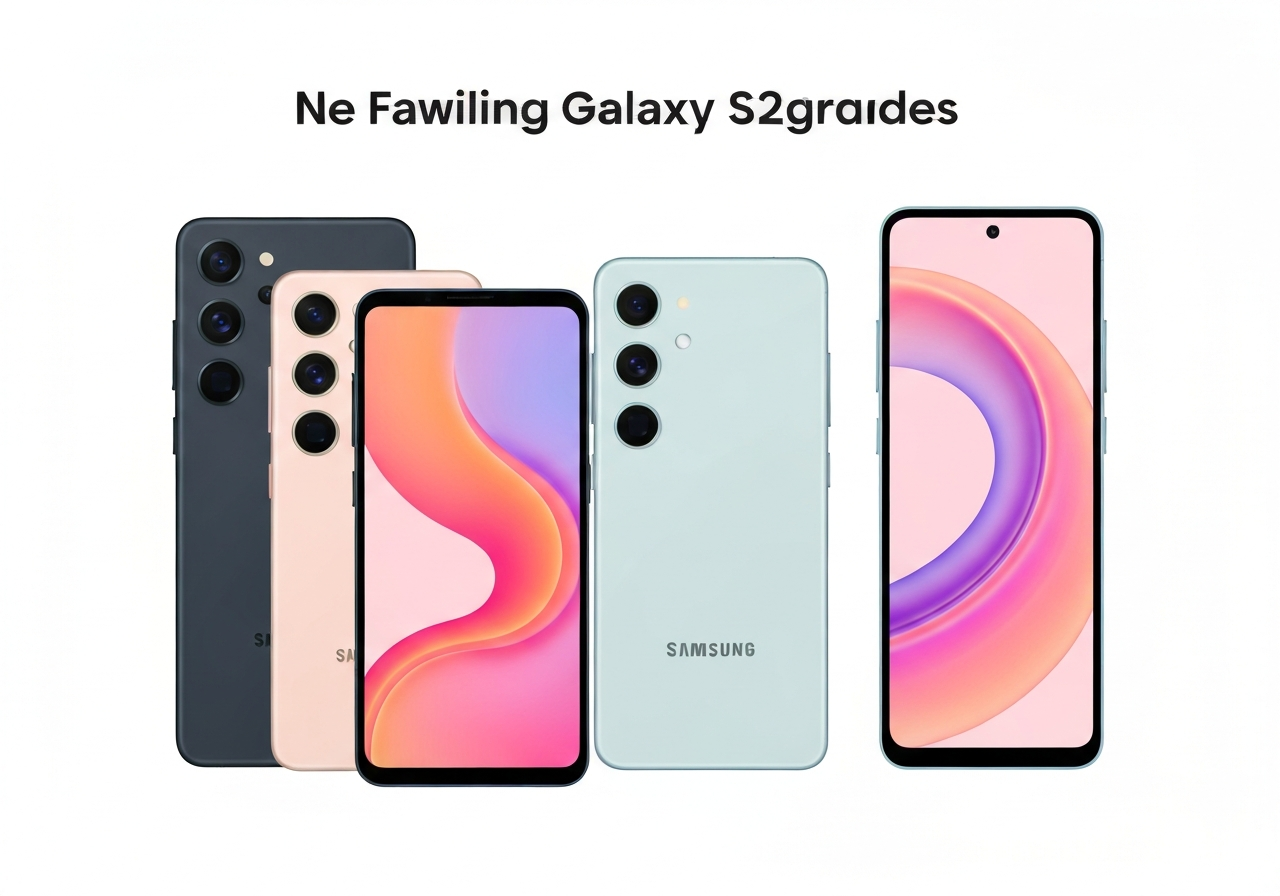
Lead
Samsung’s Galaxy S26 and S26 Plus arrive in 2026 with incremental hardware tweaks rather than headline-making features. Launched globally alongside the larger S26 Ultra, the two smaller models keep the same basic design language and camera hardware while adding modest battery and charging improvements. The 6.3-inch S26 starts at $899 for 256GB and the 6.7-inch S26 Plus is $200 higher; both carry a roughly $100 price increase versus last year. For most owners of S23–S25 phones, the S26 pair offer safer refinements than reasons to upgrade.
Key Takeaways
- The S26 (6.3″) starts at $899 with 256GB, the S26 Plus (6.7″) is $1,099 — each roughly $100 more than last year’s equivalents.
- The S26 gains a 4,300mAh battery (up 300mAh from the S25); the S26 Plus uses a 4,900mAh cell and supports faster wired (45W) and 20W wireless charging.
- Neither smaller model includes Samsung’s new privacy display; the Ultra retains that feature and the S Pen option.
- Chipsets vary by market: Snapdragon 8 Elite Gen 5 in the US, Exynos 2600 in many other regions; the Ultra uses Snapdragon globally.
- Camera hardware is unchanged from recent years: 50MP main, 10MP telephoto (3x), 12MP ultrawide, 12MP selfie — image processing remains conservative.
- Qi2 magnetic charging magnets are not built into the phones; Samsung recommends magnet-equipped cases instead.
- New AI and software features include expanded Circle to Search, Gemini agent integrations (pending rollout), improved call screening, natural-language photo edits, and an updated Bixby.
- Samsung promises seven years of software updates for both phones.
Background
Samsung has pursued aggressive hardware differentiation in its foldable and flip lines over recent years, but the Galaxy S series has largely evolved via iterative spec bumps rather than radical redesigns. The S26 family follows that pattern: Samsung focused headline upgrades on the Ultra model (privacy display, improved cameras and S Pen), leaving the two smaller phones closer to their immediate predecessors. Market competition has intensified, with rivals like Google and Xiaomi introducing new magnetic Qi2 charging standards and aggressively tuned camera systems.
Pricing and configuration choices reflect market positioning and supply decisions. Samsung removed the 128GB base tier for the S26, so the 256GB S26 now starts at $899 — about $40 more than the 256GB S25 — while the larger S26 Plus is $200 above the S26. At the same time, Samsung commits to long software support, promising seven years of updates for both models, a response to consumer demand for longevity in flagship devices.
Main Event
Physically, the S26 and S26 Plus retain the straight-edged frame and corner camera cluster familiar from recent Galaxy models, but the rear sensors now sit on a raised oval island similar to the Galaxy Z Fold 7. The change is subtle: the devices feel familiar in hand, with the S26 still among the smaller mainstream flagships at 6.3 inches, 167g, and 7.2mm thin. Compared with the S25 the S26’s display is fractionally larger (6.3″ vs 6.2″), producing a modest increase in height and weight.
Battery and charging are the clearest hardware differences between the two phones. The S26 uses a 4,300mAh cell (300mAh larger than the S25), and Samsung says it delivers full-day endurance under typical mixed use; the S26 Plus uses a 4,900mAh cell and supports faster wired charging (45W versus the S26’s 25W) and 20W wireless charging (versus 15W on the S26). Samsung declined to build Qi2 magnetic coils into the phones themselves, preferring thinner chassis and advising buyers to use magnetized cases if they want magnetic charging accessories.
Performance varies by region because Samsung ships different SoCs: US handsets use Qualcomm’s Snapdragon 8 Elite Gen 5, while most other markets receive Samsung’s Exynos 2600. In daily use the Exynos version reviewed in the UK handled frame rates, multitasking, and battery life acceptably, but the split-sourcing strategy continues to be a talking point among buyers and reviewers. Display hardware is substantially the same as last year’s S models and lacks the Ultra’s privacy layer.
Samsung has not upgraded the cameras this cycle: the primary system remains a 50MP f/1.8 main with OIS, a 10MP f/2.4 3x telephoto with OIS, a 12MP f/2.2 ultrawide, and a 12MP selfie with autofocus. Image processing continues to favor consistent exposure and conservative sharpening; daytime photos are generally pleasing while low-light and highlight handling can look overprocessed or artificially smoothed. A notable video improvement is horizontal lock stabilization — an aggressive stabilization mode that keeps footage nearly level during complex motion, capped at QHD and supported on both rear lenses.
Analysis & Implications
Samsung’s strategy with the S26 pair signals a deliberate product cadence: prioritize major experimental features on one flagship (the Ultra) while keeping the mainstream S line evolutionary. That reduces risk for mainstream buyers, preserves component commonality, and allows Samsung to introduce premium features (privacy displays, S Pen support) where they can command higher margins. But it also creates a perception problem: when rivals introduce visible new standards (Qi2 magnets) or stronger per-pixel camera hardware, Samsung’s conservative updates can feel behind the curve to some buyers.
Price increases matter. With both S26 models landing around $100 more than the previous generation, the value proposition depends heavily on what a buyer sacrifices. Owners of S23–S25 phones gain little compelling hardware-wise: the S26’s larger battery and minor charging upgrades are useful but not transformative. Meanwhile, competitors have narrowed gaps in software experience and camera performance, making brand loyalty and ecosystem integration larger purchase drivers than raw specs alone.
The market impact will be regional. In the US, where Samsung ships Snapdragon silicon, performance headlines are easier to make; in other markets the Exynos chips continue to fuel debate. Longer-term, Samsung’s emphasis on multi-year software support and incremental feature rollouts aims to lock customers into the Galaxy ecosystem, but that also raises expectations that the S line should occasionally deliver standout, category-defining features — something the S26 pair largely does not provide.
Comparison & Data
| Model | Display | Battery | Wireless (phone) | Starting price (256GB) |
|---|---|---|---|---|
| S25 (reference) | 6.2″ | 4,000mAh | 15W | $859 (256GB) |
| S26 | 6.3″ | 4,300mAh | 15W | $899 (256GB) |
| S26 Plus | 6.7″ | 4,900mAh | 20W | $1,099 (256GB) |
The table summarizes the clearest numerical differences: modest display growth, a 300mAh battery increase for the base model, and a larger battery plus faster charging for the Plus. The S26 family’s price step-up and the removal of a 128GB entry SKU are responsible for much of the headline cost increase compared with the prior model.
Reactions & Quotes
“The two smaller S26 phones deliver incremental gains but lack a single standout hardware innovation.”
Review analysis (independent reviewer)
This summary reflects the central critique from reviewers who note the unchanged camera hardware and absence of in-body Qi2 support. It captures consumer-facing concerns: modest improvements, higher prices, and many features concentrated in the Ultra model.
“Samsung recommends magnet-equipped cases rather than embedding Qi2 magnets in the phone to keep thickness down.”
Samsung (official guidance)
Samsung’s messaging frames the company’s design decision as a trade-off between device thinness and accessory-based magnetic charging — a choice that shifts the burden of Qi2 adoption to accessory makers.
“The Exynos 2600 delivers competent daily performance outside the US, though chip sourcing remains a regional differentiator.”
Industry performance summary
That succinctly notes the practical outcome: users in markets with Exynos silicon should expect solid day-to-day use, but comparisons with Snapdragon-equipped units will continue to shape perceptions.
Unconfirmed
- The exact timetable for Gemini agent features to reach all sold S26/S26 Plus units is not yet public and may vary by region and carrier.
- Long-term camera improvements via software updates are possible but not guaranteed; Samsung has not published a detailed roadmap for major imaging enhancements.
- Accessory makers’ adoption rate of Qi2 magnetized cases that Samsung recommends is unknown and will affect the practical utility of magnet-based charging for buyers.
Bottom Line
The Galaxy S26 and S26 Plus are competent flagship phones that prioritize incremental refinement over breakthrough innovation. They bring modest battery gains, a small display size increase for the S26, region-dependent chipset choices, and more AI features arriving via software — but they reuse camera hardware and omit built-in Qi2 magnets, which will disappoint users seeking more visible upgrades.
For owners of very recent Samsung S-series phones (S23–S25), there is little technical urgency to upgrade. Buyers deciding between the standard and Plus models should weigh battery and charging needs against the price difference, and those seeking standout features or camera leadership may find the S26 Ultra, competing phones from other vendors, or waiting for the next cycle more compelling.