
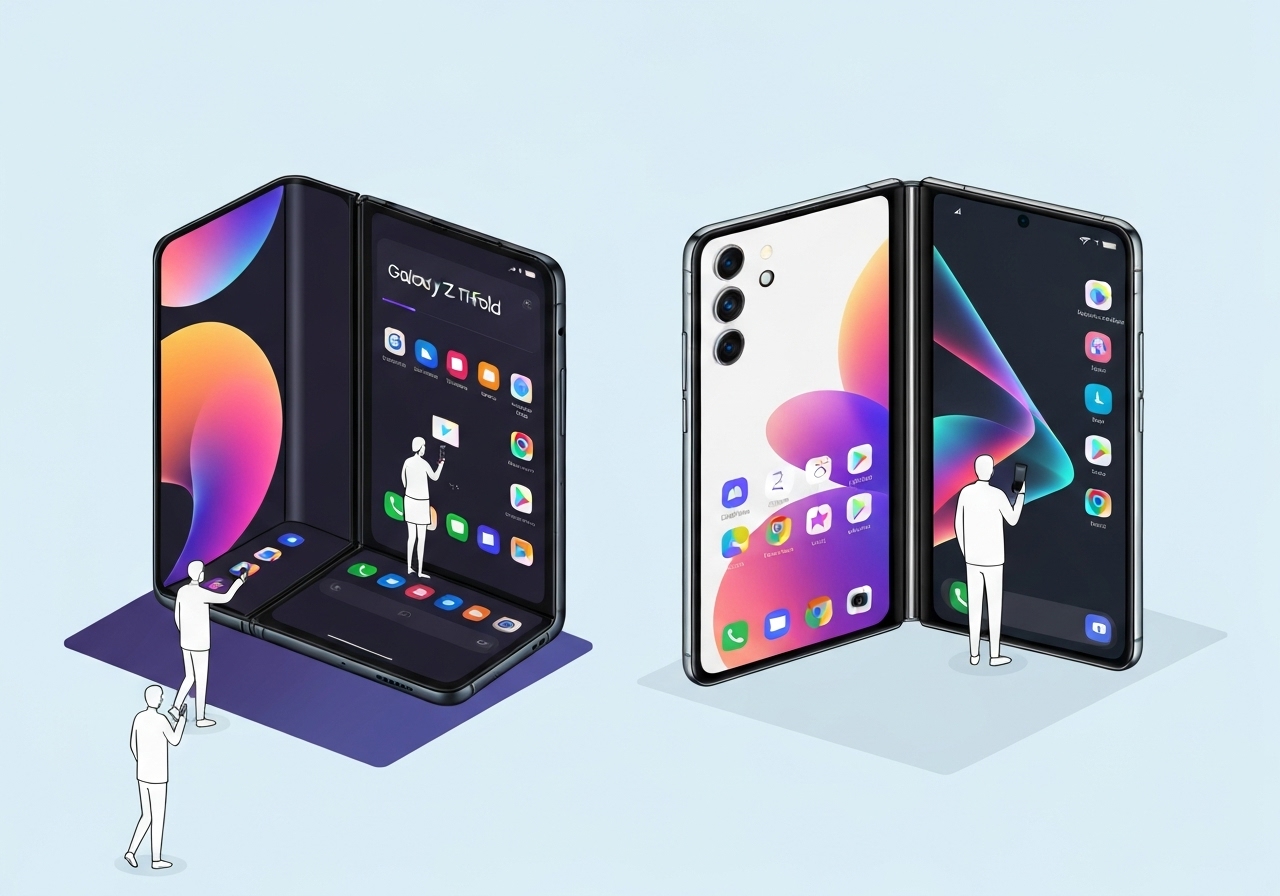
Since Huawei expanded the Mate XT Ultimate beyond China in February 2025 and Samsung revealed the Galaxy Z TriFold at the APEC CEO Summit last October, both companies have pushed the idea of a three‑panel foldable. I tested the Mate XT intermittently since February and later handled Samsung’s TriFold during a brief hands‑on session in Dubai; each device yields a distinct user experience. Industry watchers including IDC forecast foldable sales to grow about 30% year‑over‑year in 2026, raising the stakes for differentiation. This piece compares design, screens, performance, cameras and practical use to show where each trifold shines and where trade‑offs remain.
Key takeaways
- Huawei brought the Mate XT Ultimate to global markets in February 2025; Samsung showcased the Galaxy Z TriFold at APEC in October 2024 and launched it thereafter.
- Both phones use two hinges to create three usable panels, but Huawei’s single flexible display folds in a Z shape for three intermediate modes while Samsung’s TriFold folds inward in a U shape and offers full open or closed modes only.
- Display specs differ: Mate XT uses a single 10.2″ OLED at 90Hz and 382 ppi; TriFold offers a 6.5″ cover AMOLED (1–120Hz, 422 ppi) and a 10.0″ internal AMOLED (1–120Hz, 269 ppi).
- Both pack 16GB RAM, 512GB/1TB storage options and a 5,600‑mAh battery; Samsung runs Android 16 with One UI 8 and promises seven years of updates, Huawei ships EMUI 14.2/HarmonyOS and lacks Google services by default.
- Camera hardware differs markedly: TriFold uses a 200MP main plus 12MP ultrawide and 10MP 3x telephoto; Mate XT ships a 50MP main with a 12MP 5.5x periscope telephoto and 12MP ultrawide.
- Physical feel contrasts: Mate XT is slimmer (3.6mm thinnest unfolded) and lighter (298g) with faux‑leather accents and IPX8 water resistance; TriFold is 309g, carbon‑fiber finish and rated IP48 for limited dust and water protection.
- Creases are present on both but feel and visibility differ: Samsung’s folding surfaces felt smoother to touch in my brief handling, while Huawei’s crease is deeper but not intrusive for daily use.
Background
The move from dual‑fold to tri‑panel designs is the latest phase in the foldable phone evolution. Manufacturers have been experimenting with hinges and flexible displays to balance durability, pocketability and larger screen real estate. Huawei’s Mate XT Ultimate is widely credited as the category pioneer for bringing a “trifold” concept to market in 2024 and opening global sales in February 2025.
Samsung followed with the Galaxy Z TriFold, showcased publicly at the APEC CEO Summit in October 2024 and later released as its first commercial trifold. While both devices advertise three panels, their engineering choices—single continuous flexible OLED versus stacked panels with different hinge tensions—reflect distinct product philosophies: one prioritizes intermediate modes and cinematic aspect ratios, the other emphasizes protection of the soft display and a familiar cover‑display experience.
Main event
Design is the most immediately obvious difference. Huawei’s Mate XT uses one continuous 10.2″ flexible OLED that folds into a Z configuration so the device can function as a compact phone (fully closed), a mini‑tablet (one fold), or a widescreen tablet (fully open). That flexibility led me to rely often on the mini‑tablet mode and to keep the phone folded shut mainly when making calls.
Samsung’s Galaxy Z TriFold, by contrast, employs three distinct panels and two hinges that fold inward, creating a U‑shaped stack. The TriFold is effectively usable as a phone when closed and as a tablet when fully opened, but it lacks the stable one‑fold mini‑tablet mode Huawei offers. Samsung’s approach protects the inner soft display by keeping it enclosed when folded.
Hinge execution diverges too. The TriFold uses two different hinge assemblies—one tighter hinge similar to the Fold 7 on the left and a wider spring‑biased hinge on the right that opens after a tactile threshold—so panels tuck cleanly atop each other. Huawei’s Z‑fold exposes part of the flexible screen when folded; the company bundles a case with an extended lip to shield that exposed edge.
In hands‑on use, Samsung’s folding seams felt smoother under a fingertip and the TriFold’s exposed lip on the closed device made unfolding easier. Huawei’s creases were more pronounced but did not affect day‑to‑day interactions. Both phones show creases under extreme lighting angles.
Analysis & implications
These two engineering philosophies position the devices for different buyers. Huawei’s Z‑fold design intentionally creates three distinct form factors that can replace both a phone and a compact tablet for users who bounce between media consumption and one‑handed tasks. That versatility may appeal to multitaskers who value intermediate screen sizes and a wider full‑screen aspect ratio for video.
Samsung’s inward‑fold TriFold emphasizes protection, conventional cover‑screen usability and integration with the Galaxy ecosystem—One UI 8, Galaxy AI features and a longer formal update commitment (seven years). For users who prioritize software continuity, access to Google services and long OS support, the TriFold presents a lower friction option.
On imaging, Samsung’s 200MP main sensor and telephoto array suggest stronger versatility across shooting scenarios, especially when combined with Samsung’s image processing. Huawei’s optical telephoto reach (5.5x periscope) is a distinctive advantage for long‑distance shots, and its portrait rendering can have strengths, though earlier models sometimes overprocess skin tones.
From a market perspective, IDC’s estimate of ~30% YoY growth in foldable sales for 2026 (industry analyst projection) implies both firms must carve clear use cases. Huawei’s model trades some screen protection for more modes and a cinematic ratio, while Samsung trades the mini‑tablet mode for better durability and ecosystem features. These choices will influence carrier partnerships, accessory ecosystems and buyer guidance.
Comparison & data
| Spec | Galaxy Z TriFold | Huawei Mate XT Ultimate |
|---|---|---|
| Cover display | 6.5″ AMOLED, 2520×1080, 1–120Hz | — |
| Internal display | 10.0″ AMOLED, 2160×1584, 1–120Hz (269 ppi) | 10.2″ OLED, 3184×2232, 90Hz (382 ppi) |
| Weight | 309 g | 298 g |
| Battery | 5,600 mAh; 45W wired; Qi wireless | 5,600 mAh; 66W wired; 50W wireless |
| SoC | Snapdragon 8 Elite for Galaxy | Kirin 9010 |
| Cameras | 200MP main; 12MP ultrawide; 10MP 3x telephoto | 50MP main; 12MP ultrawide; 12MP 5.5x telephoto |
| OS | Android 16, One UI 8 | HarmonyOS 4.2 / EMUI 14.2 (global) |
The table highlights where each device concentrates its strengths: Samsung on raw imaging sensor resolution, software features and a protected inner screen; Huawei on an uninterrupted flexible panel with higher internal pixel density and a long‑reach telephoto module. These engineering trade‑offs help explain real‑world differences in media playback, multitasking and photography.
Reactions & quotes
“We designed the TriFold to protect the main folding surface while delivering a familiar Galaxy experience with extended software support,” Samsung representatives said regarding hinge strategy and software promises.
Samsung (official statement)
“Our Z‑fold aims to give users three genuinely useful forms — phone, mini‑tablet and full tablet — on a single continuous display,” Huawei said when discussing the Mate XT’s single‑panel design.
Huawei (official statement)
“Foldables are entering a growth phase, and diverse hinge approaches indicate manufacturers are still testing which use cases stick with consumers,” said an industry analyst about category trajectories.
Industry analyst (IDC, market comment)
Unconfirmed
- Long‑term durability comparisons between the two hinge designs remain unverified — public reviews are early and controlled stress‑test data is limited.
- Real‑world battery endurance under heavy multitasking or standalone DeX use for the TriFold requires extended testing beyond short hands‑on sessions.
- Camera processing differences (especially subjectively judged skin tones) are based on prior models and initial impressions; full side‑by‑side photo testing is pending.
Bottom line
Huawei’s Mate XT Ultimate and Samsung’s Galaxy Z TriFold both expand the foldable category but aim at different trade‑offs. If you want a single device that frequently toggles between phone, mini‑tablet and full tablet, Huawei’s Z‑fold offers the most flexible set of modes. If you prioritize a protected inner display, longer software support, seamless access to Google services and a more conventional cover‑screen experience, Samsung’s inward‑fold TriFold will feel more familiar and resilient.
For buyers, the decision narrows to which compromises matter most: three steady form factors and a higher internal pixel density versus guarded folding mechanics, a broader software feature set and seven years of updates. As the market grows (IDC projects ~30% YoY growth in 2026), both devices stake plausible claims—Huawei on versatility, Samsung on ecosystem and durability.