
Lead
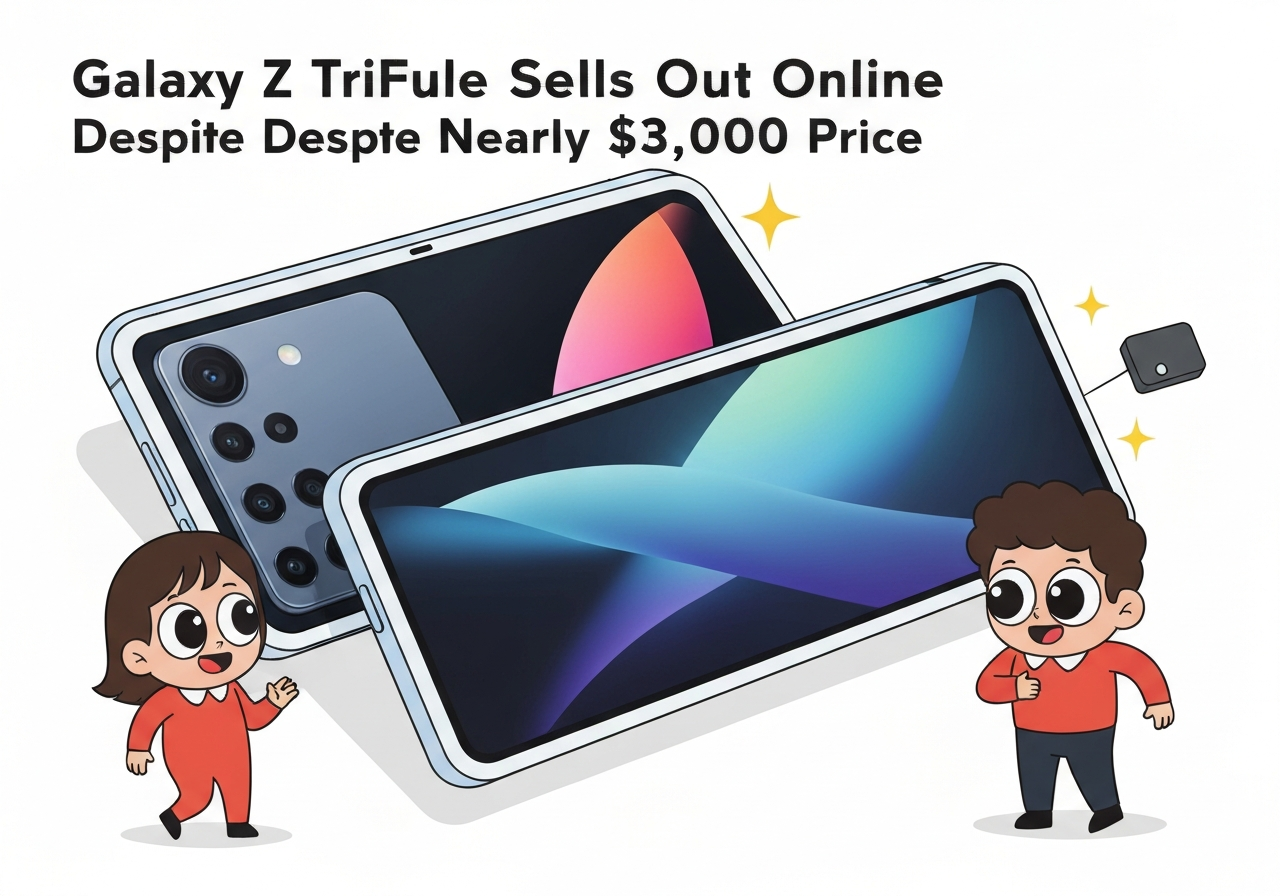
Samsung’s Galaxy Z TriFold went on sale in the U.S. on Jan. 30 and was snapped up within minutes despite a near-$3,000 sticker price. Early reports say the $2,900 device quickly showed as out of stock on Samsung’s website, with multiple shoppers logging in at launch. CNET reported that several customers attempted purchases but only one managed to complete an order during the initial window. Mashable and other outlets praised hands-on impressions, and Samsung’s product page currently lists the model as sold out with no firm restock date.
Key Takeaways
- The Galaxy Z TriFold launched in the U.S. on Jan. 30 and was listed as sold out on Samsung’s site within minutes.
- The device carries a $2,900 price — roughly $100 short of $3,000 — positioning it above most mainstream flagship phones.
- CNET reported multiple users logged in at launch but only one customer successfully completed an order in the first minutes.
- Samsung’s official product page shows the TriFold as out of stock and indicates a future restock without a specific timeframe.
- Early reviews from Mashable and other outlets were strongly positive; the TriFold was named among the Best of CES 2026 by the CNET Group.
- The rapid sellout highlights early-adopter appetite for premium foldable devices despite steep pricing.
Background
Samsung introduced the Galaxy Z TriFold at CES 2026 as its most ambitious foldable to date, marketing a display that folds twice to expand usable screen area. The device represents Samsung’s push to broaden the foldable market beyond single- and dual-fold designs by offering a tablet-like canvas that still fits a pocket. Foldable-phone development has been accelerating across the industry since mainstream launches in 2019 and 2020, with incremental improvements in durability, hinge design, and software optimization feeding consumer interest.
Historically, foldable devices have targeted premium buyers and early adopters, often carrying prices well above standard flagship phones. Samsung has treated the TriFold as a halo product, emphasizing unique functionality and multimedia use cases aimed at creators and professionals. Retail and carrier inventory strategies for such limited, high-margin launches typically prioritize controlled first runs, which can create rapid sellouts even when base demand is uncertain.
Main Event
On the morning of Jan. 30, the TriFold became available for purchase on Samsung’s U.S. storefront. Within minutes shoppers reported the listing flipping to “sold out.” CNET’s coverage noted multiple shoppers attempting to buy the phone at the instant of launch; sources in that report said just one transaction successfully completed in the initial wave. Samsung’s live product page likewise showed the device unavailable and referenced an upcoming restock without providing timing.
Media hands-on coverage from CES amplified early interest. Mashable’s reviewer Timothy Beck Werth singled out the TriFold as a standout at CES 2026, and the CNET Group collectively labeled it among the show’s top products. Those positive impressions appear to have translated into immediate purchase intent among a subset of buyers willing to pay a premium for the novel form factor.
Samsung has not published detailed inventory or sales figures for the launch, and the company provided no public schedule for when additional units will ship to consumers. Retailers and carriers have not announced broad availability plans, leaving prospective buyers reliant on Samsung’s store updates and potential future waves of stock or carrier promotions.
Analysis & Implications
The TriFold’s rapid sellout suggests strong latent demand among early adopters and enthusiasts for distinctive hardware experiences, even at prices approaching $3,000. For Samsung, a successful limited launch achieves multiple goals: validates the product concept, generates high-profile press, and establishes a price anchor at the top end of the smartphone market. That said, sellouts do not equal mass-market adoption; broader consumer uptake will depend on usability, durability, and perceived value relative to less expensive alternatives.
On the supply side, constrained initial inventory can both intensify demand and obscure longer-term sales trends. If Samsung intentionally limited the first run to manage risk and gather feedback, the sellout becomes a controlled success. Conversely, if supply shortfalls are logistical, consumers may face frustration and delayed adoption, which can damage momentum. The restock cadence and any software or hardware revisions will be critical for sustaining interest beyond early headlines.
Competitors are watching closely: a palatable reception to a tri-fold design could spur rivals to experiment with multi-fold formats or to accelerate investments in flexible display manufacturing. For carriers and accessory makers, a premium tri-fold phone presents new revenue opportunities but also technical challenges for cases, repairs, and network provisioning. Regulators and warranty providers will monitor long-term durability claims as more units reach consumers.
Comparison & Data
| Device/Category | Launch/Typical Price |
|---|---|
| Galaxy Z TriFold (Jan. 30, 2026) | $2,900 |
| Typical flagship smartphone | $800–$1,200 (range) |
| Earlier premium foldables (typical) | $1,000–$1,800 (range) |
The table contrasts the TriFold’s $2,900 launch price with common flagship and earlier foldable price ranges. While previous high-end foldables frequently entered the market between $1,000 and $1,800, the TriFold pushes well above that band, reflecting its unique form factor and positioning as a premium specialty device. Those gaps make the TriFold a clear outlier in price and, potentially, in target audience.
Reactions & Quotes
Media coverage and early buyer activity framed the launch as a test of premium demand.
“Sold out within minutes,”
CNET (media)
“Among the best tech I saw at CES,”
Timothy Beck Werth, Mashable (reviewer)
“Sold out”
Samsung product page (official)
Unconfirmed
- The precise number of units allocated to the initial U.S. sale has not been disclosed by Samsung.
- The claim that only a single buyer completed a purchase in the first minutes is based on CNET’s reporting and has not been independently confirmed by Samsung.
- Exact timing for a Samsung restock or broader carrier availability remains unspecified and unconfirmed.
Bottom Line
The Galaxy Z TriFold’s near-immediate sellout at a $2,900 price point highlights a willing segment of early adopters for cutting-edge foldable hardware. Positive critical response from outlets at CES 2026 helped fuel demand, but the device’s long-term success depends on wider availability, real-world durability, and software that justifies the premium for a broader audience.
For prospective buyers, the current outlook is wait-and-see: monitor Samsung’s product page and carrier announcements for restock details, and weigh hands-on reviews about daily practicality and repairability before committing. For the industry, the TriFold is a signal that expansive, multi-fold form factors can attract attention — and that manufacturers may continue to push the boundaries of flexible-display design.