
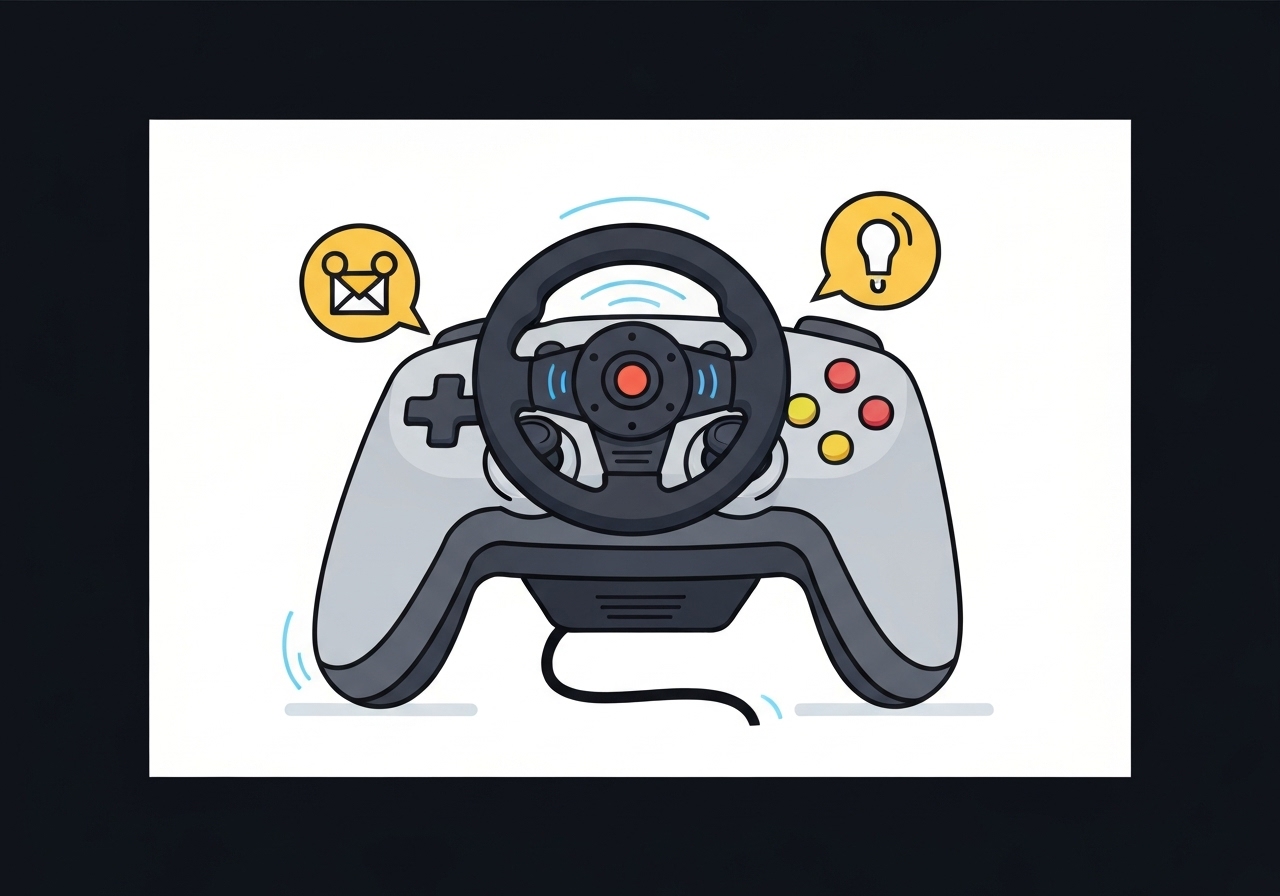
GameSir this week unveiled the Swift Drive, a handheld controller that places a small, removable steering wheel in its center and pairs it with what the company calls the “world’s smallest direct drive motor” to deliver force-feedback effects for racing games. The announcement, revealed alongside a larger Turbo Drive wheel system, arrives with detailed specs but no price or ship date yet. The Swift Drive uses high-precision Hall effect sensing with up to 65,000-step resolution, an adjustable 30–1,080° rotation range, and a mix of haptic motors for brake and slip simulation. Both products rely on 2.4GHz wireless links and include multi-hour battery estimates that vary by model and feature use.
Key Takeaways
- GameSir introduced the Swift Drive controller featuring a center-mounted removable steering wheel driven by a miniature direct-drive motor; pricing and availability have not been disclosed.
- The wheel encoder uses Hall effect sensing with up to 65,000 levels of resolution and offers adjustable rotation between 30° and 1,080° for different racing styles.
- Hall effect sensors are applied across joysticks and buttons; triggers include independent haptic motors intended to simulate ABS braking and wheel slip.
- Swift Drive connects over 2.4GHz wireless and, with RGB and active haptics, GameSir estimates 20–30 hours of battery life on a single charge.
- GameSir also revealed a Turbo Drive desk-mounted yoke-style wheel and pedal kit, notable for a built-in turbine fan that simulates airflow and yields 15 hours battery with the fan active, or up to 50 hours with it off.
- Both products emphasize customization — removable wheels, rotation limits and configurable controls — aimed at blending portability with simulation features.
Background
GameSir has spent recent years experimenting with nonstandard controller features to stand out in a crowded accessories market. Past products include the Tarantula Pro, which automatically swaps face-button labels to match different control schemes, and the Pocket 1, which clamps Game Boy–style inputs to a smartphone for retro-style play. That history frames the company’s latest push: adapting simulation-grade feedback into more compact, consumer-friendly formats.
The rise of accessible sim racing and the growth of cloud and console gaming have increased demand for varied steering solutions, from full-size rigs to compact controllers that still offer tactile feedback. Traditional sim wheels deliver high torque via large direct-drive motors and wired connections; GameSir’s approach attempts to approximate that sensation at a much smaller scale while preserving portability. Stakeholders include console and PC racers seeking more immersion, hardware competitors such as established wheel makers, and esports and streamers who value compact setups.
Main Event
GameSir detailed the Swift Drive’s core novelty: a tiny steering wheel mounted in the controller’s center that connects to a compact direct-drive motor. According to the company, the wheel’s encoder employs Hall effect sensing that reports up to 65,000 discrete positions for precise steering input. The wheel can be set to rotate anywhere from 30° for arcade-style play up to 1,080° to match real-world steering ranges, and users can swap in alternate wheel styles.
The Swift Drive extends Hall effect sensing to its joysticks and face buttons for contactless input detection, and its triggers incorporate individual haptic motors designed to emulate ABS braking pulses and wheel-slip sensations. GameSir says the controller talks to host systems over a 2.4GHz wireless link and supports reactive RGB lighting while still achieving an estimated 20–30 hours of battery life depending on settings and usage.
For users seeking a more traditional rig, GameSir also previewed the Turbo Drive: a desk-clamp yoke-style wheel and pedal set that shares Hall effect encoders, throttle controls and paddle shifters. The Turbo Drive’s standout hardware addition is a built-in turbine fan intended to simulate airflow and amplify speed cues; GameSir estimates roughly 15 hours of runtime with the fan engaged, extending to about 50 hours with it switched off.
Analysis & Implications
Introducing a direct-drive motor at this scale aims to bridge the gap between handheld controllers and full-size simulation wheels. If the Swift Drive’s motor can convey meaningful resistance and micro-corrections, it could materially boost immersion for console and portable racers without requiring a full cockpit. That said, physical torque and force characteristics are constrained by size and power; a micro direct-drive unit cannot reproduce the raw torque of desktop DD wheels used in professional sim rigs.
For consumers, the Swift Drive’s mix of Hall effect sensors and per-trigger haptics could reduce input wear and increase fidelity compared with traditional potentiometer-based controllers. Hall sensors are already favored in higher-end peripherals for their durability and precision, and applying them across inputs suggests GameSir is targeting longevity as well as accuracy. Wireless 2.4GHz links keep setups cable-free but raise questions about latency compared with wired USB or Bluetooth LE implementations preferred by some competitive players.
Market impact will depend heavily on price, cross-platform support and software integration. A competitively priced Swift Drive that works seamlessly on PC and consoles and offers driver/firmware updates could attract a broad segment of users who want more realistic feedback without investing in a desk-mounted rig. Conversely, a high price or limited compatibility would likely confine the product to enthusiasts rather than mainstream adoption.
Comparison & Data
| Feature | Swift Drive | Turbo Drive |
|---|---|---|
| Primary form | Handheld controller with center steering wheel | Desk-mounted yoke-style wheel + pedals |
| Encoder | Hall effect, up to 65,000 steps | Hall effect encoder(s) |
| Rotation range | 30°–1,080° adjustable | Configurable (user limit) |
| Force feedback | Mini direct-drive motor (micro DD) | Motorized wheel; turbine fan for airflow |
| Wireless | 2.4GHz | 2.4GHz |
| Battery life (est.) | 20–30 hours | 15 hours (fan on) / 50 hours (fan off) |
The table highlights how GameSir is offering two tiers: a portable hybrid in the Swift Drive and a more immersive desk setup in the Turbo Drive. Battery estimates and rotational limits are central selling points and reflect trade-offs between portability and sustained, high-fidelity feedback.
Reactions & Quotes
GameSir framed the Swift Drive as an attempt to miniaturize simulation sensations for a wider audience, emphasizing encoder precision and replaceable wheels. The company stressed configurability and multi-hour battery life as selling points while noting that pricing and shipping dates remain pending.
“We built a compact direct-drive solution with high-resolution Hall sensing to bring meaningful feedback to handheld play,”
GameSir (company announcement)
Industry observers welcomed the idea of more accessible force feedback but cautioned that raw torque and latency will determine real-world performance. Several sim-racing content creators and peripheral makers said they were curious about actual force metrics and cross-platform drivers before judging how disruptive the products will be.
“If the micro direct-drive can convey nuanced forces without noticeable lag, it could be a game-changer for console racers — but the devil is in torque and latency numbers,”
Independent sim-racing analyst
Unconfirmed
- Exact torque output and force-profile curves for the Swift Drive’s micro direct-drive motor have not been published by GameSir and remain unverified.
- Full cross-platform compatibility (specific console support, PC driver availability) and latency benchmarks for the 2.4GHz connection have not been independently confirmed.
- Final retail price and official launch date for both Swift Drive and Turbo Drive are still pending disclosure by GameSir.
Bottom Line
GameSir’s Swift Drive and Turbo Drive represent a clear attempt to broaden access to force-feedback sensations by applying precision encoders, targeted haptics and a compact direct-drive motor. The Swift Drive is notable for blending portability with simulation-style controls, while the Turbo Drive targets desk-based users seeking extra immersion via a turbine fan and traditional pedal set.
Whether these products change the market will depend on price, real-world torque and latency performance, and software support across platforms. Watch for hands-on reviews and independent measurements of force and responsiveness when units ship; those metrics will determine whether GameSir has delivered a meaningful technical advance or an interesting but niche novelty.