
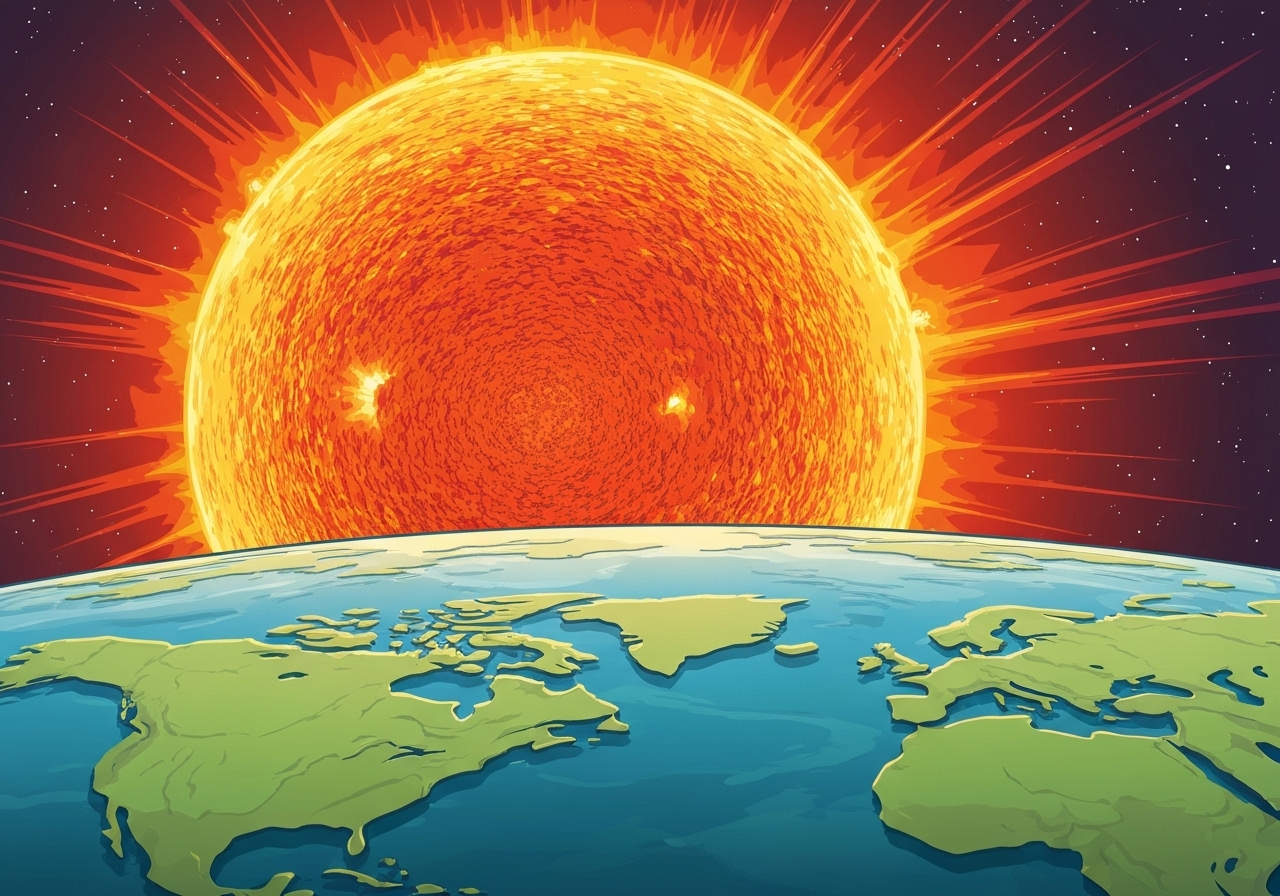
A massive sunspot complex labeled AR 4294–4296 has rotated into view on the Sun’s Earth-facing hemisphere and is currently pointed toward our planet. First seen by NASA’s Perseverance rover on the Sun’s far side about a week before it crossed into view, the group’s dark area measures roughly 90% of the size of the 1859 Carrington sunspot that spawned the largest recorded solar storm. Scientists say powerful flares and geomagnetic effects are possible over the coming days, but there is no clear evidence yet that a Carrington-scale event is imminent.
Key Takeaways
- AR 4294–4296 appeared on the Sun’s western limb on Nov. 28 after earlier detection from Mars-based Perseverance about a week prior.
- The combined dark area of the complex is about 90% the size of the 1859 Carrington sunspot that produced an estimated X45-class flare.
- The group is among the largest observed in the past decade and has magnetic complexity that can produce X-class flares; a candidate X-class flare was recorded while the complex was on the Sun’s far side.
- A Carrington-scale impact today would likely disable most satellites and could cause ground infrastructure damage estimated to exceed $1 trillion (current estimates vary by model).
- 2024 has seen an unusually active Sun: it recorded the highest number of X-class flares in a year since records began in 1996 and produced a severe G4 geomagnetic storm on Nov. 11–12.
- Sunspot size increases the potential for strong flares, but magnetic configuration and eruption timing determine actual impact—large groups can remain inactive during a transit.
Background
Sunspots are regions of concentrated magnetic field on the solar surface that appear dark because they are cooler than their surroundings. When magnetic field lines become twisted and reconnect, they can release energy as solar flares and launch coronal mass ejections (CMEs), which may interact with Earth’s magnetosphere to produce geomagnetic storms and auroras.
The Carrington Event of September 1859 is the historical benchmark: British astronomer Richard Carrington observed a very large sunspot and a contemporaneous flare that led to global auroras and telegraph disruptions. Modern simulations suggest a similar flare today could disrupt satellites and electrical grids on a massive scale.
The Sun is currently near the peak of its ~11-year solar cycle (solar maximum), a period that elevates the frequency of large sunspots and energetic flares. 2024 in particular has been active, with several X-class flares and multiple geomagnetic disturbances recorded by monitoring agencies.
Main Event
Observers cataloged the sunspot complex as AR 4294–4296; it comprises at least two magnetically linked groups. The feature first rotated onto the Sun’s visible hemisphere on Nov. 28, though NASA’s Perseverance rover imaged it from Mars when it remained on the Sun’s far side roughly a week earlier.
Initial analysis shows the total dark area of AR 4294–4296 is about 90% of the Carrington sunspot’s surface coverage. Visual comparisons circulated on Dec. 2 show the new complex appearing larger at first glance, but area measurements reduce that estimate to the ~90% figure.
Spaceweather observers reported a candidate X-class flare from the complex while it was on the Sun’s far side, indicating the group is already capable of major energy releases. Agencies continue to monitor magnetic field topology because entangled fields raise the probability of significant flares and CMEs.
If AR 4294–4296 produces an Earth-directed CME, forecasters say the storm would be geoeffective—meaning it could disturb Earth’s magnetosphere. Possible short-term effects include enhanced auroras at mid-to-low latitudes, temporary radio blackouts, and increased risk to satellites and high-frequency communications.
Analysis & Implications
Size alone does not determine a sunspot’s destructive potential. While larger groups can contain more stored magnetic energy, the orientation of the magnetic field and whether eruptions are CME-producing are decisive. A Carrington-scale outcome requires both an extreme flare and a CME whose magnetic field aligns to couple strongly with Earth’s magnetosphere.
Operational systems are more vulnerable now than in 1859 because society depends heavily on satellites for navigation, communications, and financial systems, and power grids are more interdependent. Models suggest a direct Carrington-class hit could severely degrade satellite constellations and damage high-voltage transformers on the ground, with economic exposure quantified in the trillions in some studies.
Short-term monitoring by NOAA-affiliated space weather centers and NASA assets will focus on AR 4294–4296’s magnetic complexity and any fast, Earth-directed CMEs. If the cluster rotates past without major eruptions, it could survive multiple solar rotations and return near the end of the year, prolonging the period of heightened risk.
Comparison & Data
| Event/Feature | Representative Measure | Date |
|---|---|---|
| Carrington sunspot | Reference area (historic sketch), produced estimated X45 flare | Sept. 1859 |
| AR 4294–4296 | ~90% of Carrington sunspot area; Far-side X-class candidate flare | First seen by Perseverance ~late Nov. 2025; visible Nov. 28 |
| Recent large flare for context | X7 flare (Oct. 2024) | Oct. 2024 |
| May 2024 superstorm reference | Sunspot >15× Earth width | May 2024 |
The table positions AR 4294–4296 relative to historical and recent events to give scale and context. Area comparisons are approximate because historic records rely on drawings while modern data use calibrated imagery. Timing and flare class are firm where agencies reported them; impacts depend on CME arrival and magnetic orientation.
Reactions & Quotes
“The group is large and magnetically complex; it has the potential for X-class activity that could be geoeffective if the geometry is favorable.”
Spaceweather.com representative
Spaceweather analysts emphasized the group’s size and magnetic entanglement, noting prior far-side activity. They caution that while X-class flares are possible, a Carrington-scale chain of events requires several conditions to align.
“We are closely monitoring the region; there is no immediate sign of a Carrington-level superstorm, but the situation is dynamic and could change within days.”
NOAA/SWPC forecaster (paraphrased)
Forecasters with operational space weather centers reiterated that continuous observations are essential to refine impact probabilities and to provide warnings to satellite operators and grid managers.
Unconfirmed
- Whether AR 4294–4296 will produce a Carrington-scale flare is unknown; current observations do not confirm such an outcome.
- Estimates that a Carrington-level event would knock out every satellite are model-dependent and vary by satellite shielding and orbital parameters.
- Exact economic damage figures for a hypothetical Carrington-class impact exceed $1 trillion in some studies, but precise totals depend on mitigation and recovery measures.
Bottom Line
AR 4294–4296 is a large, magnetically active sunspot complex now facing Earth and capable of producing powerful flares and geoeffective CMEs. Given its size and complexity, the region warrants continued monitoring by NASA, NOAA and independent observers over the coming days and weeks.
However, current assessments do not indicate an imminent Carrington-scale catastrophe. Preparedness measures—such as satellite operators reviewing safe modes and grid managers checking resilience plans—remain prudent steps during this period of elevated solar activity.
Sources
- Live Science (news report summarizing observations and expert commentary)
- NASA — Perseverance mission (official NASA mission page; Perseverance imagery and observations)
- NOAA Space Weather Prediction Center (SWPC) (official operational forecasts and alerts)
- Spaceweather.com (specialist observational site reporting sunspot imagery and activity)