
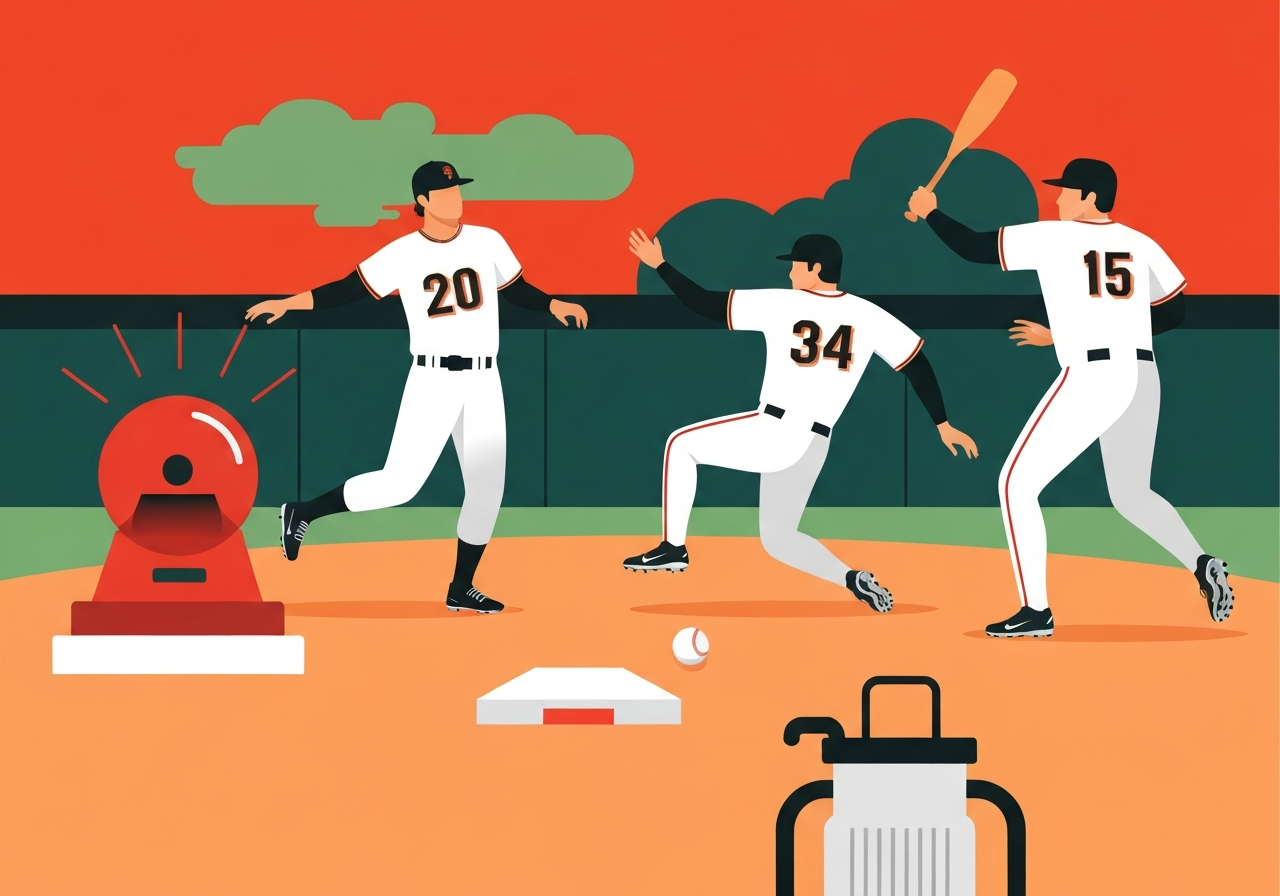
In Scottsdale, Ariz., on Sunday, Feb. 22, 2026, a spring-training inning unfolded into one of the strangest triple plays in modern major-league memory. With a smoke alarm blaring and recorded evacuation instructions playing in the ballpark, San Francisco left-hander Robbie Ray faced three batters, issued two walks and yielded a single — and yet the inning ended with three outs. The final out came when veteran third baseman Matt Chapman tagged Chicago Cubs runner Matt Shaw after confusion around third base produced an unusual 4-3-6-5 scoring sequence.
Key takeaways
- Location and date: The game occurred in Scottsdale, Arizona, on Sunday, Feb. 22, 2026, during Cactus League spring training.
- Unusual sequence: Robbie Ray faced three batters, allowed two walks and one single, but the inning concluded as a triple play scored 4-3-6-5.
- Players involved: The defensive sequence involved Rafael Devers, Willy Adames, Matt Chapman and others; the offensive confusion centered on Matt Shaw and Alex Bregman.
- Distraction factor: A smoke alarm, reportedly triggered by a fan smoking in a restroom, produced stadium evacuation announcements while play continued.
- Rarity: The Society for American Baseball Research notes no regular-season triple plays began with a base hit, making this spring-training sequence unusually novel.
- Umpires and calls: The third-base umpire ruled Bregman out as the trail runner and initially called Shaw safe before Chapman applied the tag.
- Managerial context: Tony Vitello, new to managing in spring training, watched a chaotic inning that highlighted his infielders’ awareness.
Background
Spring training games are designed to prepare players and coaches for the regular season, offering reps in live settings without affecting regular-season statistics. Managers often use Cactus League and Grapefruit League contests to evaluate veterans, rookies and position changes; Tony Vitello was managing in this spring-training environment for the first time with the Giants. Matt Chapman, a five-time Gold Glove winner with two Platinum Glove distinctions, entered the day as a defensively decorated third baseman who had never been part of a triple play as a defensive participant.
Triple plays are rare events during regular-season play and are cataloged by researchers at organizations such as the Society for American Baseball Research (SABR). Standard defensive numbering (1–9) and established scoring conventions are used to record outs; the game’s 4-3-6-5 notation reflects an atypical path through the infield. Spring training’s looser rosters and situational practice can produce unusual outcomes, but the combination of a stadium alarm and clustered baserunners pushed this inning into genuinely exceptional territory.
Main event
The inning began with Robbie Ray walking Matt Shaw and then dealing with Alex Bregman at the plate while evacuation announcements were played over the PA system. Rays later yielded a bloop single to Seiya Suzuki that fell in right field; Luis Arráez fielded the ball on a short hop and threw it to Rafael Devers, who cut off the return to the infield. As the throw came back, base-running confusion unfolded: Bregman, running from first, did not stop at third as a lead/trail situation became muddled, and Shaw wound up near third as well.
Shortstop Willy Adames received Devers’ throw, tagged Suzuki for the second out and then turned toward third base where both Cubs runners were momentarily stationary. The third-base umpire emphatically called Bregman out as the trailing runner; the umpire initially ruled Shaw safe. Shaw then stepped off third base — either thinking the inning had ended or that play was paused — and began walking toward the dugout area toward base coach Quintin Berry.
Seeing Shaw move off the bag, Chapman applied a tag to complete the final out. The play was scored 4-3-6-5 and recorded as a triple play in a spring-training inning that had been punctuated by public-address directives about an alarm. Players and coaches described the scene as chaotic but praised the infielders’ heads-up reactions that turned confusion into a three-out frame.
Analysis & implications
At a basic level, the play underscores the value of experienced, situationally aware defenders in late-game — and unexpected — scenarios. Devers, Adames and Chapman each made split-second choices that converted a potentially disastrous sequence into a defensive victory; their positioning and instincts were decisive. For a team integrating a first-year manager like Vitello into spring routines, the episode also served as a reminder that leadership and infield communication matter when unusual circumstances arise.
For Robbie Ray, the inning will be recorded in scouting notes and memory rather than the official season ledger, because spring-training results are not counted toward regular-season statistics. Nonetheless, Ray himself said the alarms and visible evacuation rattled him mid-inning and that the sequence required him to refocus quickly. Such distractions can momentarily alter a pitcher’s rhythm; coaches often treat spring outings as opportunities to test a pitcher’s capacity to manage in-game interruptions.
From a broader perspective, the play generated attention because it combined an off-field disruption (the alarm) with a common spring-training ingredient — inexperienced baserunning — yielding a highly atypical result. Media and fans gravitate to oddities like this both for the novelty and for the instructive components: coaches will replay the sequence to emphasize baseline fundamentals like reading lead runners and maintaining awareness of live play, even amid external distractions.
Comparison & data
| Scoring Sequence | Position (Number) |
|---|---|
| 4 | Second base |
| 3 | First base |
| 6 | Shortstop |
| 5 | Third base |
This 4-3-6-5 notation is an unusual path because the play began with a base hit rather than a line-drive or grounder that was fielded and relayed in traditional fashion. SABR’s database — the standard research resource for unusual defensive plays — indicates that regular-season triple plays rarely, if ever, originate from a base hit in the way this spring play did, which helps explain why the moment drew immediate attention from researchers and broadcasters.
Reactions & quotes
“I’m looking up in the stands, and they’re funneling people out. I’m like, ‘We’re just gonna play through this?'”
Robbie Ray, Giants pitcher
“I mean, it was just kind of common sense at that point. He’s walking away, and I knew he was safe, so I just tagged him.”
Matt Chapman, Giants third baseman
“That was inexplicable … for Robbie. Now we can kind of laugh about it, but it was a dicey situation.”
Tony Vitello, Giants manager
Unconfirmed
- Whether Matt Shaw believed a timeout had been granted when he stepped off third base remains unverified; his intent has not been publicly clarified beyond game reporting.
- Initial media commentary suggested the alarm was triggered by a fan smoking in a restroom; stadium operations told umpires there was no danger, but a formal public incident report was not included in immediate game coverage.
- How this specific spring-training triple play will be treated in retrospective compilations or highlight reels is subject to editorial judgment and may be categorized differently by various record-keepers.
Bottom line
The inning in Scottsdale was a reminder that baseball’s routine can be abruptly upended by a mix of human error and unexpected distractions. For the Giants, the episode showcased infield veterans who reacted quickly and intelligently, preserving a scoreless frame despite auditory alarms and logistical confusion. For observers, it reinforced why spring training yields both teaching moments and memorable oddities that will be replayed and discussed long after the dates on the calendar.
Beyond the novelty, coaches will use the sequence as a practical lesson about situational awareness: even in low-stakes settings, maintaining focus, communicating effectively and following basic baserunning rules are essential. The play will live on as a quirky footnote to spring training 2026 — an inning where a trio of defensive heads-up plays turned chaos into a triple play.
Sources
- The New York Times — news report and game account
- Society for American Baseball Research (SABR) — historical triple-play database and research resource
- Andrew Baggarly (Bluesky) — local beat reporting and social updates