
Inside GM’s New Detroit Headquarters: Midcentury Design, Artifacts and Easter Eggs
Lead: On Jan. 6, 2026, General Motors opened a portion of its new world headquarters in downtown Detroit, a space that blends midcentury design cues with contemporary workplaces and visible artifacts from the automaker’s century-long history. The site, part of the Hudson’s Detroit development, places a 1963 Chevrolet K20 and a new Chevrolet Silverado EV as symbolic markers outside the building and carries those references through interior touches and historical objects. GM occupies four of the six office floors, roughly 200,000 square feet, and says the layout is intended to encourage collaboration for a post-pandemic workforce. Company leaders describe the new HQ as a cultural beacon that connects past design heritage with future product and workplace strategies.
Key Takeaways
- GM opened its new world headquarters space in Detroit on Jan. 6, 2026, showcasing artifacts such as a 1963 Chevrolet K20 and a Chevrolet Silverado EV outside the building.
- The automaker occupies four of six office floors, totaling roughly 200,000 square feet, down from its former footprint at the Renaissance Center.
- Design elements include a McCormick Speed Form wind-tunnel model, wallpaper featuring 300 patented technologies, and graphics spotlighting more than 49,000 patents granted since 1911.
- Interior features nod to culture: a decorative cassette-tape wall referencing over 78,000 songs that mention GM brands and custom cassette designs that honor executives.
- GM maintains a broad regional footprint: the Warren Technical Center spans 710 acres and houses more than 24,000 employees, while roughly 50,000 U.S. salaried staff are expected in-office Tuesday through Thursday.
- The new HQ is steps from the Renaissance Center, a 5.6-million-square-foot complex with a 700-foot center tower and four 500-foot towers that served as GM’s previous headquarters.
- A semi-public ground-floor showroom, event space, lounges, food services and a pickleball court are planned to support events and employee engagement.
Background
GM’s move to the Hudson’s Detroit development is both symbolic and practical. For decades the Renaissance Center, commonly called the RenCen, has been an anchor on the Detroit riverfront and GM’s most visible corporate address since it purchased the complex in 1996. The RenCen’s immense 5.6-million-square-foot footprint and fortress-like layout reflected a different era of corporate campus planning and organizational silos.
The new headquarters reduces GM’s downtown square footage substantially, consolidating executive and corporate functions into a compact footprint of roughly 200,000 square feet across four floors. The shift aligns with a broader corporate strategy to modernize workplace design after the pandemic and to create spaces that encourage people to gather for collaboration rather than to replicate pre-Covid assigned-desk models. Ownership and neighborhood context matter: Hudson’s Detroit is part of a redevelopment led by entities tied to Dan Gilbert, who has invested heavily in downtown Detroit properties in recent years.
Main Event
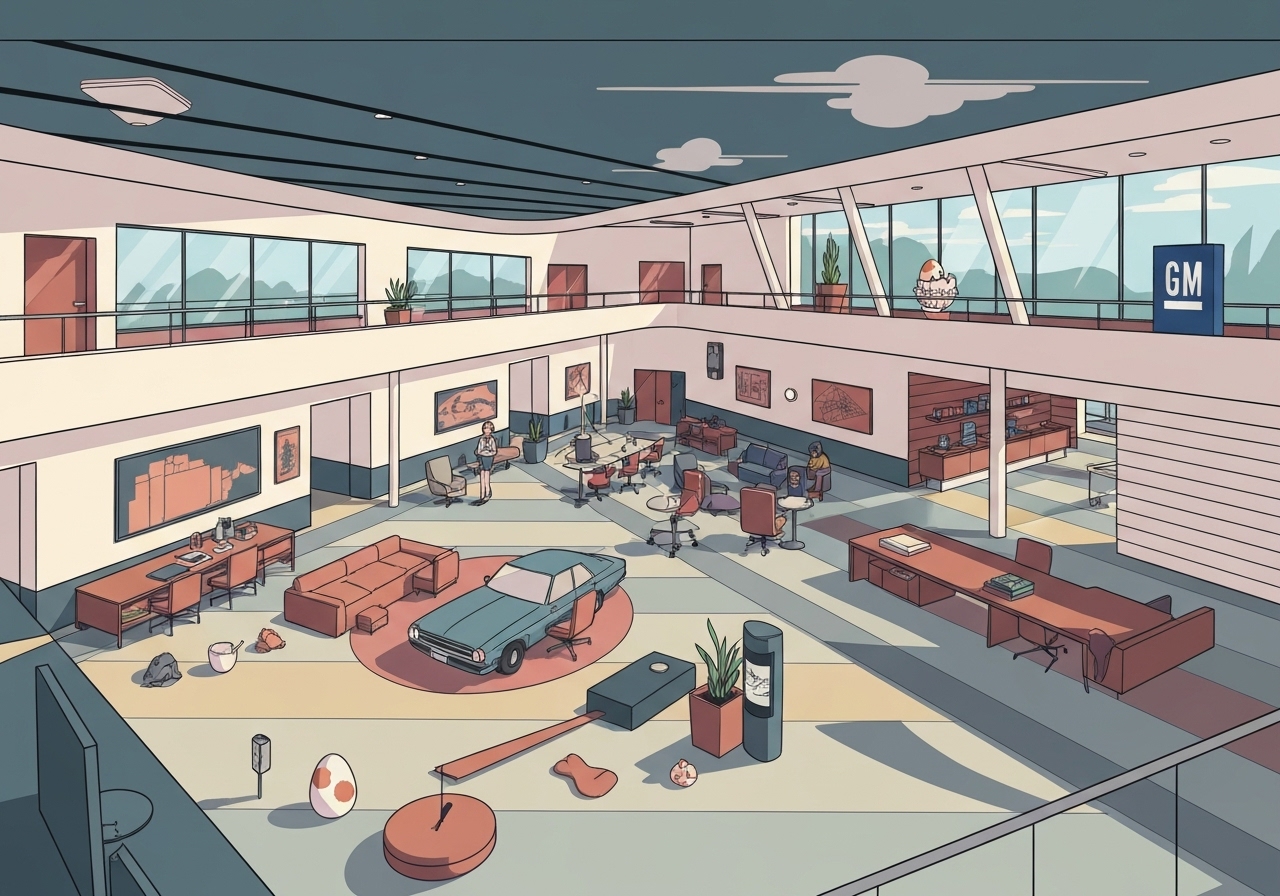
The public tour of GM’s new space highlights a deliberate interplay of historical objects and contemporary design. Outside the entrance, a 1963 Chevrolet K20 sits beside a Chevrolet Silverado EV; the juxtaposition is meant to physically signal continuity between GM’s legacy in internal combustion and its electric vehicle future. Inside, designers integrated artifacts such as the McCormick Speed Form, an aerodynamic wind-tunnel model from the Warren Technical Center, and an early map of GM’s proving grounds.
Designers also embedded more subtle references and ‘Easter eggs’ requested by leadership, according to Rebecca Waldmeir, GM industrial design architecture and experience manager. Those include wallpaper that lists 300 patented technologies, a wall of cassette tapes calling attention to GM’s cultural footprint, and cabinetry and finishes inspired by Eero Saarinen’s Global Technical Center. The executive floor largely consists of flexible offices—only four will be permanently assigned to top executives—while other suites are intended for rotational or on-demand use.
Amenities aim to support public and employee-facing activity: a semi-public showroom on the first floor will host events and display products, and on-site services range from cafés to collaboration lounges and a pickleball court. GM declined to provide precise headcount expectations for daily foot traffic and did not disclose financial details of its reported 15-year lease, saying usage will vary with priorities and workflows.
Operationally, the HQ complements rather than replaces GM’s extensive engineering and design campuses. The Warren Technical Center remains a 710-acre hub with more than 24,000 employees, underscoring that the downtown site is designed to be an urban presence and cultural touchpoint rather than a full-service industrial campus.
Analysis & Implications
Spatial downsizing reflects broader corporate recalibration about what a headquarters should signal. Moving from the RenCen’s multi-million-square-foot complex to a compact 200,000-square-foot presence reduces overhead and focuses the downtown site on executive visibility, culture-building and public engagement. The selective display of artifacts and patents indicates an intent to craft a narrative that links GM’s legacy innovations with its transition to electrification and software-driven vehicles.
Workplace policy changes reinforce that narrative: requiring salaried employees to be in-office Tuesday through Thursday suggests GM seeks predictable windows for collaboration while preserving some flexibility. Hybrid policies and shared executive offices align with industry trends where physical workplaces are designed as destinations for concentrated teamwork, product unveilings and partner meetings rather than for individual, 9-to-5 desk occupation.
There are strategic trade-offs. A smaller downtown footprint raises questions about symbolic presence versus operational capacity; GM appears to mitigate this by maintaining large suburban campuses for engineering, while using the downtown HQ to signal brand stories to media, investors and civic stakeholders. The public-facing showroom and event spaces position GM to more actively curate its public image in Detroit, potentially supporting recruiting and local economic activity.
Comparison & Data
| Site | Approx. Square Feet | Notable Features |
|---|---|---|
| GM new HQ (Hudson’s Detroit) | ~200,000 | Four of six floors occupied, showroom, executive floor, artifacts and patents display |
| Renaissance Center (former GM HQ) | 5.6 million | 700-foot center tower, historic downtown landmark, complex footprint |
| Ford Dearborn HQ | 2.1 million | Extensive dining (160,000 sq ft), design and product development facilities |
The data show GM prioritized a concentrated, curated urban presence while Ford invested in a much larger consolidated campus in Dearborn. GM’s choice reflects different physical footprints, historic assets and the automakers’ distinct regional networks of labs and design centers. The downtown HQ is intended to be a cultural touchpoint and event venue rather than the central node of day-to-day technical operations.
Reactions & Quotes
“Leadership asked when we were helping design the space to bring in some Easter eggs and details to represent who we are at GM, honoring our culture and our history and our innovation.”
Rebecca Waldmeir, GM industrial design architecture and experience manager (as reported to CNBC)
“A headquarters really should be, at some level, a beacon for the culture of the company. When you come in here, it should help people understand who we want to be.”
David Massaron, GM vice president of infrastructure and corporate citizenship (as reported to CNBC)
“The RenCen was designed in a different era, in a pre-Covid era where everybody went to work five days a week, everybody went to their desk.”
David Massaron (context: explaining the move and reduction in square footage)
Unconfirmed
- GM has not released precise daily headcount estimates for how many employees will work regularly at the downtown HQ beyond saying traffic will fluctuate.
- Financial terms of the reported 15-year lease were not disclosed by GM, and lease cost details remain unverified by public filings at the time of reporting.
Bottom Line
GM’s new Detroit headquarters is deliberately compact and heavily curated: it scales down downtown square footage while leaning into display, storytelling and flexible executive space. The combination of midcentury design references, patent graphics and cultural artifacts is meant to present a single narrative linking GM’s century of technical achievement to its push into electrification and software.
For employees and the city, the new HQ is intended as both a workplace and a civic showcase. The move signals a broader industry trend toward smaller, more purposeful urban headquarters that emphasize culture and public-facing programming while retaining large suburban engineering campuses for product development and manufacturing.