
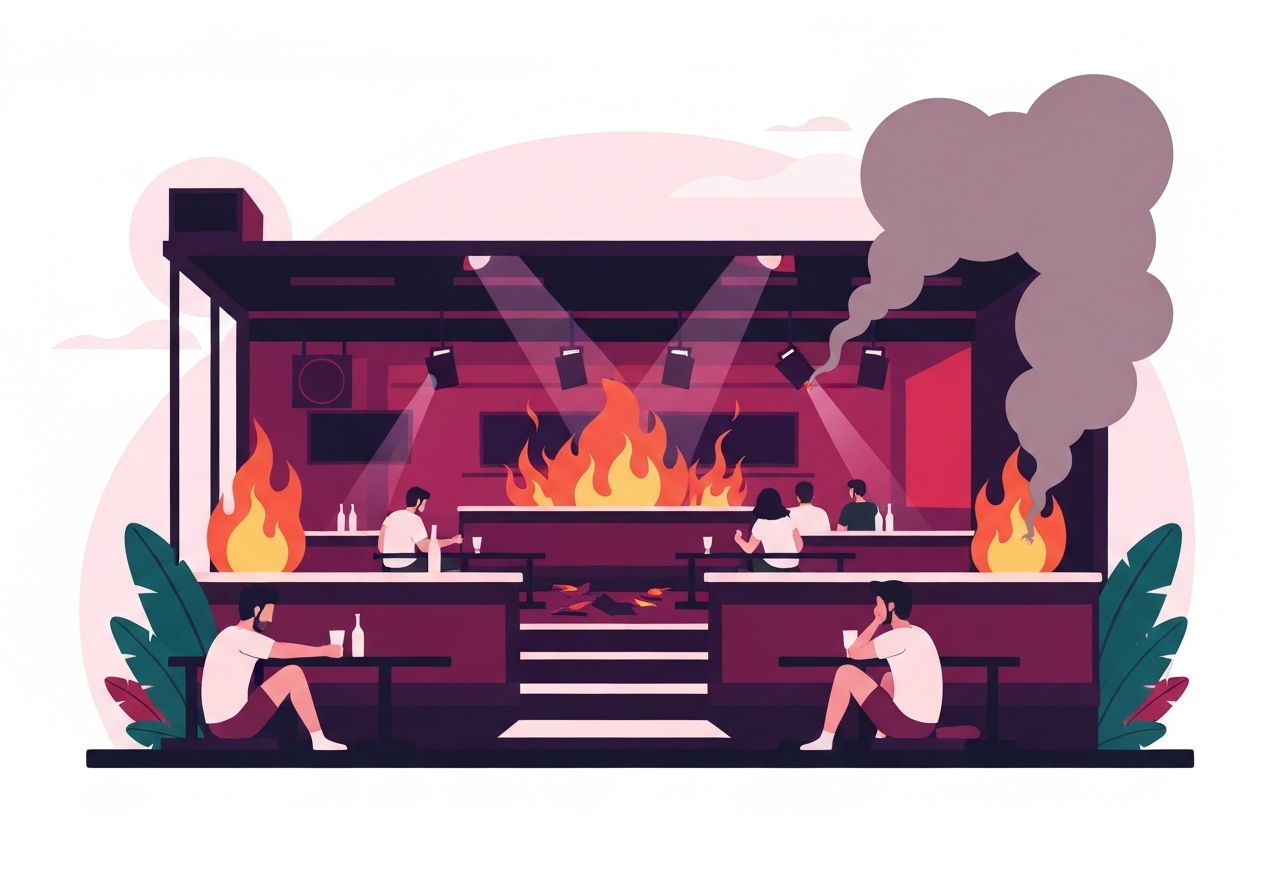
Late-night flames tore through a popular nightclub in Arpora, North Goa, on Saturday around midnight, killing 25 people and injuring others, local officials said. Police say a gas cylinder likely exploded in the club’s kitchen, and most victims were found in and around that ground-floor area. Rescue teams combed charred wreckage into Sunday morning; six people remain in hospital in a stable condition. Authorities have launched a formal inquiry and warned that anyone found negligent will face strict legal action.
Key Takeaways
- Death toll: Local officials report 25 fatalities after a fire at Birch by Romeo Lane in Baga, Arpora, North Goa; initial reports cited 23 but the figure was later revised.
- Probable cause: Police say an explosion of a gas cylinder in the club kitchen appears to have triggered the blaze around midnight on Saturday.
- Victim profile: Most bodies were located near the ground-floor kitchen, suggesting many victims were club staff; authorities said “three to four” tourists also died.
- Injuries and hospitalisation: Six people were taken to hospital and described as in a stable condition on Sunday morning.
- Response: Fire crews brought the fire under control by early Sunday; a heavy security presence has sealed the venue while investigators work.
- Official statements: Goa Director General of Police and the state chief minister confirmed the scene details and pledged stringent legal action against negligence.
- Tourism context: Goa received about 5.5 million visitors in the first half of the year, including roughly 270,000 foreign tourists, amplifying potential international attention to the incident.
Background
Goa is one of India’s most frequented coastal destinations, famed for its beaches and vibrant nightlife. The area around Baga and Arpora is lined with late-night venues that cater to domestic and international holidaymakers; the popularity of such hubs concentrates large numbers of staff and patrons in compact premises after dark. The state reported about 5.5 million tourist arrivals in the first half of the year, including roughly 270,000 foreign visitors, underscoring why a single large incident attracts national and cross-border concern.
India has experienced several deadly fires at entertainment and hospitality sites in recent years, prompting scrutiny of safety standards, building compliance and emergency planning. Past official reviews have repeatedly cited lapses in fire exits, structural safety and equipment maintenance as factors that increase casualty counts. Local businesses, municipal authorities and state regulators share responsibility for enforcing standards, but enforcement and inspection capacity varies by jurisdiction.
Main Event
According to police and state officials, the blaze began at approximately midnight on Saturday on the ground floor of the club known locally as Birch by Romeo Lane in the Baga area. The Goa Director General of Police said the fire was concentrated around the kitchen, where investigators believe a gas cylinder exploded. Witnesses described a rapid spread of flames in a busy nightlife setting and scenes of panic as people fled the club and surrounding venues.
Rescue teams worked through the night and into Sunday morning; firefighters said they were still identifying victims and recovering remains from charred and melted furniture and fittings. Bodies were transported to Goa Medical College in Panaji for formal identification. Officials said the majority of those found near the kitchen were likely employed at the club, while the chief minister acknowledged that three to four tourists were among the dead but did not confirm ages or nationalities.
Authorities secured the scene and barred entry to the venue while forensic teams and fire investigators examined structural damage, burn patterns and equipment. Local law enforcement has opened a formal inquiry to establish the precise sequence of events and whether negligence or safety lapses contributed to the high casualty count. The chief minister vowed that those found responsible will face the most stringent legal action.
Analysis & Implications
The immediate implication is a renewed focus on occupational safety and fire prevention in Goa’s nightlife sector. If a gas cylinder failure is confirmed, investigators will examine installation, cylinder maintenance, vendor certification and staff training on emergency shut-off and evacuation. Many small and medium leisure venues rely on portable fuel sources and sometimes operate without rigorous inspection regimes, a structural weakness that can amplify harm when an incident occurs.
For Goa’s tourism-dependent economy, the incident presents both reputational and operational challenges. Public perception of safety influences booking decisions, particularly among foreign tourists; the state government and industry bodies will likely accelerate visible compliance checks and public messaging to reassure visitors. In the short term, authorities may impose temporary curbs on similar venues pending inspections, with potential economic ripple effects for workers and businesses in the hospitality chain.
Legally, the inquiry could lead to criminal or administrative sanctions if lapses are found — ranging from fines and licence suspensions to more serious charges where gross negligence is established. Politically, state leaders face pressure to demonstrate swift action; past incidents across India have prompted reviews of fire codes and emergency response protocols, but sustained reform requires coordination across municipal, state and industry stakeholders.
Comparison & Data
| Year/Month | Location | Deaths | Primary reported cause |
|---|---|---|---|
| 2025, May | Hyderabad | 17 | Building fire (reported) |
| 2025, April | Kolkata | 15 | Hotel blaze (reported) |
| 2024 | Gujarat | 24 | Amusement-park arcade collapse and poor safety |
These recent incidents show a pattern of high-casualty events in public entertainment or hospitality settings across India, often where safety oversight was later criticised. Comparisons underline recurring vulnerabilities: temporary structures, inadequate exits, equipment failures and uneven enforcement. Such data strengthen calls for systematic inspections, clearer accountability and investment in emergency preparedness at popular tourist sites.
Reactions & Quotes
State and national leaders offered condolences and promised investigations; emergency crews and local workers described chaotic scenes and an intense overnight recovery operation.
“The fire was mainly concentrated around the kitchen area on the ground floor,”
Alok Kumar, Goa Director General of Police (official statement)
The police description framed the early forensic focus on the kitchen and fuel sources; investigators will use burn patterns and equipment traces to test the gas-cylinder explosion hypothesis.
“Those found responsible will face the most stringent action under the law,”
Pramod Sawant, Chief Minister of Goa (official statement)
The chief minister also confirmed that several of the deceased suffered burn injuries while others appeared to have died from smoke inhalation; he announced a formal inquiry and offered condolences to families.
“Deeply saddening,”
Narendra Modi, Prime Minister of India (social media post)
The prime minister’s brief public comment signalled national attention to the incident and is likely to accelerate inter-agency coordination for the investigation and victim assistance.
Unconfirmed
- Exact trigger: While police say a gas cylinder likely exploded, the formal forensic investigation has not yet publicly confirmed the precise ignition source.
- Victim nationalities and ages: Authorities reported “three to four” tourists among the dead but have not released confirmed nationalities or ages pending family notification and identification.
- Liability and compliance records: At the time of reporting, the club’s licensing, inspection history and compliance documentation had not been publicly disclosed.
Bottom Line
The fatal fire in Arpora underscores persistent safety challenges in crowded nightlife venues and will test Goa’s capacity to enforce standards while protecting its tourism economy. Immediate priorities are victim identification, family notifications, a transparent inquiry into cause and visible safety audits across similar establishments.
Longer term, the incident may prompt stricter inspections, clearer accountability for equipment and emergency planning, and renewed regulatory attention to how portable fuel sources are handled in hospitality settings. Observers should watch inquiry findings and any policy or enforcement changes that follow.