
Lead
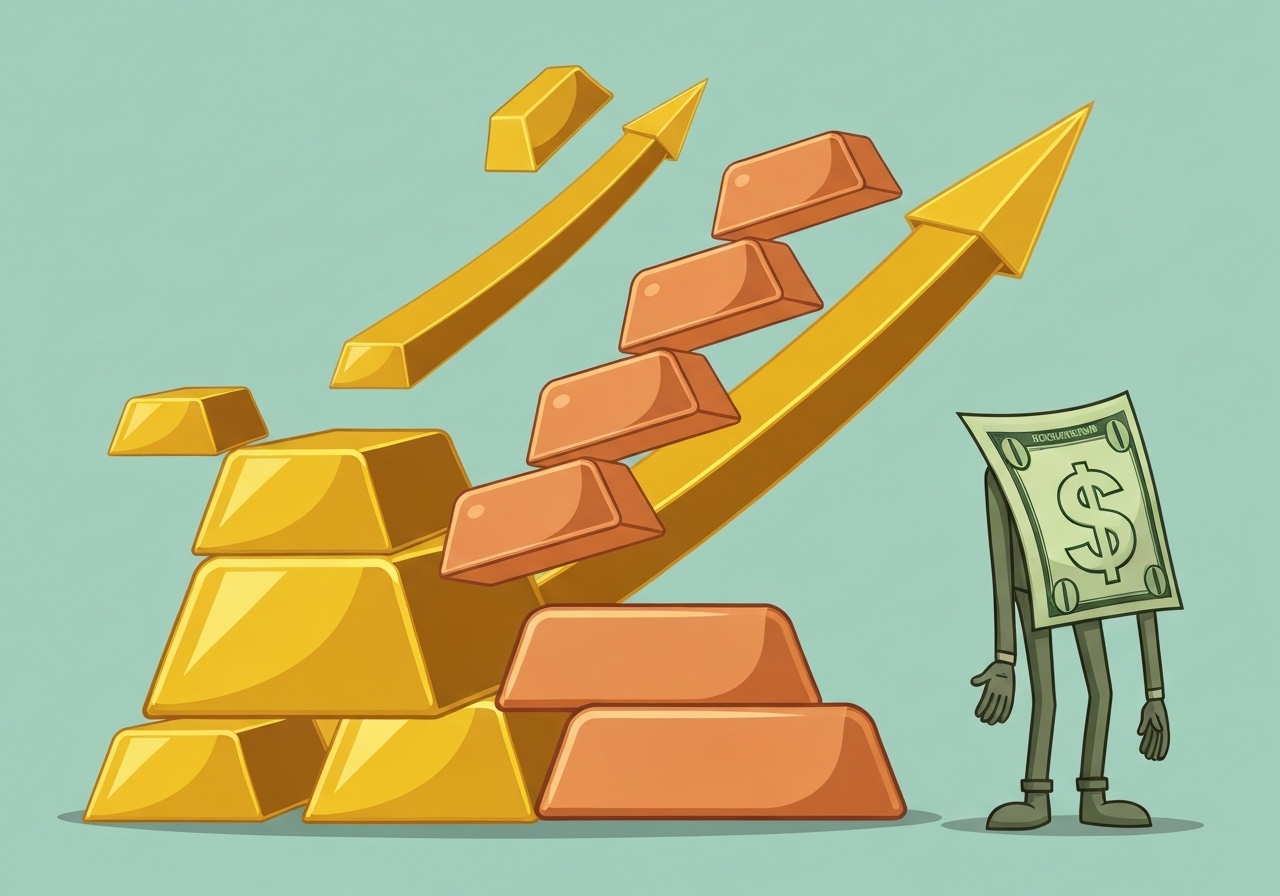
On January 28–29, 2026, global commodity markets accelerated as gold, copper and silver reached fresh record highs against a weakening U.S. dollar and rising geopolitical tensions. Gold surged 2.7% to $5,564 an ounce, bringing its January advance to roughly 29%. Copper spiked as much as 7.9% on the London Metal Exchange while silver and Brent crude also climbed, amplifying gains across dollar-priced commodities. The Australian dollar extended a nine-day winning streak, its longest run in a decade, underscoring broad commodity strength.
Key Takeaways
- Gold rose 2.7% to $5,564 an ounce on Jan. 28–29, lifting its month-to-date gain to about 29%.
- Silver pushed higher, extending a 2026 advance to roughly 66% after a 148% surge in 2025.
- Copper climbed up to 7.9% on the London Metal Exchange in intraday trading, marking one of its largest single-session moves in recent years.
- Brent crude reached its highest levels since September 2025, contributing to broader commodity upside.
- The U.S. dollar weakened materially, amplifying dollar-priced commodity gains; the Australian dollar rose for a ninth consecutive session.
- Rising geopolitical tensions were cited as a near-term catalyst, boosting safe-haven and industrial-metal demand simultaneously.
Background
The rally comes after an extended period of commodity strength in 2025, when base and precious metals recorded outsized gains amid tight supply, stimulus-driven demand and shifting energy dynamics. Gold and silver notably outperformed last year, with silver’s 148% jump in 2025 reflecting both industrial demand recovery and speculative flows into precious metals. Copper’s role as a gauge of industrial activity has made it sensitive to global demand expectations and supply disruptions.
Macroeconomic forces are also in play: a softer U.S. dollar reduces the local-currency price of dollar-priced commodities for overseas buyers, often lifting physical and futures demand. Central-bank positioning, inventory dynamics on exchanges such as the London Metal Exchange, and regional consumption patterns—especially in China—are long-running structural drivers that traders and analysts say underpin the current move.
Main Event
Trading on Jan. 28–29 saw a coordinated jump across commodity markets. Gold’s 2.7% intraday advance to $5,564 an ounce marked a new nominal peak, driven by a combination of safe-haven buying and dollar weakness. Market participants noted accelerated speculative and exchange-traded fund flows that compounded directional moves.
Copper’s intraday surge of as much as 7.9% on the LME reflected both physical tightness and short-covering in futures contracts. Reports of shipment delays and concentrate shortages in key producing regions tightened near-term availability, prompting aggressive buying from manufacturers and traders alike.
Silver continued its momentum from 2025, extending its year-to-date advance to about 66%. The metal’s dual role—industrial input and store of value—has attracted both industrial buyers and investors seeking leverage to gains in gold. Meanwhile, Brent crude climbed to levels not seen since September 2025, feeding cost pressures and inflation-sensitive positioning that can reinforce metal and commodity rallies.
Analysis & Implications
The immediate market mechanics are straightforward: a weaker dollar raises the dollar-denominated price of commodities in local terms, supporting demand and speculative flows. But the implications extend beyond currency moves. For gold and silver, heightened geopolitical risk increases portfolio demand for haven assets, potentially sustaining elevated prices even if macroeconomic indicators moderate.
For copper, the surge poses a signal and a risk. Rapid price gains can strain downstream consumers—manufacturers and construction firms—potentially leading to demand destruction if prices remain elevated. At the same time, higher prices send investment signals to miners and could accelerate capital allocation to new projects, though supply response typically lags price signals by quarters or years.
Energy-price strength, reflected in Brent’s rise, can create cross-market feedback: higher fuel and input costs may lift inflation expectations, influence central-bank policy outlooks, and thus feed back into currency and asset allocation decisions. Policymakers will be watching commodity-driven inflation closely; persistent inflation surprises could prompt more hawkish language from some central banks, complicating the rally’s path.
Comparison & Data
| Asset | Move (latest) | Level / Note |
|---|---|---|
| Gold | +2.7% | $5,564/oz, ~+29% MTD (Jan 2026) |
| Silver | Extended gains | ~+66% YTD 2026; +148% in 2025 |
| Copper (LME) | Up to +7.9% | Large intraday spike amid supply tightness |
| Brent crude | Higher | Highest since Sept 2025 (price elevated vs Q4 2025) |
The table highlights the rapid scale of moves across metal and energy markets. While percentages convey short-term momentum, absolute price levels—especially for gold and copper—are important for assessing profitability across miners, sovereign revenue, and inflation transmission to consumer prices.
Reactions & Quotes
Market participants and institutions offered a mix of explanations that emphasize both macro and micro drivers.
“The dollar’s pullback has magnified demand for dollar-denominated commodities, adding to flows that were already directed by supply constraints,”
Senior market strategist, multinational brokerage (comment)
Analysts at trading houses noted that positioning in futures and ETFs accelerated moves once the dollar weakened. Traders said short-covering in copper futures intensified the price swing, while ETF inflows and safe-haven buying pushed gold above prior peaks.
“Physical tightness in concentrates and delayed shipments created an outsized reaction in LME prices when buying intensified,”
Metals trader, regional commodities firm
Officials at exchanges and logistics providers reported increased settlement activity and higher bid-side pressure, consistent with accounts of shorter available inventories and delivery delays in some hubs.
Unconfirmed
- The degree to which specific supply disruptions (shipments, labor actions) directly caused copper’s 7.9% spike is still being verified by exchange and port data.
- No official statement has confirmed that central banks will change policy in direct response to these commodity moves; any link is conjectural at this stage.
- Attribution of flows from any single large investor or fund to the price moves has not been independently confirmed by trade reports at the time of writing.
Bottom Line
The late-January 2026 advance represents both a continuation of 2025’s commodity momentum and a fresh leg driven by currency moves and geopolitical sensitivity. Gold’s record and copper’s sharp intraday jump together suggest a market environment where both safe-haven and industrial-demand narratives are active. Investors and users of these commodities should expect heightened volatility: rapid upward moves can prompt abrupt corrections when dollar dynamics or physical flows shift.
Going forward, market watchers should monitor three variables closely: U.S. dollar direction, confirmed supply-chain developments for base metals, and any escalation or de-escalation in geopolitical hotspots that influence safe-haven flows. Policy responses from central banks or trade authorities could materially alter the rally’s trajectory, so timely data and exchange-reported inventory figures will be key to assessing sustainability.
Sources
- Bloomberg (news)
- London Metal Exchange (LME) (official exchange)
- ICE/Brent crude market (official market operator)