
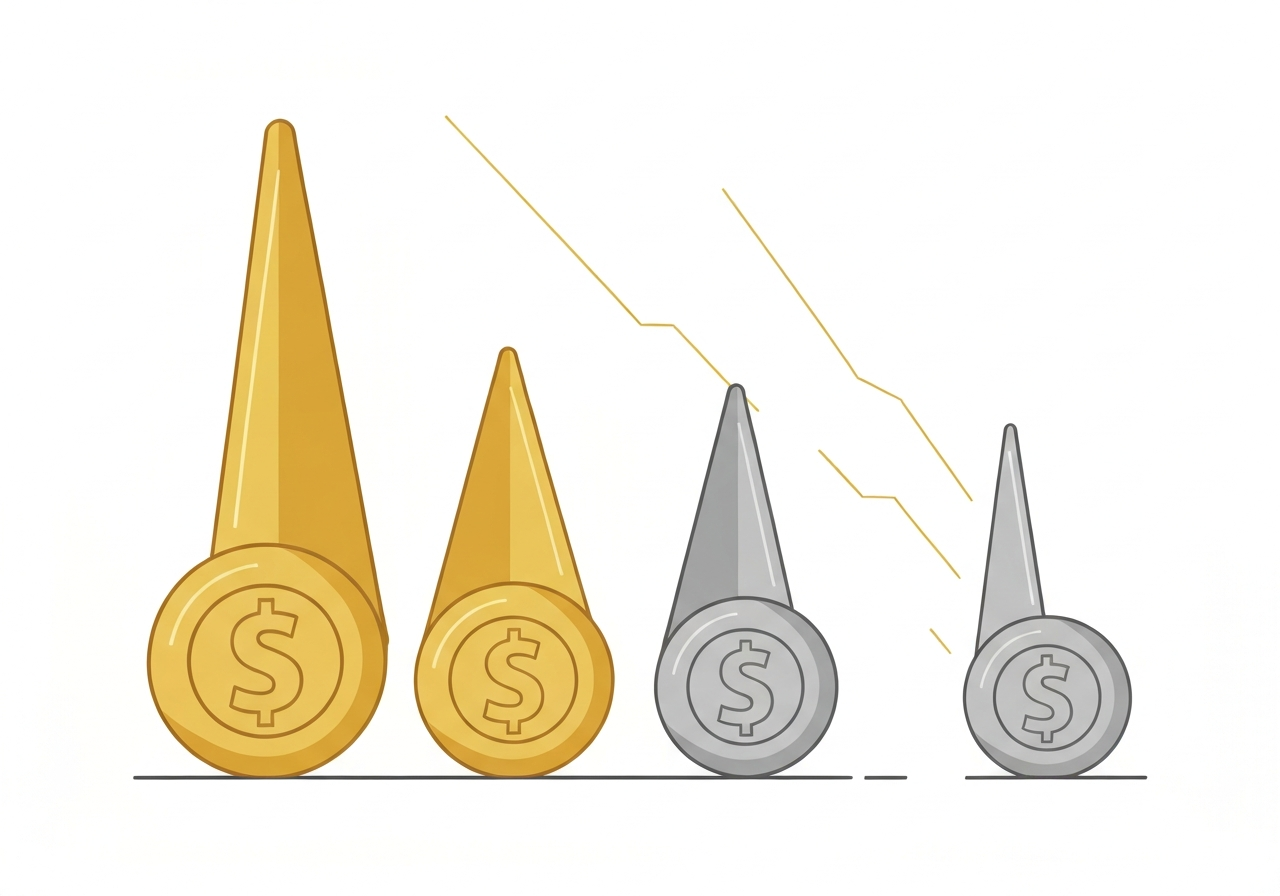
Precious metals prices fell sharply this week as a market reversal accelerated, unsettling equity investors and prompting portfolio rebalancing across asset classes. Traders cited a renewed rise in real yields and a firmer dollar as immediate drivers of the move, while liquidity strains amplified momentum in thin markets. The rapid shift weighed on risk appetite, with some equity segments retreating as investors recalibrated exposure to inflation-linked and cyclical assets.
Key Takeaways
- Gold and silver both declined as the recent market reversal gathered pace, eroding recent safe-haven inflows and pressuring commodity-focused portfolios.
- Rising real yields and a stronger US dollar were identified by market participants as principal near-term headwinds for precious metals.
- Equity markets showed increased volatility and selective selling, particularly in commodity-sensitive and interest-rate-sensitive sectors.
- Leveraged positions and thin liquidity exacerbated price moves in smaller precious-metal contracts, according to market observers.
- Investors reassessed hedging strategies, with flows into some alternatives and short-term cash instruments increasing as downside protection.
Background
Gold and silver traditionally act as hedges against inflation and currency weakness, attracting demand when real yields fall or geopolitical risk rises. Over the past year, bullion markets oscillated between safe-haven buying and profit-taking linked to changes in central bank signals. Shifts in expectations for monetary policy—especially in the United States—have been a consistent influence on metals, because higher real yields increase the opportunity cost of holding non-yielding assets.
Precious-metal markets are also sensitive to dollar moves and liquidity conditions. When the dollar strengthens, dollar-priced commodities typically become less attractive to holders of other currencies, while episodes of thin trading can magnify intraday swings. Market structure—positioning by hedge funds, ETFs and physical market flows—has amplified cycles in recent episodes of stress.
Main Event
This reversal accelerated over several trading sessions as participants adjusted to fresh signals from bond markets and currency traders. Real yields rose, diminishing some of the carry advantage of holding gold and silver, and spot prices moved lower in response. Dealers reported heavier selling interest and a widening of bid-ask spreads in the smaller silver contracts, reflecting both positioning and lower depth in certain venues.
Equity investors reacted to the spillover: several risk-on sectors saw profit-taking as traders sought to reduce exposure to rate-sensitive assets. Portfolio managers described a period of reassessment rather than a broad flight to safety, emphasizing targeted de-risking where duration or commodity sensitivity was highest. The simultaneous repricing across fixed income, currencies and commodities underscored the interconnectedness of modern markets.
Market participants noted that margin requirements and derivative positioning contributed to velocity in prices. In some desks’ accounts, stop-losses and automated trading layered on top of directional flows, pushing prices further during low-liquidity windows. While some buying interest emerged at lower levels, the overall tone remained cautious as investors awaited clearer signals from monetary authorities.
Analysis & Implications
The immediate implication is a recalibration of hedge strategies. Investors who had leaned on gold and silver as inflation hedges or as portfolio ballast are reassessing allocations in light of rising real rates. This can compress near-term demand for bullion-backed ETFs and physical holdings, reducing one stable source of support for prices.
For equity markets, the episode highlights vulnerability in sectors sensitive to rate and dollar moves. Financials, industrials and resource-related companies can experience divergent impacts: some face margin pressure or weaker demand, while others benefit from commodity price adjustments. Portfolio diversification and active duration management have gained renewed importance.
Looking ahead, the persistence of the move will depend on the drivers of real yields and the dollar. If central-bank rhetoric or data sustains higher real rates, precious metals may struggle to regain earlier levels. Conversely, any abrupt pivot in growth or inflation expectations could reverse flows and restore metal prices. Investors should therefore monitor macroeconomic releases and central-bank communications closely.
Comparison & Data
| Asset | Recent Direction |
|---|---|
| Gold | Downward pressure amid rising real yields |
| Silver | Stronger downside volatility; liquidity-sensitive |
| Equities | Selective weakness in rate- and commodity-sensitive sectors |
The table above summarizes directional moves rather than precise intraday levels, reflecting cross-market repricing during the reversal. Market participants emphasized that smaller contract sizes and concentrated positions increased sensitivity to shocks, particularly in silver where open-interest concentration can affect price dynamics.
Reactions & Quotes
Investors are reassessing risk as bond markets signal a tighter real-rate outlook, and that is spilling into commodity and equity arenas.
Market analysts (reported by Financial Times)
Liquidity was thinner than usual in key windows, which amplified price moves and widened execution costs.
Commodity dealers (market comment)
Portfolio managers said they were reducing exposure where duration and commodity sensitivity coincided, rather than undertaking blanket risk-off moves.
Institutional asset managers (industry feedback)
Unconfirmed
- Reports that a single large leveraged fund triggered concentrated liquidations in silver remain unverified and lack confirmatory public data.
- Claims that physical-offtake from ETFs reached record outflows in the latest session are not yet corroborated by official custodial statements.
- Attributions of the sell-off to a specific central-bank statement are disputed; more evidence is required to link causation directly to any single communication.
Bottom Line
The recent slide in gold and silver reflects a broader market recalibration driven largely by higher real yields and a firmer dollar, compounded by episodic liquidity constraints. While the move unsettled equity segments, responses have so far been targeted rather than uniformly risk-off, indicating differentiated impacts across sectors and strategies.
Investors should watch incoming macro data and central-bank signals closely, as these will likely determine whether this reversal is a temporary correction or the start of a more prolonged re-pricing. In the shorter term, liquidity conditions and position concentrations may continue to amplify price swings, warranting careful execution and risk-management planning.
Sources
- Financial Times — media: reporting (original coverage of precious metals and market moves)