
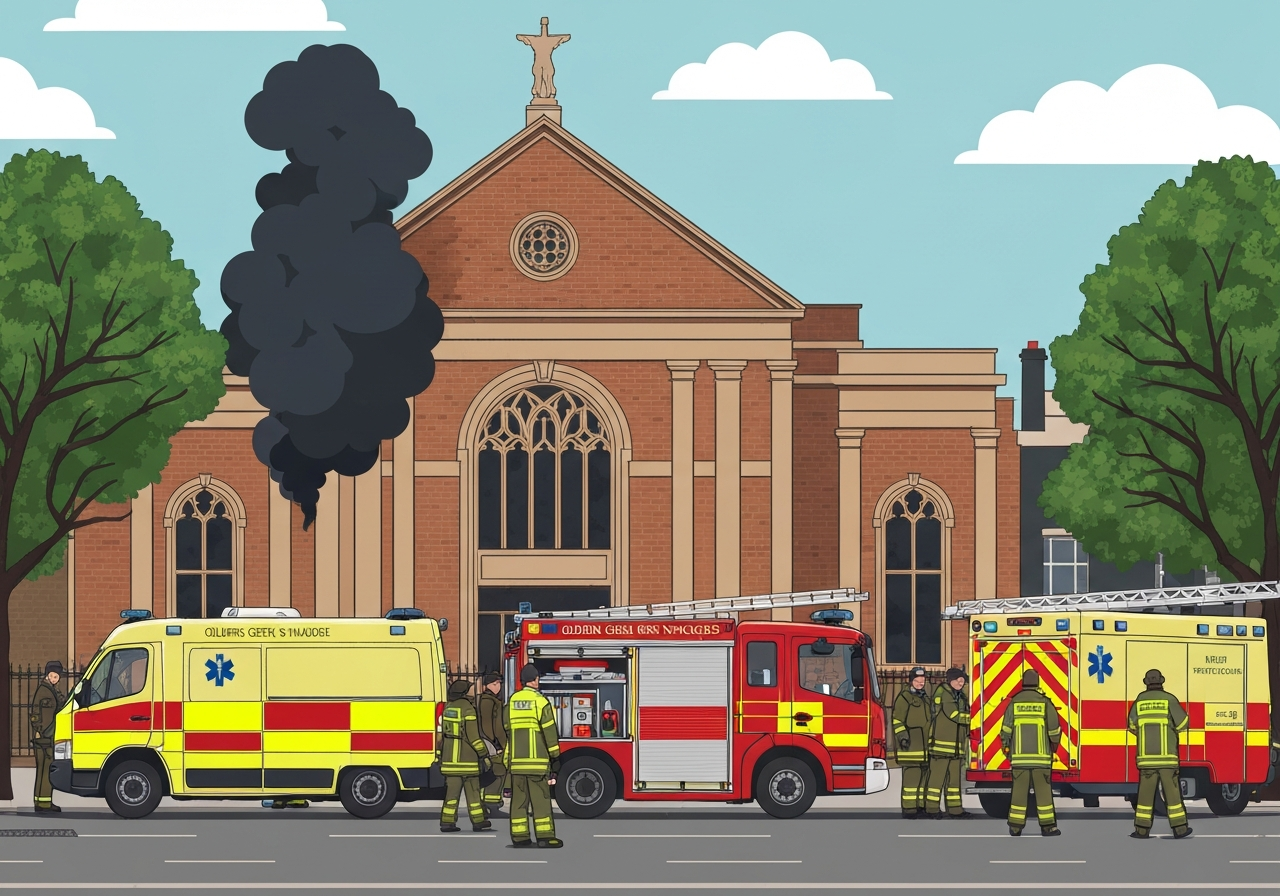
In the early hours of Monday, several volunteer ambulances operated by Hatzola Northwest were deliberately set on fire outside the Machzikei Hadath synagogue in Golders Green, north London, in an attack police are treating as antisemitic. Security footage timestamped 1:36 a.m. shows three masked individuals approach and ignite a vehicle; firefighters responded to large flames and explosions thought to be caused by gas canisters on board. Four of Hatzola’s six ambulances were damaged and some nearby residents were evacuated; police say there have been no arrests yet and three suspects are being sought. The incident has prompted condemnation from community leaders and increased patrols in the area.
Key Takeaways
- Attack location: Golders Green, a London suburb with a large Jewish and Orthodox community; the synagogue adjacent to the scene is Machzikei Hadath.
- Timing and footage: Security camera footage shows the incident at 1:36 a.m. on Monday with three masked people setting fire to a Hatzola Northwest ambulance.
- Scale of damage: Four of the organization’s six ambulances were set alight, according to Hatzola Northwest leadership.
- Explosions and safety: Residents reported multiple explosions and long plumes of smoke; police said explosions were likely caused by gas canisters on board the vehicles.
- Police response: The Met Police are treating the episode as an antisemitic hate crime, have evacuated some residents as a precaution, and are seeking three suspects; no arrests reported at the time of reporting.
- Community impact: Local leaders described the attack as an assault on life-saving services and expressed heightened fear among residents.
- Contextual trend: The Community Security Trust (CST) recorded record levels of antisemitic incidents in 2024, reinforcing wider community concerns.
Background
Golders Green is home to numerous synagogues, Jewish schools and kosher businesses and is widely recognised as one of London’s largest Jewish neighborhoods. Hatzola Northwest is a volunteer medical response charity that serves this area and beyond, providing pre-hospital emergency care to Jewish and non-Jewish residents alike. Volunteer ambulance crews routinely attend thousands of call-outs each year and the organisation is integrated into local emergency response arrangements.
Antisemitic incidents in the UK have been a growing concern in recent years. The 2021 census recorded just under 300,000 people identifying as Jewish in England and Wales, and charities monitoring hate crime reported record incident levels in 2024. High-profile attacks in previous years, including the Manchester synagogue attack that killed two worshippers, have led senior government figures to warn about rising hatred and to call for stronger measures to protect Jewish communities.
Main Event
Shortly before dawn on Monday, residents in Golders Green were roused by bright flames and loud explosions as multiple firefighters attended the scene. Security footage provided to journalists shows three masked individuals approach a parked Hatzola Northwest ambulance and set it alight; the clip bears a timestamp of 1:36 a.m. and identifies the location as adjacent to Machzikei Hadath synagogue.
Emergency services described large fires and explosive sounds; local resident Charlie Richards recorded footage of a large orange blast and smoke plumes rising over the neighborhood. Police told reporters they believed explosions were caused by gas canisters stored in the vehicles, and some nearby homes were evacuated as a precautionary measure while firefighters tackled the blaze.
Hatzola Northwest’s chairman, Shloimie Richman, told reporters that four of the six ambulances used by the group were deliberately set on fire and emphasised the attack targeted life-saving equipment. The Met Police issued a statement confirming the investigation is being treated as an antisemitic hate crime and that detectives are seeking three suspects; they also said there were no arrests at the time of the statement.
Analysis & Implications
The deliberate targeting of volunteer ambulances carries weight beyond property damage: it strikes at public confidence in community-led emergency services that operate alongside statutory responders. Hatzola crews are trained to deliver pre-hospital care and are frequently first on scene; incapacitating that fleet reduces local medical resilience and could delay responses to future emergencies.
Politically and socially, the incident reinforces long-standing fears in Britain’s Jewish communities about rising antisemitism. Public figures, including senior faith leaders and elected representatives, have framed attacks on religious infrastructure or community services as attacks on civic values. The police classification of the event as a hate crime signals investigators will consider motive as a central element of the inquiry, which can affect investigative resources and legal outcomes.
For local security planning, the arson highlights vulnerabilities in how volunteer services store and protect vehicles and equipment. If gas canisters or other medical supplies contributed to explosions, organisations will need to review storage protocols and coordination with statutory emergency services on safe-keeping and rapid mitigation. Longer term, insurers, local councils and charities may be pushed to invest in hardened parking, CCTV and patrols, adding budgetary pressures.
Comparison & Data
| Item | Reported detail |
|---|---|
| Ambulances damaged | 4 of 6 vehicles set alight |
| Timestamp on footage | 1:36 a.m., Monday |
| Police classification | Antisemitic hate crime (under investigation) |
The table above summarises the verifiable incident-specific data reported by police and Hatzola Northwest. While national-level monitors such as the CST report year-on-year rises in antisemitic incidents, this local attack should be viewed both as a discrete criminal event and as part of a pattern that charities say has intensified pressure on Jewish communities across the UK.
Reactions & Quotes
“A particularly sickening assault — not only on the Jewish community, but on the values we share as a society.”
Sir Ephraim Mirvis, Britain’s Chief Rabbi (public statement)
Chief Rabbi Mirvis framed the attack as an affront to shared civic values, emphasising the cross-community role of Hatzola’s life-saving work.
“We will be engaging with faith leaders and carrying out additional patrols in the local area as we continue our investigation to provide reassurance and a highly visible presence.”
Superintendent Sarah Jackson, Metropolitan Police (official statement)
Police leadership highlighted immediate operational steps to reassure residents and indicated the investigation will prioritise identifying suspects and establishing motive.
“They were deliberately targeted in an arson attack.”
Shloimie Richman, Chairman, Hatzola Northwest (organisation statement)
Hatzola’s leaders underscored the organisation’s charitable mission and expressed concern about the broader impact on community safety and service continuity.
Unconfirmed
- Whether the explosives were definitively caused by gas canisters on board remains under investigation; police have described this as their working theory.
- The identities and affiliations of the three suspects seen on camera have not been confirmed or publicly released.
- Any connection between this arson and wider national or international events has not been established and remains unproven.
Bottom Line
The arson attack on Hatzola ambulances in Golders Green is both a targeted assault on community life-saving infrastructure and a local manifestation of broader anxieties about antisemitism in the UK. By damaging multiple ambulances, the attack immediately reduces emergency medical capacity and raises hard security questions for volunteer services operating in residential neighbourhoods.
Investigation priorities are clear: identify suspects, determine motive, and close security gaps that allowed the attack. Community leaders, police and national monitors will be watching whether this incident prompts new protective measures, funding for hardened infrastructure, or changes in how volunteer emergency services operate in high-risk contexts.