
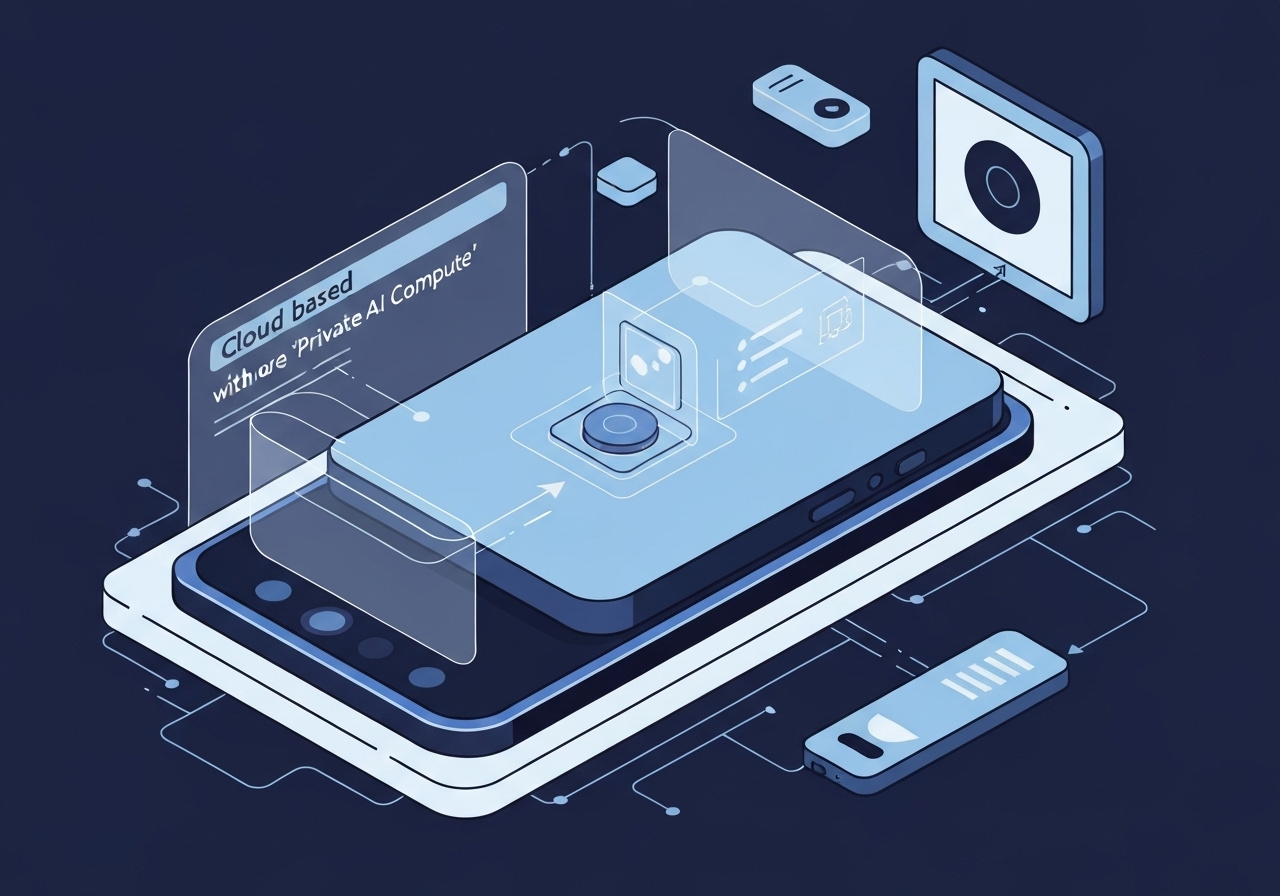
Google on 11 November 2025 unveiled Private AI Compute alongside the November 2025 Feature Drop to give Pixel 10 features such as Magic Cue faster, context-aware suggestions while keeping sensitive data private. The system routes select processing to a hardware‑sealed cloud environment that Google says it cannot access, combining cloud Gemini models and on‑device Gemini Nano to balance capability and privacy. Pixel apps including Messages, Phone by Google, Pixel Weather and Gboard will surface Magic Cue suggestions more frequently, and Pixel Recorder gains broader transcription summary support via the new platform.
- Private AI Compute is a new Google “AI processing platform” announced in the November 2025 Feature Drop, intended to combine cloud model power with on‑device privacy protections.
- Google describes the system as a hardware‑secured, sealed cloud environment using CPUs and Cloud TPUs, with encrypted connections and remote attestation to the handset.
- Development is joint across Google’s Platform & Devices, DeepMind, and Cloud teams, targeting tasks that need more compute or reasoning than on‑device models alone.
- Magic Cue on Pixel 10 will use cloud Gemini models for “more timely suggestions” while still leveraging on‑device Gemini Nano for local responsiveness.
- Magic Cue triggers remain the same: Google Messages conversations, Phone by Google call screen, Pixel Weather for upcoming events, and the Gboard suggestion row.
- Pixel Recorder will use Private AI Compute to produce transcription summaries in additional languages beyond the device‑only workflow.
- Users can view Private AI Compute activity via Developer options: Settings > Security & Privacy > More security & privacy > Android System Intelligence > Network Usage log > Log network activity.
Background
Smartphone makers increasingly split AI work between on‑device models and cloud services to balance latency, capability and privacy. Apple introduced a comparable Private Cloud Compute concept with Apple Intelligence; Google’s Private AI Compute follows that pattern but emphasizes a hardware‑sealed cloud that it says prevents Google from accessing raw user data. Historically, phones have relied on smaller local models (for latency and offline use) or cloud models (for scale and advanced reasoning); the new platform aims to let Pixel 10 tap larger Gemini models when appropriate while retaining on‑device safeguards.
The move responds to growing user demand for features that anticipate needs—calendar prompts, conversation summaries and real‑time suggestions—while avoiding broad data exposure. Google’s description points to “end‑to‑end” stack integration: device hardware, encrypted network transport, cloud TPUs and model orchestration from DeepMind and Cloud teams. Regulatory scrutiny of mobile AI and data flows means such designs now foreground provable isolation and auditable connections in addition to technical performance.
Main Event
At the November 2025 Feature Drop announcement, Google said Private AI Compute will be available to Pixel 10 for specific features where extra reasoning or model size materially improves results. Magic Cue—Google’s contextual suggestion layer—will call cloud Gemini models to generate suggestions at moments the company deems time‑sensitive, for example when a message thread, incoming call or scheduled weather event indicates a likely action. Google stressed that Gemini Nano remains on the device for routine, low‑latency tasks.
Technically, Private AI Compute runs inside a hardware‑secured sealed cloud environment that uses Cloud TPUs and CPUs; the handset establishes an encrypted, remotely attested connection so the cloud can verify device integrity without exposing user data to Google. Google published a technical brief describing the architecture and cryptographic steps used for attestation and data isolation. The company framed the platform as selectively elevating computation to the cloud only when on‑device resources would limit the quality of assistance.
Functionally, Pixel 10 users should notice Magic Cue suggestions appear more often and with richer context in Google Messages, Phone by Google’s calling screen, the Pixel Weather page when an event is upcoming, and in Gboard’s suggestion strip. Pixel Recorder’s summaries will support more languages by offloading heavier summarization work to the sealed cloud. Google also added a developer‑accessible network usage log so advanced users can see when Private AI Compute is invoked.
Analysis & Implications
Technically, combining a sealed cloud with on‑device models lets Google use larger Gemini variants for deep reasoning while keeping the initial data collection and short‑term processing local. For users, this can mean more contextually helpful suggestions and higher‑quality language summaries without a blanket shift of private data to Google servers. However, the privacy guarantee rests on technical isolation, encryption and attestation—which must be auditable and resilient to future platform changes to sustain user trust.
Commercially, Private AI Compute helps Google differentiate Pixel 10 features against competitors by enabling richer assistant behaviors without requiring all inference to run locally. It also leans on Google Cloud and DeepMind IP, potentially increasing lock‑in for enterprise or developer ecosystems that prefer an integrated device‑to‑cloud AI stack. For app developers, the model suggests new product designs that can selectively escalate work to the cloud for complex tasks while preserving on‑device fallbacks.
On the regulatory and risk side, claims that Google cannot access user data in the sealed cloud should be testable only through independent audits or verifiable attestation records. Governments and privacy advocates will likely inspect the attestation and key‑management practices. If validated, the approach could set a new baseline for mobile AI privacy; if gaps are found, the same architecture could attract scrutiny for perceived opacity in how data is routed or retained.
| Feature | Private AI Compute | On‑device (Gemini Nano) | Comparable (Apple Private Cloud Compute) |
|---|---|---|---|
| Primary use | Cloud reasoning for time‑sensitive, complex tasks | Low‑latency, routine inference | Cloud for advanced tasks with privacy controls |
| Compute | Cloud TPUs and CPUs | Local CPU/NN accelerators | Cloud accelerators (vendor specific) |
| Privacy claim | Hardware‑sealed cloud, encryption, attestation | Data stays local by default | Private cloud isolation claims |
The table highlights the qualitative tradeoffs: Private AI Compute sits between pure on‑device AI and unrestricted cloud processing. The differences matter most for workloads that require larger models or multi‑step reasoning that exceed on‑device capabilities.
Reactions & Quotes
“A secure, fortified space for processing sensitive user data that Google cannot access,”
Google (official announcement)
Google framed Private AI Compute as an environment designed to prevent Google from reading user inputs while allowing larger models to run for select tasks. The phrasing emphasizes technical isolation as the primary privacy guarantee and positions the new platform as a bridge between device and cloud capabilities.
“[Private AI Compute] opens up a new set of possibilities for helpful AI experiences now that we can use both on‑device and advanced cloud models for the most sensitive use cases,”
Google (official announcement)
This second statement outlines Google’s product rationale: richer, anticipatory assistant behaviors that are feasible only when device and cloud resources are used together. The company presents the system as selective—invoked for sensitive tasks that need more compute or reasoning.
Unconfirmed
- Exact latency and battery impacts of routing Magic Cue queries to the sealed cloud versus on‑device processing are not published and remain unmeasured in independent tests.
- Which specific Gemini model variants will be used in the cloud for each Magic Cue or Recorder task—and whether model weights persist beyond ephemeral inference—has not been fully disclosed.
- Whether the sealed cloud’s attestation logs and key‑management procedures will be available for third‑party audits or regulator review is not confirmed.
Bottom Line
Google’s Private AI Compute is a strategic step to deliver richer Pixel 10 assistant features—notably more timely Magic Cue suggestions and expanded Recorder summaries—by selectively elevating computation to a hardware‑sealed cloud. The design attempts to preserve user privacy through encryption, attestation and workload isolation while leveraging Cloud TPUs and Gemini models for tasks beyond the reach of on‑device models.
If the technical guarantees hold under independent review, the approach could become a practical middle ground for mobile AI: stronger model capability than pure on‑device systems with privacy protections stronger than traditional cloud processing. Key next steps for observers are independent performance and privacy audits, clarity on model selection and retention policies, and monitoring how the feature scales across Pixel devices and apps.
Sources