
Lead
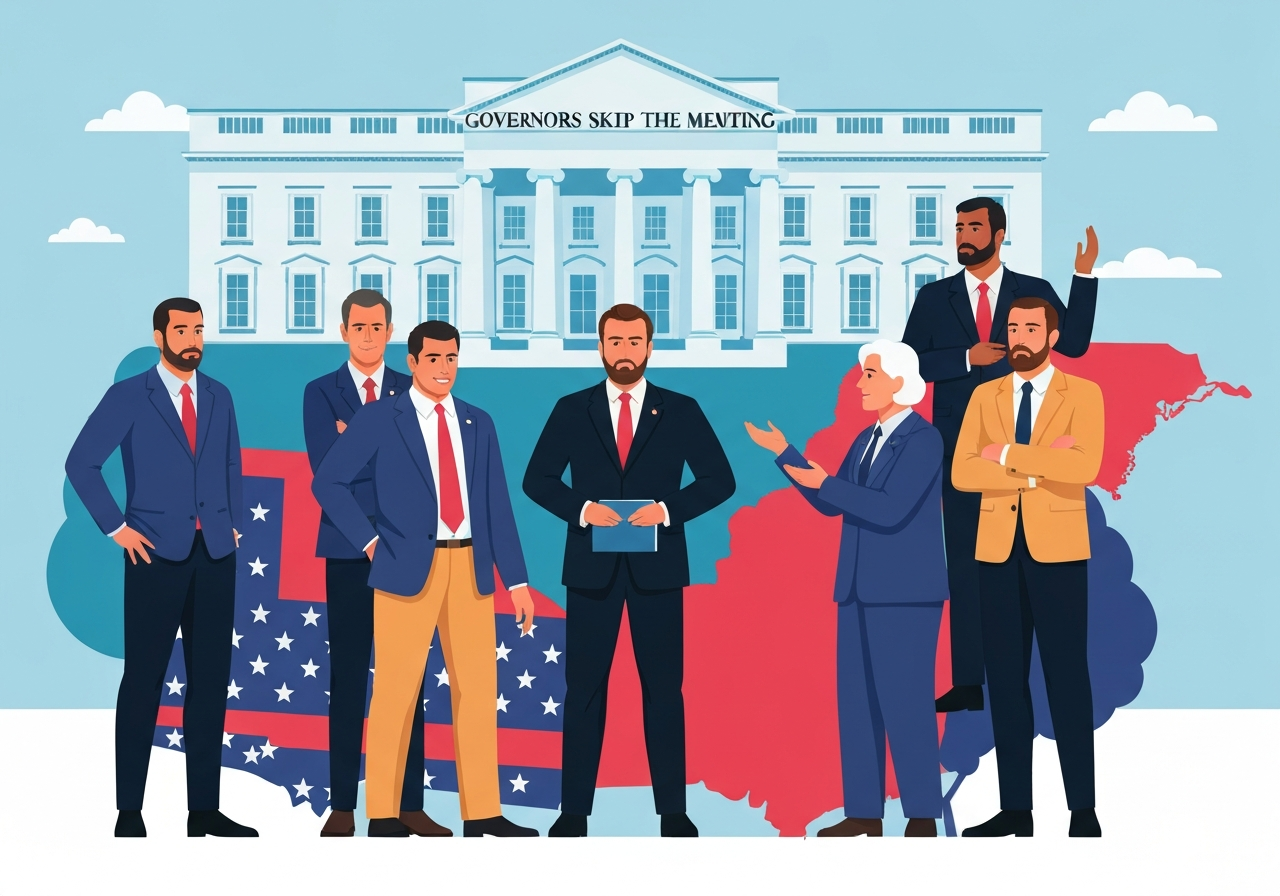
The National Governors Association (NGA) withdrew from an annual White House meeting this week after President Donald Trump declined to invite Democratic governors Jared Polis of Colorado and Wes Moore of Maryland, undercutting a rare bipartisan forum in Washington. The president is still expected to meet with governors at the White House on Friday, but the NGA—an organization founded more than a century ago to unite state leaders—will not facilitate the event. The split followed public social-media attacks by Trump aimed at the two Democrats and produced sharp reactions from governors of both parties.
Key Takeaways
- The NGA pulled out of the White House-hosted annual gathering after the administration declined to invite Govs. Jared Polis (D-CO) and Wes Moore (D-MD).
- President Trump is still slated to meet governors at the White House on Friday, but the meeting will not be organized by the NGA, which was founded more than 100 years ago.
- GOP Chair of the NGA, Gov. Kevin Stitt (R-OK), tried to mediate the standoff; Trump subsequently criticized Stitt on social media.
- NGA vice chair Wes Moore said he has no appetite for personal conflict with the president but described the administration’s public jabs as troubling.
- Governors from both parties continued informal exchanges in Washington, with attendees saying they planned to share policy ideas despite the rupture.
- Some governors warned the episode underlines broader concerns about executive overreach, pointing to past threats to withhold federal funds or deploy federal forces.
- Political observers noted the incident feeds into 2028 presidential speculation for several governors who were present in the capital this week.
Background
The National Governors Association was created more than a century ago as a nonpartisan forum for state executives to coordinate policy positions and advocate to the federal government. Traditionally, the NGA’s annual White House engagement has brought together Republican and Democratic governors for a mix of ceremonial and policy-focused sessions. That institutional practice has been one of the few regular bipartisan interactions between state executives and the presidency.
Over recent years, relations between the White House and some state governors have grown more contentious. The president—during his second term—has at times publicly clashed with governors, and governors across the political spectrum have expressed concerns about federal-state friction on issues ranging from disaster response to public-health policy. Those strains have made the symbolic value of gatherings like the White House dinner more salient to governors who view the event as a chance to maintain working relationships across party lines.
Main Event
The dispute began when the White House did not include all sitting governors on the invitation list and left out Democratic Govs. Jared Polis and Wes Moore. The omission prompted the NGA to decline to facilitate its customary role for the event. The White House’s invite list and the administration’s rationale for exclusion were publicly challenged by governor officials and media observers.
President Trump publicly criticized the two governors on social media, calling them “not worthy of being there,” language that heightened the controversy. In turn, several governors—Republicans and Democrats—expressed discomfort with the personalization and public airing of the dispute. Gov. Spencer Cox (R-UT) said the president was not focused on unifying the country, while Gov. Kevin Stitt (R-OK), NGA chair, attempted to smooth relations and explained he would still participate in White House activities.
Despite the NGA’s withdrawal, governors continued informal meetings in Washington. Polis said he spent time with colleagues from both parties to exchange policy ideas and best practices. Moore, the NGA vice chair, said he did not want a confrontation with the president and framed his response in personal terms, while noting the strain that public attacks impose on institutional norms.
Analysis & Implications
The NGA’s decision to pull back from facilitating the White House meeting deprives governors of an established nonpartisan platform in which to coordinate federal advocacy. That institutional gap could complicate governors’ ability to present united, cross-party positions on federal funding, disaster aid, and regulatory priorities. When a forum intended to be nonpartisan fractures along partisan lines, state executives lose a predictable channel for influencing federal policymaking.
Politically, the episode reinforces a broader pattern in which the president’s public rhetoric shapes intergovernmental relations. Governors who rely on steady cooperation with the federal government—particularly for disaster response and budget negotiations—may find themselves negotiating around heightened personal and partisan tensions rather than through routine institutional processes. This dynamic could raise the transaction costs of cooperation and make bilateral, ad hoc arrangements more common.
For the Republican Party, the episode also highlights intraparty strains. Gov. Stitt’s effort to mediate and the president’s subsequent rebuke illustrate fissures between White House signaling and some state-level Republican leaders. That dynamic could affect coordination on federal priorities that require strong GOP unity in state-federal interactions.
Finally, the timing—coming amid public discussion about potential presidential contenders for 2028—means the incident may feed both policy and political narratives. Governors present in Washington, including potential national contenders, are now navigating the dual tasks of advancing state agendas while responding to a high-profile dispute that draws national attention.
Comparison & Data
| Traditional Practice | 2024 White House Event |
|---|---|
| NGA typically facilitates an annual, bipartisan White House gathering for all governors. | NGA declined to facilitate after two Democratic governors—Jared Polis and Wes Moore—were not invited to the White House list. |
The table above highlights the break from precedent: an institution designed to convene all governors removed itself from a ceremonial role because the invitation list departed from typical inclusivity. That disruption is meaningful less for a single dinner than for the precedent it sets about when and how the federal executive engages the full slate of state leaders.
Reactions & Quotes
Governors offered terse public responses that conveyed both personal frustration and institutional concern. Some framed the dispute as a symptom of rising personalization in national politics.
I don’t have any ability to get in his head.
Gov. Jared Polis (D-CO)
Polis said he focused on meeting colleagues and exchanging policy ideas in Washington despite the White House controversy. He framed the week’s gatherings as practical exchanges of best practices across party lines.
I didn’t run for governor like, man, I can’t wait so me and the president can go toe to toe.
Gov. Wes Moore (D-MD)
Moore, who serves as the NGA vice chair, said he had no desire for personal conflict and expressed concern about the toll of constant public attacks. He emphasized his role in seeking bipartisan solutions for Maryland.
He’s not putting his mind to it.
Gov. Spencer Cox (R-UT)
Gov. Cox used the episode to criticize the broader political posture of the White House, urging Congress to act as a check on executive excess and to focus on governance over spectacle.
Unconfirmed
- Whether President Trump personally dictated the final White House invitation list remains unconfirmed; White House officials have not provided a detailed public account of the decision-making process.
- The long-term impact on formal NGA policymaking and whether future NGA events will be similarly affected is uncertain at this time.
- It is unconfirmed whether the exclusion will materially change federal funding or policy outcomes for the states led by the two excluded governors.
Bottom Line
The NGA’s withdrawal from its traditional White House facilitation marks a symbolic rupture in a long-standing bipartisan channel between state leaders and the presidency. While governors continue to meet and exchange policy ideas, the loss of a formal, nonpartisan convening body for this event raises questions about the durability of intergovernmental cooperation amid heightened partisan rhetoric.
For policymakers, the episode is a reminder that institutional norms matter: when routine practices are abandoned, the burden of coordination shifts to ad hoc arrangements that can be less predictable and less conducive to unified state-federal responses. Observers should watch whether this is an isolated incident or the start of a pattern that reshapes how governors engage the federal government.