
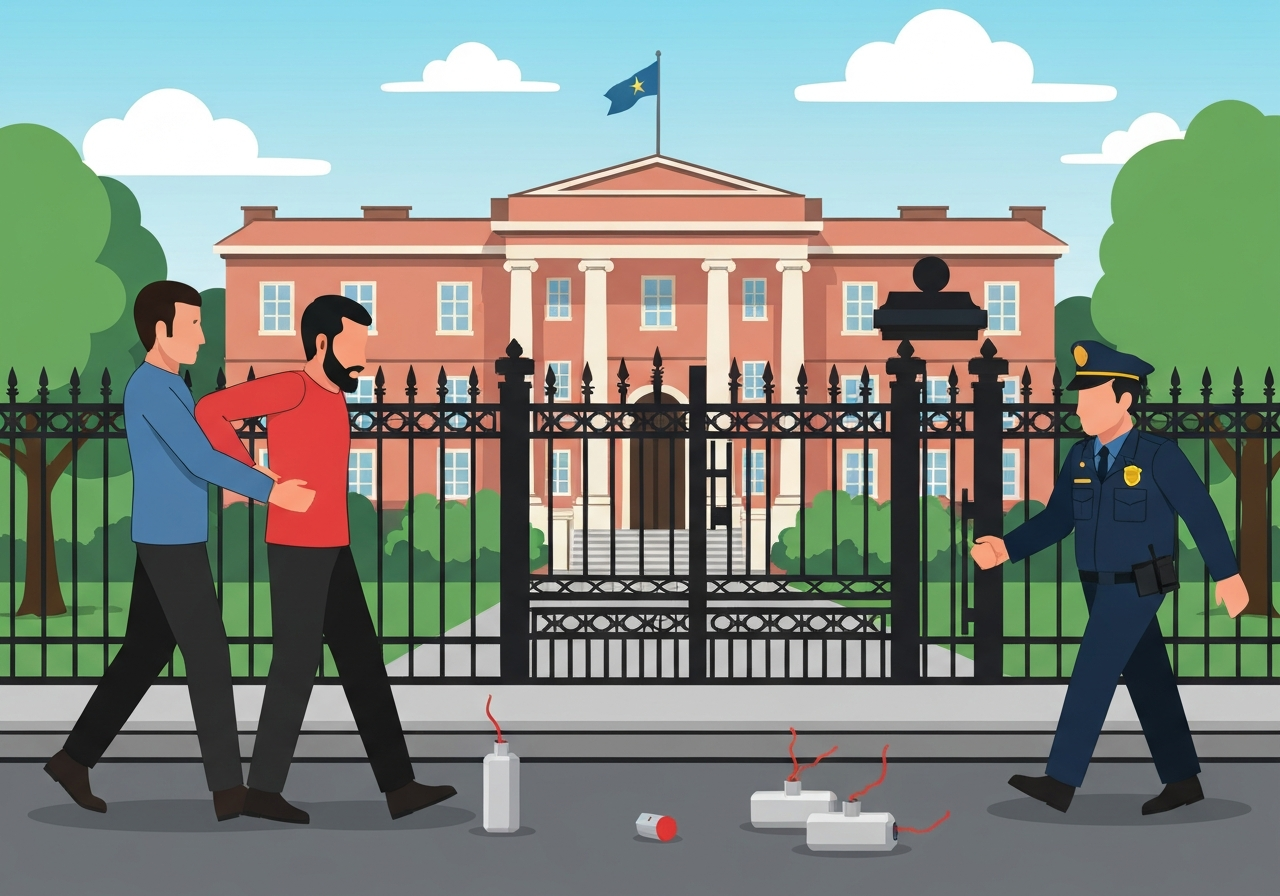
Two people were taken into custody on Saturday after law enforcement found two “suspicious devices” outside Gracie Mansion, the official residence of New York City’s mayor, amid an anti‑Islam demonstration organized by conservative influencer Jake Lang. The New York Police Department said there were no injuries and that an investigation remained active; it was not immediately clear whether Mayor Zohran Mamdani or First Lady Rama Duwaji were inside the residence at the time. Images circulating from the scene showed smoke and what appeared to be one device near the mansion’s perimeter during the protest, which took place during the Muslim holy month of Ramadan. Organizers and some participants dispersed after police intervened; authorities have not released a full timeline of where the devices came from or who placed them.
- Two suspicious devices were reported outside Gracie Mansion on Saturday; the NYPD confirmed the discovery and described them as “suspicious devices.”
- Two people were taken into custody in connection with the incident; the NYPD also said there were no injuries reported at the scene.
- The protest was organized by right‑wing influencer Jake Lang and took place during Ramadan; Lang had previously said he intended to burn a Quran at the demonstration but did not appear to do so.
- Zohran Mamdani is New York City’s first Muslim mayor; his office did not immediately respond to requests for comment about whether he or the first lady were present.
- Jake Lang has held several high‑profile rallies in recent weeks and was pardoned for charges tied to the Jan. 6 attack on the U.S. Capitol, a fact that has heightened scrutiny of his public actions.
- Photos from the scene published by news agencies showed smoke and an object resembling a device near the mansion’s grounds, prompting a security response from the NYPD.
Background
Gracie Mansion serves as the official residence of New York City’s mayor and is protected by multiple city and federal security protocols because of its prominence and the high profile of occupants. Zohran Mamdani, who assumed office as the city’s first Muslim mayor, has been a polarizing figure for some groups and a symbol for others; demonstrations outside Gracie Mansion have drawn attention since his inauguration. The protest on Saturday occurred during Ramadan, a period of heightened sensitivity for many Muslim New Yorkers, which added to the political and cultural stakes surrounding the event.
The organizer cited in reporting, Jake Lang, is known for provocative public demonstrations and was previously pardoned for charges related to the Jan. 6, 2021, attack on the U.S. Capitol; he has staged similar rallies in other cities in recent months. His January protest in Minneapolis came days after the killing of Renee Good and drew widespread condemnation and counterprotests. Those prior events, together with the public promise Lang reportedly made to burn a Quran at Saturday’s site, contributed to preexisting tensions and close monitoring by law enforcement and civil liberties groups.
Main Event
According to the NYPD statement cited by reporters, officers discovered two “suspicious devices” outside Gracie Mansion during a demonstration organized by Lang and his supporters. Photographs distributed by news agencies captured smoke on the grounds and an object that appeared to be one of the devices; local officers cordoned off the area while investigators examined the scene. The NYPD said there were no injuries and that the investigation was ongoing; investigators have not publicly detailed whether the devices were functional explosive devices or inert objects at the time they were found.
Two people were taken into custody in connection with the incident; authorities have not yet released the identities or specific charges tied to those arrests. Mayor Mamdani’s representatives did not immediately provide comment to reporters, and Lang could not be reached for immediate reaction, according to coverage. Witness accounts and images indicate that some participants departed the scene after the discovery, while others remained under police supervision and were questioned as part of the response.
Local law enforcement increased their presence around the mansion and nearby public areas following the discovery, and the NYPD reaffirmed that its investigation continued into the devices’ origin and whether any additional material posed a threat. Officials described the items only as “suspicious devices” in initial statements; the terminology has been used previously by police when an item requires bomb‑squad or technical review before being characterized further. At the time of reporting, no official conclusion about the devices’ construction, intent, or operability had been released.
Analysis & Implications
The incident highlights a growing intersection between online provocation and in‑person demonstrations in major cities, where influencers with national followings can mobilize small but highly visible actions that prompt security responses. Given Lang’s public profile and his pardon for Jan. 6‑related charges, authorities and civic leaders are likely to scrutinize whether organizers coordinate activities that cross legal lines or risk public safety. That scrutiny may in turn influence how permits, policing resources, and public messaging are managed for future protests, especially those that touch on religion and identity during sensitive periods such as Ramadan.
For the mayor’s office and city security planners, the discovery of suspicious items at the mayoral residence raises questions about perimeter security and rapid response protocols at Gracie Mansion. Officials may review buffer zones, screening procedures for protest areas adjacent to the residence, and communication channels between municipal and federal partners responsible for protecting high‑profile officials. Any subsequent legal findings about intent or device functionality could also affect criminal charging decisions and civil liability for organizers or participants.
There are broader political implications as well: episodes that tie protests to religious targets can deepen communal anxiety and shift public debate toward questions about hate speech, protected expression and public order. City leaders will need to balance constitutional protections for assembly and speech with measures to prevent intimidation and violence, a challenge that often plays out in courts and legislatures after headline‑grabbing incidents. The event may also draw national attention because of Lang’s prior pardon and the continuing debates over accountability for actions connected to January 6 and similar episodes.
Comparison & Data
| Metric | Saturday Incident |
|---|---|
| Suspicious devices reported | 2 |
| People taken into custody | 2 |
| Injuries reported | 0 |
| Presence of mayor/first lady | Not confirmed |
The table above summarizes verifiable, reported metrics from the incident: two suspicious devices, two arrests, and no reported injuries. These are initial counts provided by law enforcement or visible in scene photography; investigators often revise or refine such figures as forensic work and interviews proceed. Comparing this to earlier protests connected to the organizer, the Saturday event appears to have been smaller in scale but notable because of the location and the presence of items described as devices rather than conventional protest paraphernalia.
Reactions & Quotes
Officials and participants gave terse public statements as city authorities secured the scene and began an inquiry. The NYPD’s initial wording emphasized the discovery and the ongoing nature of the probe while noting the absence of injuries.
“Two suspicious devices were located outside the residence and the investigation is ongoing,”
New York Police Department (statement)
Media coverage also noted that the NYPD said there were no injuries; that distinction framed the immediate public safety assessment even as investigators continued to examine the items.
“There were no injuries reported,”
New York Police Department (statement)
Reporting on the organizer’s intent and prior statements drew attention to a publicly stated plan that heightened alarm among observers and officials before the event.
“[Lang] promised to burn a Quran at the site of the demonstration,”
Organizers/News reports
Unconfirmed
- Whether the items discovered were operational explosive devices remains undetermined pending forensic analysis.
- It is not confirmed whether Mayor Zohran Mamdani or First Lady Rama Duwaji were present inside Gracie Mansion at the time the devices were found.
- Attribution of the devices to any specific individual, group, or the organizers of the protest has not been publicly established.
- The full identity, charges, and alleged roles of the two people taken into custody have not been released by authorities at the time of reporting.
Bottom Line
The discovery of two suspicious devices outside Gracie Mansion during an anti‑Islam protest left a high‑visibility question of public safety and free expression in its wake. While no injuries were reported and two people were detained, many core details remain under active investigation; those details will shape both legal outcomes and public understanding of what occurred. The incident underscores how quickly protests organized by influential figures can escalate into security crises, especially when they intersect with religious sensitivities and recent national controversies.
City officials and law enforcement face short‑term tasks—clarifying the nature of the devices, completing forensic work and deciding on charges—and longer‑term choices about how to manage protests near symbolic civic sites. For communities, the episode may deepen calls for clearer rules and stronger safeguards to prevent intimidation and violence while upholding constitutional rights. Readers should monitor official updates and forensic findings to distinguish confirmed facts from speculation as the investigation continues.
Sources
- NBC News — news report summarizing NYPD statements and scene reporting (media).
- Gracie Mansion — official New York City page for the mayoral residence (official).