
Lead
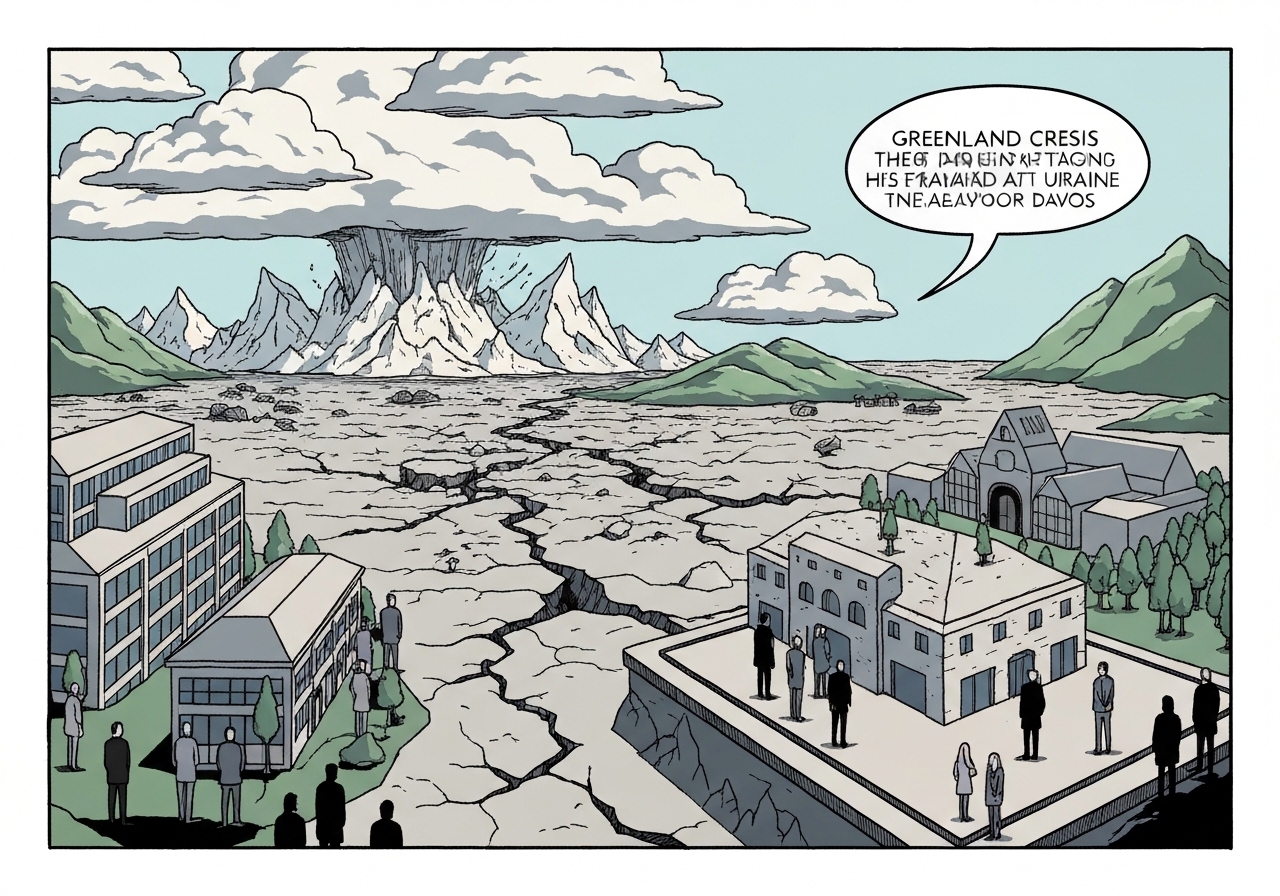
At the World Economic Forum in Davos on Jan. 21, 2026, European leaders found their agenda dominated by U.S. President Donald Trump’s repeated threats regarding Greenland, diverting attention from the active war in Ukraine. The distraction has raised real concern in Kyiv that urgent requests for military and energy support could be sidelined. Ukrainian officials, including President Volodymyr Zelenskyy’s circle, have even weighed whether attending Davos is worth the trip if their security needs cannot get traction. The shift in diplomatic focus comes as Russia continues heavy strikes on Ukraine’s energy grid and civilians face a bitter winter.
Key Takeaways
- At Davos, nearly 65 leaders gathered; Trump’s comments about Greenland drew disproportionate attention away from Ukraine’s needs.
- Trump warned he might not rule out seizing Greenland and suggested punitive tariffs on eight European countries that oppose his stance.
- Ukraine is confronting intense attacks on energy infrastructure while temperatures fell below −20°C in parts of the country this winter.
- DTEK CEO Maxim Timchenko reported electrical service limited to three or four hours daily in many areas and prolonged heating outages in apartment blocks.
- Zelenskyy has had difficulty securing a bilateral slot with President Trump; plans for a U.S.-Ukraine reconstruction agreement at Davos became vague.
- European ministers, including Norway’s Espen Barth Eide and Finland’s Elina Valtonen, publicly warned that Greenland talk is pulling focus from the real war in Europe’s east.
Background
The war in Ukraine, now in its fourth winter since Russia’s full-scale invasion in 2022, remains Europe’s central security crisis. Kyiv has been pressing Western partners for air-defence systems, energy-repair assistance and formal guarantees it says will deter renewed large-scale aggression. Those requests are time-sensitive: repeated strikes have targeted generation and distribution infrastructure, compounding civilian hardship as winter sets in.
Greenland is an autonomous territory within the Kingdom of Denmark and has long attracted geopolitical interest because of its Arctic location and natural resources. President Trump’s recent rhetoric—refusing to rule out seizure and proposing economic measures against opponents—revived a diplomatic row that several European capitals fear could undercut transatlantic cooperation. The dispute reached a crescendo at Davos, where many delegates had expected Ukraine to dominate discussions.
Main Event
Throughout Davos this week, European leaders and diplomats worked to persuade President Trump to abandon his public campaign to claim Greenland. Delegations warned that his language risked undermining the U.S.-led postwar security architecture in Europe and splintering allied unity. That concern intensified as Trump amplified his statements and signalled a readiness to take unilateral economic measures against countries that resist his approach.
Ukrainian officials — from senior aides to business leaders — arrived at Davos seeking clearer U.S. commitments on security guarantees and reconstruction funding. Instead, several said their meetings were overshadowed by back-channel efforts to manage the Greenland flap and by White House attention on Gaza as well. Ukrainian sources report that gaining a fixed bilateral meeting time with Trump proved difficult, leaving planned diplomatic pushes for guarantees and a reconstruction pact uncertain.
On the ground, Kyiv is dealing with a deteriorating energy situation: utility stations and substations have been repeatedly struck, repair crews face ongoing danger, and many citizens experience long power and heating outages. Those humanitarian and operational pressures make rapid allied assistance — especially in air defence and grid restoration — more urgent, officials argue.
Analysis & Implications
Politically, the Greenland episode exposes how a single leader’s rhetoric can reorient a high-level diplomatic agenda. If transatlantic attention remains split, Ukraine risks receiving delayed or diluted commitments at a moment when battlefield conditions and winter hardships heighten urgency. Delays in securing air-defence systems or reconstruction financing could have a measurable effect on Kyiv’s ability to sustain civilian infrastructure and military deterrence through the coming months.
Strategically, the row tests NATO cohesion and the durability of informal U.S. leadership in Europe. Allies worry that public threats—economic penalties or territorial claims—against partners could erode trust and complicate coordinated policy responses to Russia. Even if Trump’s Greenland rhetoric does not translate into policy, the political cost is immediate: less room at multilateral tables for sustained discussion of Ukraine’s needs.
Economically, talk of punitive tariffs on eight European countries raises the prospect of reciprocal measures and market uncertainty. That scenario could distract European capitals further, prompt emergency diplomatic bandwidth to resolve trade disputes, and reduce appetite for large-scale commitments to reconstruction spending or military procurement in the near term.
Comparison & Data
| Metric | Reported Figure |
|---|---|
| Heads of state at Davos | 65 (including Trump) |
| European countries threatened with tariffs | 8 |
| Reported winter lows in Ukraine | Below −20°C |
| Typical daily electricity availability (affected areas) | 3–4 hours |
The table compiles figures reported at Davos and by Ukrainian energy-sector leaders. Together they illustrate why Ukrainian delegations viewed the timing of international support as critical: severe weather and limited power increase civilian vulnerability even as the diplomatic spotlight shifts.
Reactions & Quotes
European ministers expressed frustration that Greenland talk was diverting attention from the eastern front. Below are representative comments given at Davos, with brief context.
“There’s a real war with the Russians going on in Ukraine. Greenland is taking energy away from what we should be talking about.”
Espen Barth Eide, Norwegian Foreign Minister
Barth Eide’s remark captured a common refrain among European diplomats: urgent, concrete support for Ukraine risks being crowded out by a transatlantic confrontation over an Arctic territory.
“We don’t think the future that might unfold…is especially bright for any one of us. I would really hope that we could return to discussing how to end the [Ukraine] war as soon as possible.”
Elina Valtonen, Finland’s Foreign Minister
Finland’s foreign minister emphasised the wider strategic stakes and urged a refocusing on resolving the war and restoring allied unity.
“They’re firing everything they have to try to destroy the energy infrastructure…We only have three or four hours of electricity during the day.”
Maxim Timchenko, CEO, DTEK
Timchenko’s account detailed the humanitarian and operational realities on the ground that Kyiv wanted allies to address immediately.
Unconfirmed
- No independent confirmation that the U.S. intends to annex Greenland or will carry out a forcible seizure; President Trump’s statements remain rhetorical at this stage.
- Specific details and scope of any punitive tariffs on eight European countries are unconfirmed; announced comments indicate a threat but not a finalized policy.
- Whether President Zelenskyy will ultimately skip Davos or secure a bilateral meeting with President Trump remains unresolved at the time of reporting.
- The timing and exact contents of any U.S.-Ukraine economic reconstruction agreement originally planned for Davos are unclear and were reported as vague by Ukrainian officials.
Bottom Line
The Davos episode demonstrates how high-profile rhetoric can reallocate diplomatic attention at a critical moment for European security. Ukraine’s appeals for air defence, grid repairs and reconstruction financing face a higher bar when allied focus is split; the practical consequence could be slower delivery of urgently needed capabilities this winter.
For allies, the urgent question is whether diplomatic energy can be rapidly redirected to concrete support for Kyiv while still managing a transatlantic spat over Greenland. Watch for whether Davos produces clear, scheduled follow-up meetings on security guarantees and reconstruction financing for Ukraine, and whether allied capitals coordinate a message that preserves unity in the face of competing crises.