
Lead
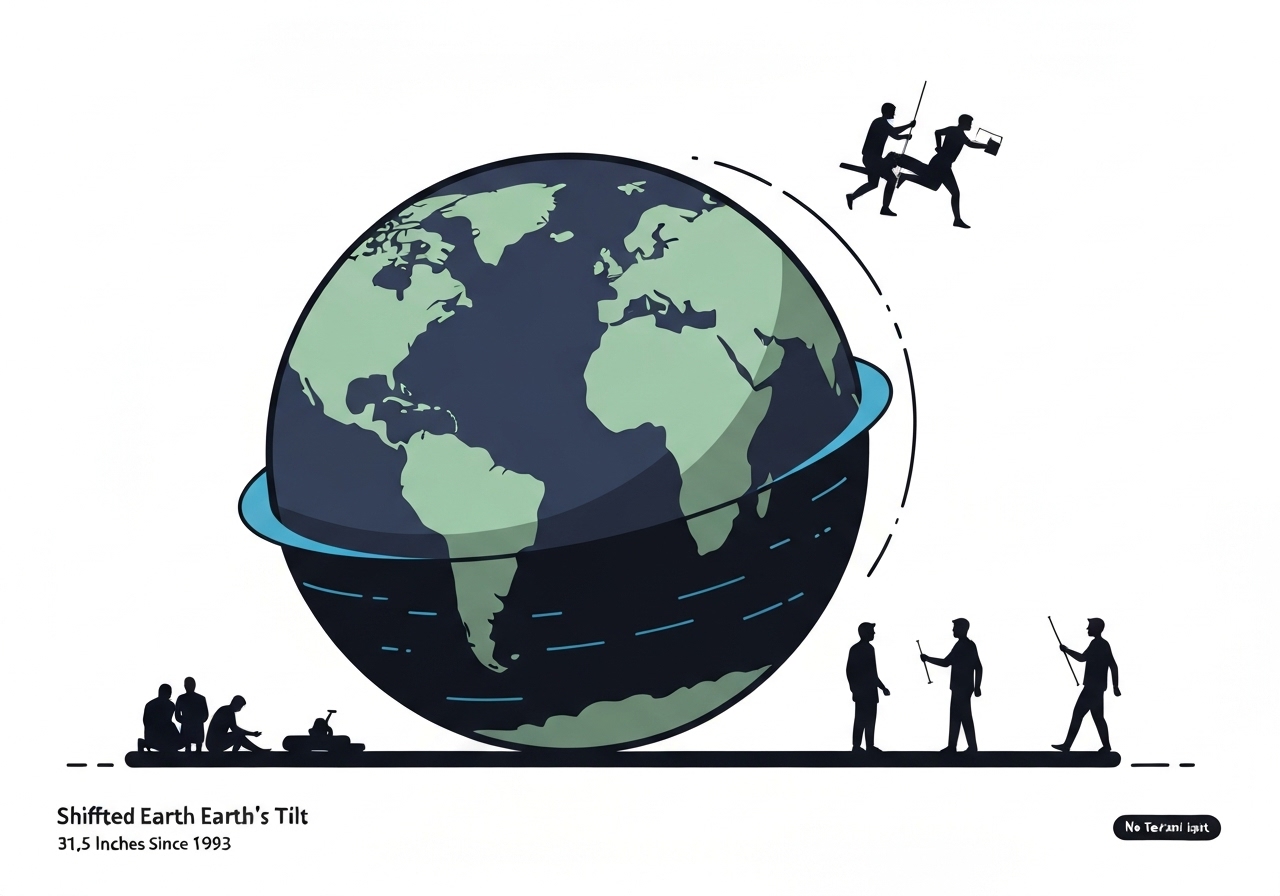
New research published in Geophysical Research Letters finds that intensive groundwater extraction between 1993 and 2010 shifted Earth’s rotational pole by about 31.5 inches (80 cm), an amount the authors say corresponds to roughly 0.24 inches (6 mm) of global sea‑level rise. The study attributes the shift mainly to removal of about 2,150 gigatons of groundwater for irrigation and human use, with much of that water later reaching the oceans. Scientists say the pole drift is measurable and that redistributing mass on the planet—especially from midlatitude regions—changes how Earth spins. The finding links local water-management choices to planetary-scale changes in rotation and sea level.
Key Takeaways
- Researchers analyzed observations from 1993–2010 and modeled mass redistribution to explain an observed ~31.5‑inch (80 cm) shift in Earth’s rotational pole.
- The model that best matched observed pole drift included about 2,150 gigatons of groundwater removed from land storage and relocated toward the oceans.
- The groundwater loss during that period is estimated to have contributed ~0.24 inches (6 mm) to global mean sea‑level rise.
- Redistribution from midlatitude regions—notably western North America and northwestern India—had an outsized effect on polar motion because of their distance from the rotational axis.
- Authors identify groundwater pumping as the largest single climate‑related contributor among the causes they tested for short‑term pole drift.
- Previous NASA work (2016) showed water movement can affect rotation; this study provides quantified mass estimates linking groundwater to polar drift.
- Understanding mass redistribution at continent scale could improve monitoring of large‑scale water storage changes and inform coastal planning.
Background
Earth’s rotation axis is not fixed; the geographic location of the rotational pole wanders in response to redistribution of mass on and within the planet. Large transfers of water—from ice, surface reservoirs or subsurface aquifers—alter the planet’s moment of inertia and cause measurable changes in polar motion. Satellite observations and other geodetic records over recent decades have made it possible to detect relatively small shifts in the pole and to tie them to hydrological and cryospheric changes.
Groundwater pumping has accelerated in many regions for irrigation, drinking water and industry. When groundwater withdrawn for human use reaches the oceans as runoff or wastewater, it becomes part of global sea volume and shifts mass toward lower latitudes and the ocean basins. Prior to the 2016 NASA analyses and the current Geophysical Research Letters study, the relative contribution of groundwater to short‑term polar drift had been suspected but not robustly quantified.
Main Event
The recent study combined observed polar drift records with models of continental water storage changes for 1993–2010. The authors tested multiple scenarios of water redistribution; only the scenario that included roughly 2,150 gigatons of groundwater removal reproduced the measured pole motion. That mass loss corresponds to large, sustained extraction primarily for irrigation in several midlatitude regions.
Researchers highlight western North America and northwestern India as major contributors because extraction there relocates mass from midlatitudes—regions that exert a stronger lever arm on Earth’s rotation than equivalent mass changes near the equator. The study frames the effect as analogous to adding weight to a spinning top: moving mass away from one place changes the spin and the location of the rotational axis.
Lead author Ki‑Weon Seo of Seoul National University said the team was surprised by how much groundwater redistribution explained of the previously unexplained pole drift. The authors caution that the results refer to the 1993–2010 window and rely on available hydrological and geodetic records integrated into their models. They also emphasize that much of the pumped groundwater eventually enters the oceans, linking terrestrial water use to sea‑level rise.
Analysis & Implications
The quantification of groundwater’s contribution to pole drift refines our understanding of short‑term Earth rotation variability. Identifying 2,150 gigatons as a plausible magnitude of pumped groundwater over 17 years provides a concrete figure for modelers and policymakers. Because the polar motion depends on where mass is moved from and to, regional water‑management decisions have disproportionate global effects: extraction in midlatitudes shifts the pole more than equivalent losses near the equator.
From a sea‑level perspective, the ~0.24‑inch (6 mm) contribution is modest but meaningful when compared with other contributors over the same period. Sea level rises from thermal expansion and ice melt are larger overall, but groundwater loss is an additional, cumulative source that directly transfers terrestrial water to the ocean. For coastal planners, the result highlights another anthropogenic driver of rising seas to incorporate into risk assessments.
The finding also has scientific utility: observed pole motion can act as an independent integrator of continent‑scale water storage changes. In regions with sparse in‑situ hydrological data, geodetic signals may help close water budgets and detect unsustainable extraction. However, translating pole motion into specific regional policies requires continuing improvements in hydrological, geodetic and mass‑transport models and longer observational records.
Comparison & Data
| Metric | Value | Period |
|---|---|---|
| Estimated groundwater removed | 2,150 gigatons | 1993–2010 |
| Polar shift attributed to groundwater | 31.5 inches (80 cm) | 1993–2010 |
| Equivalent global sea‑level rise | 0.24 inches (6 mm) | 1993–2010 |
This table summarizes the core numerical results reported by the study. The 2,150‑gigaton figure is an aggregate modeled mass loss required to reproduce observed pole drift; it represents pumped groundwater that the authors estimate was later redistributed, largely to the oceans. The 31.5‑inch figure refers to the modeled displacement of the rotational pole over the same interval, and the 0.24‑inch number is the corresponding contribution to global mean sea level when that groundwater reaches the ocean.
Reactions & Quotes
Experts familiar with polar motion and mass‑transport studies welcomed the quantification while noting caveats about model assumptions and the limited time window.
“Our study shows that among climate‑related causes, the redistribution of groundwater actually has the largest impact on the drift of the rotational pole.”
Ki‑Weon Seo, Seoul National University (study lead)
Seo framed the result as both a scientific clarification and a personal concern: the same processes altering pole motion also contribute to sea‑level rise. Other researchers emphasized that the new paper builds on earlier NASA work that first demonstrated water redistribution can change rotation.
“They’ve quantified the role of groundwater pumping on polar motion, and it’s pretty significant.”
Surendra Adhikari, NASA Jet Propulsion Laboratory (research scientist)
Adhikari, who worked on the 2016 NASA analysis, said the quantification helps put groundwater in context alongside glacier and ice‑sheet mass loss. Public and policy reactions so far focus on the implication that water management choices have planetary consequences.
Unconfirmed
- Whether the 2,150‑gigaton estimate captures all regional sources and sinks precisely—model sensitivity means the number has uncertainty.
- How trends after 2010 alter the long‑term trajectory of polar motion—post‑2010 data were not part of this study.
- The degree to which specific local policies directly caused the modeled groundwater loss—attribution to particular management decisions requires regional hydrological analyses.
Bottom Line
The study provides concrete numbers linking human groundwater extraction to measurable changes in Earth’s rotation and a small but non‑negligible contribution to sea‑level rise between 1993 and 2010. It reinforces that water‑use practices have consequences beyond local shortages: they reshape mass distribution at a planetary scale and therefore affect geophysical metrics like polar motion.
For policymakers and resource managers, the result argues for integrating groundwater stewardship into both water security and coastal risk planning. For scientists, the study points to the value of combining geodetic observations and hydrological modeling to monitor large‑scale water redistribution and to reduce uncertainties by extending and refining records.
Sources
- Yahoo News (news report summarizing the study)
- Geophysical Research Letters (journal — publisher page for the study)
- NASA Jet Propulsion Laboratory (agency — prior 2016 research on water redistribution and rotation)
- Seoul National University (academic institution — lead author affiliation)