
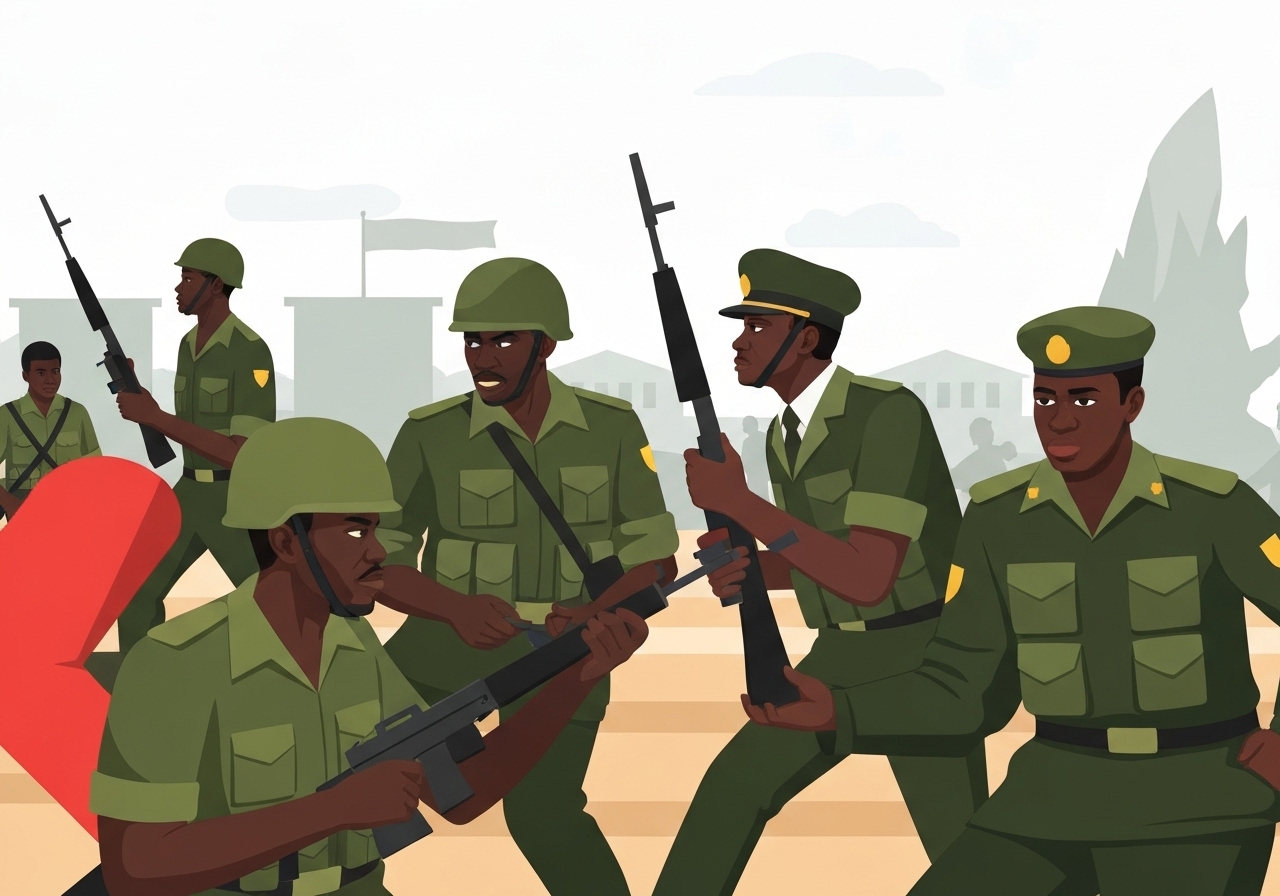
Lead
Soldiers in Bissau on Thursday installed Gen. Horta N’Ta as head of a new military junta, formalizing a takeover that began in the aftermath of a tense presidential vote held days earlier. The junta announced a one-year transition during a state-televised declaration, citing a breakdown of political order as justification. Deposed President Umaro Sissoco Embaló was reported detained amid gunfire near the presidential palace, while his main rival, Fernando Dias, accused Embaló of staging the disruption to avoid electoral defeat.
Key Takeaways
- The military announced Gen. Horta N’Ta as junta leader on state television and set a one-year transition timeline.
- President Umaro Sissoco Embaló, 53, said he had been arrested; his whereabouts were unconfirmed on Thursday.
- Fernando Dias, 47, who also claims victory in Sunday’s vote, said the reported takeover was fabricated to block results.
- The election commission’s office was reported sealed and gunfire was heard near the presidential palace on Wednesday.
- Guinea-Bissau, population about 2.2 million, has a long history of coups and remains a transit hub for drug trafficking between Latin America and Europe.
- International bodies, including the United Nations, have condemned the reported takeover and said they are monitoring developments closely.
Background
Guinea-Bissau has experienced chronic political instability since independence, with multiple coups and attempted coups over decades. The country of roughly 2.2 million people has struggled with weak state institutions, which analysts say have been exploited by criminal networks involved in transatlantic drug trafficking. That illicit economy is widely seen as a factor that has deepened political rivalries and weakened civilian governance.
This week’s events unfolded against the backdrop of a closely contested presidential election held on Sunday, in which both incumbent Umaro Sissoco Embaló and challenger Fernando Dias declared victory. Embaló, a 53-year-old former army general seeking a second term, has faced opposition claims that his mandate had expired, heightening tensions before the vote. A coup attempt occurred as recently as October, underscoring the country’s fragile democratic gains.
Main Event
On Wednesday, gunfire was reported close to the presidential palace in the capital, Bissau, and the electoral commission’s offices were later sealed, according to multiple accounts. The following day military leaders appeared on state television to announce they had taken control and named Gen. Horta N’Ta as head of a military government that would manage a one-year transition. The junta framed the intervention as a response to a worsening political climate and alleged schemes to manipulate results.
Deposed President Embaló told French media on Wednesday that soldiers had arrested him amid the unrest; by Thursday his location remained unclear to independent observers. Fernando Dias said he had been detained briefly but escaped and accused Embaló of faking a coup to avoid conceding defeat. Dias and the opposition African Party for the Independence of Guinea and Cape Verde urged citizens to protest and demand publication of the official results.
Military spokespeople, speaking on state television, alleged a plot involving national politicians, a known drug lord, and foreign nationals to manipulate the vote. The Associated Press noted it could not independently verify some claims, including allegations about third-party involvement and the precise circumstances of arrests. In the capital on Thursday morning, daily life appeared to be resuming gradually, with businesses and public transport operating again.
Analysis & Implications
The junta’s rapid consolidation of power highlights enduring weaknesses in Guinea-Bissau’s political institutions and electoral processes. When military leaders justify interventions by pointing to electoral manipulation or political paralysis, it can create a permissive environment for future coups across the region. This episode may encourage other actors in West Africa where disputed elections have already weakened democratic norms.
Economically, renewed instability threatens foreign aid flows and investor confidence in a country that relies heavily on external support and remittances. The alleged involvement of drug-trafficking networks in political manipulation — if substantiated — would further complicate international cooperation on law enforcement and anti-corruption efforts. Donor states and regional bodies are likely to condition engagement on a clear return to civilian rule and transparent election verification.
Diplomatically, the junta faces immediate pressure: sanctions, suspension of aid, or regional isolation are possible responses from ECOWAS, the African Union and other partners if the military does not set a credible path back to constitutional order. Conversely, if the junta proceeds with a one-year transition that leads to an internationally supervised vote, some sanctions may be averted, but trust in institutions will still require major reforms and verification mechanisms.
Comparison & Data
| Indicator | Value |
|---|---|
| Population | ~2.2 million |
| Transition announced by junta | 1 year |
| Recent coup activity | Multiple events; an attempt reported in October |
These figures underscore the narrow margin for stability in a small state where institutional capacity is limited. The one-year timeline is a common concession by juntas to signal temporariness, but history in the country and the region shows such timelines are often extended unless guaranteed by strong external oversight.
Reactions & Quotes
Military leaders said the armed forces stepped in after political actors failed to control a deteriorating climate and alleged schemes to manipulate results.
Military spokesperson Dinis N’Tchama (state television)
Fernando Dias accused the incumbent of fabricating a coup to avoid admitting electoral defeat and vowed to mobilize supporters.
Fernando Dias (opposition leader)
The United Nations said it was following the situation with deep concern and urged restraint and respect for democratic processes.
United Nations (international organization)
Unconfirmed
- The military’s claim that a scheme to manipulate results involved a named drug lord and foreign nationals has not been independently verified.
- Reports of Embaló’s arrest and his exact location on Thursday remained unconfirmed by independent observers.
- Competing claims of victory by both Embaló and Dias have not been substantiated by a publicly released, verified count from the electoral commission.
Bottom Line
The installation of Gen. Horta N’Ta as junta leader marks a significant reversal for Guinea-Bissau’s fragile democratic trajectory and risks prolonging instability in a country already challenged by weak institutions and illicit economies. Key questions now are whether the junta will allow independent verification of the election and whether regional and international actors can compel a credible return to civilian rule within the junta’s proposed one-year transition.
For citizens and international partners alike, the immediate priorities are verification of the electoral outcome, confirmation of the detained president’s status, and assurances that protests and political activity will not be met with further violence. The coming days will determine whether this intervention becomes a brief interruption with a clear exit strategy or a prolonged military hold on power with lasting consequences for governance and regional stability.