
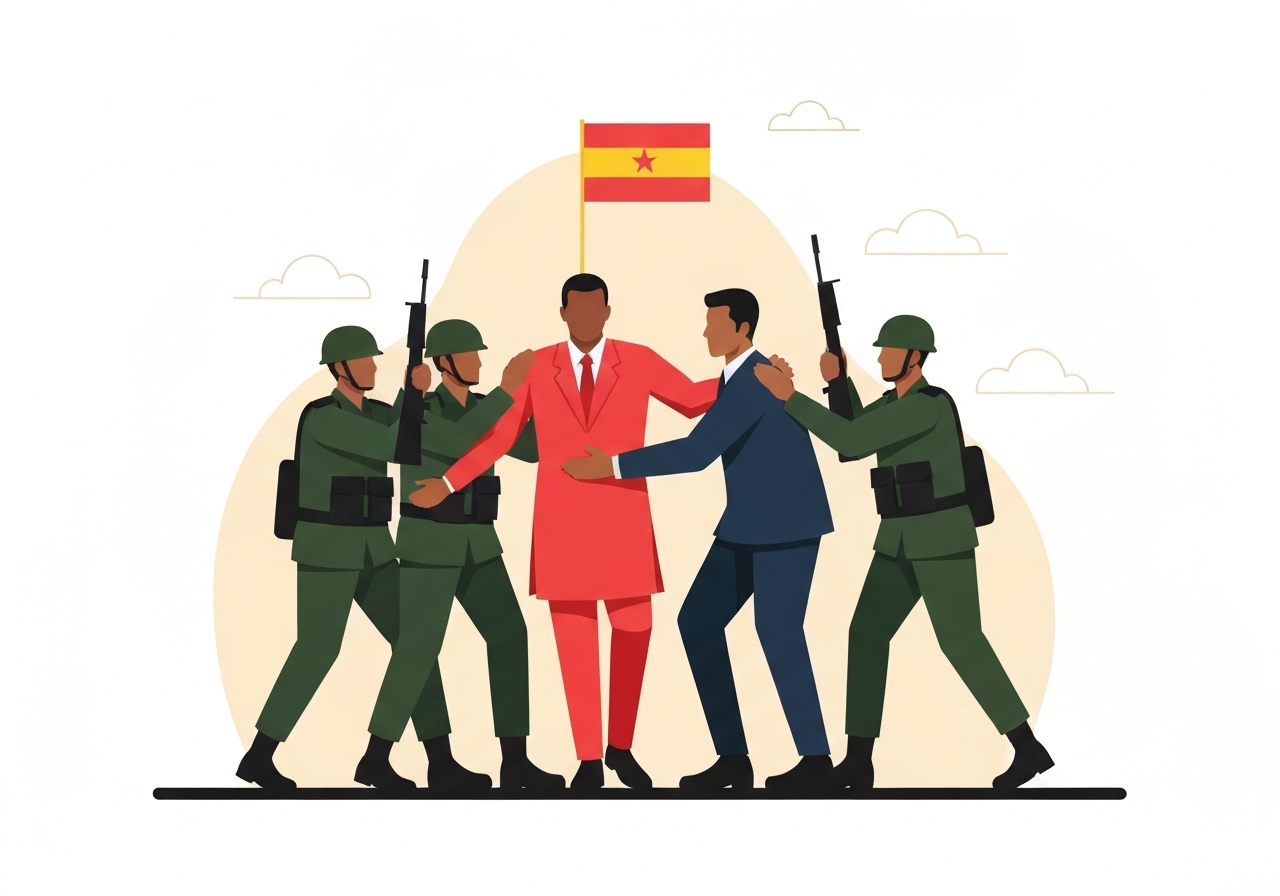
— Guinea-Bissau’s armed forces announced they had taken control of the country on Wednesday, one day before the official announcement of presidential election results in the capital, Bissau. Gunfire was reported near the presidential palace and the national electoral commission, and a military spokesman said borders and airspace were closed and the electoral process suspended. Later the main opposition candidate, Fernando Dias, posted a video accusing President Umaro Sissoco Embaló of staging the seizure to avoid conceding defeat; that allegation remains unverified.
Key Takeaways
- The military announced a takeover on Nov. 26, 2025, and said it had deposed President Umaro Sissoco Embaló.
- Gunfire was heard near the presidential palace and the National Electoral Commission headquarters in Bissau, prompting citywide confusion.
- Military spokesman Dinis N’Tchama declared on state television that borders and airspace were closed and the electoral process suspended.
- Fernando Dias, the leading opposition candidate, accused Mr. Embaló in a late-night video of staging the event after the president realized he was losing the vote; independent verification of that claim was not available.
- The takeover occurred one day before the scheduled announcement of the presidential election results, heightening uncertainty about the legitimacy of the process.
- No independently verified casualty figures or confirmed arrests have been reported as of the latest statements.
- The incident adds to a regional pattern of military interventions in parts of West Africa in recent years and may prompt responses from regional bodies and donor partners.
Background
Guinea-Bissau has experienced repeated political instability since independence, with frequent changes in government, military interventions, and a fragile civilian rule. The country’s politics have been shaped by factional divisions within political elites, a history of coups and attempted coups, and challenges in building durable institutions that can manage contested elections. Presidential elections were held recently, and authorities had scheduled a formal announcement of results the day after the military’s action. Election management and credibility have been central fault lines in Guinea-Bissau’s political life, with the national electoral commission repeatedly at the center of disputes.
Regional actors — notably West African organizations and international partners — have in past crises urged restraint and a return to constitutional order, while also weighing sanctions or mediation when seizures of power occur. The armed forces remain a potent political actor in Bissau, and the rapid appearance of heavily armed, uniformed personnel on state television has become an increasingly familiar signal when the military moves against civilian authorities in parts of the region. Economic fragility and dependence on external assistance further raise the stakes for any interruption of governance.
Main Event
On the afternoon of Nov. 26, residents of Bissau reported sounds of gunfire near two high-profile sites: the presidential palace and the electoral commission’s headquarters. The shootings prompted confusion and closures of some streets as civilians sought safety. A short time later a military spokesman, identified as Dinis N’Tchama, appeared on state television flanked by uniformed, armed soldiers to announce the seizure. He framed the move as a response to what the military described as a plan to destabilize the country.
The military announcement said it had deposed President Umaro Sissoco Embaló, shut the country’s borders and airspace, and suspended the electoral process. The statement did not provide a detailed timeline for how authority would be organized going forward or which institutions would be responsible for security and governance during the suspension. State television carried the announcement live, amplifying the message across the capital.
Late on Wednesday night, Fernando Dias, the main opposition candidate, released a video message in which he accused President Embaló of fabricating the coup after realizing he would lose the vote. Mr. Dias said security forces loyal to the president attempted to arrest him and he had to flee through a back door; those claims have not been independently confirmed. The sequence — election, sudden military intervention, and competing narratives — created a highly contested picture of who controls state authority and why.
Analysis & Implications
For Guinea-Bissau, the immediate consequence is a disruption of the electoral timetable and a sharp escalation of political risk. Suspending the electoral process undermines the mechanism by which leadership transitions are legitimized and could deepen polarization between supporters of the president and the opposition. If the military consolidates control, political institutions such as the electoral commission and the judiciary may be sidelined, complicating efforts to restore a credible vote count or to hold new elections under neutral oversight.
Regionally, the event may provoke responses from West African bodies and international partners that have sought to deter unconstitutional changes of government. Possible measures include diplomatic pressure, targeted sanctions, or offers of mediation; each option presents trade-offs between isolating a military regime and preserving channels for negotiation. The credibility of Guinea-Bissau’s next steps will also determine donor confidence and the flow of external assistance, with negative economic ripple effects if instability persists.
Longer-term risks include a potential erosion of civilian rule if the armed forces remain engaged in governance for an extended period, and a discouragement of investment and development projects that depend on predictable institutions. Conversely, a rapid, transparent mediation that restores the electoral timetable and clarifies accountability could limit damage. Much will depend on whether key domestic actors — political parties, the civil service, and security commanders — align behind a negotiated pathway or a prolonged power struggle.
Reactions & Quotes
Officials and political actors offered sharply different accounts, reflecting the contested facts on the ground and the speed of developments.
“This operation responds to an ongoing plan to destabilize our country,”
Dinis N’Tchama, military spokesman (state television)
The military framed its actions as preventive and justified by security concerns; the statement emphasized closure of borders and suspension of the vote without detailing the evidence for the described plot.
“Umaro lost the elections, and instead of accepting the result, he fabricated a coup d’état,”
Fernando Dias, opposition candidate (video message)
Mr. Dias accused the president of orchestrating the events to avoid conceding defeat and said he narrowly escaped arrest. The claim has not been independently corroborated, and both parties offered competing versions of control over state institutions.
Unconfirmed
- Whether President Umaro Sissoco Embaló personally orchestrated or authorized the military action; this remains an allegation from the opposition without independent verification.
- Exact numbers of casualties, arrests, or detentions related to the gunfire and subsequent security operations have not been publicly confirmed.
- The identity and chain of command of forces who carried out the operation beyond the named military spokesman require further corroboration.
Bottom Line
The Nov. 26 military takeover in Guinea-Bissau interrupted a scheduled election result announcement and left competing narratives about who engineered the crisis. The military contends it acted to prevent destabilization, while the opposition alleges the president staged the event to cling to power; independent verification of the core allegation is lacking.
How regional actors and domestic institutions respond in the coming days will shape whether the interruption resolves into a short-term governance crisis with a return to the vote or a longer period of uncertainty. For citizens and external partners, the immediate priorities are clarity on the safety of civilians, the status of detained or threatened political figures, and a credible path to restore an accepted electoral outcome.