
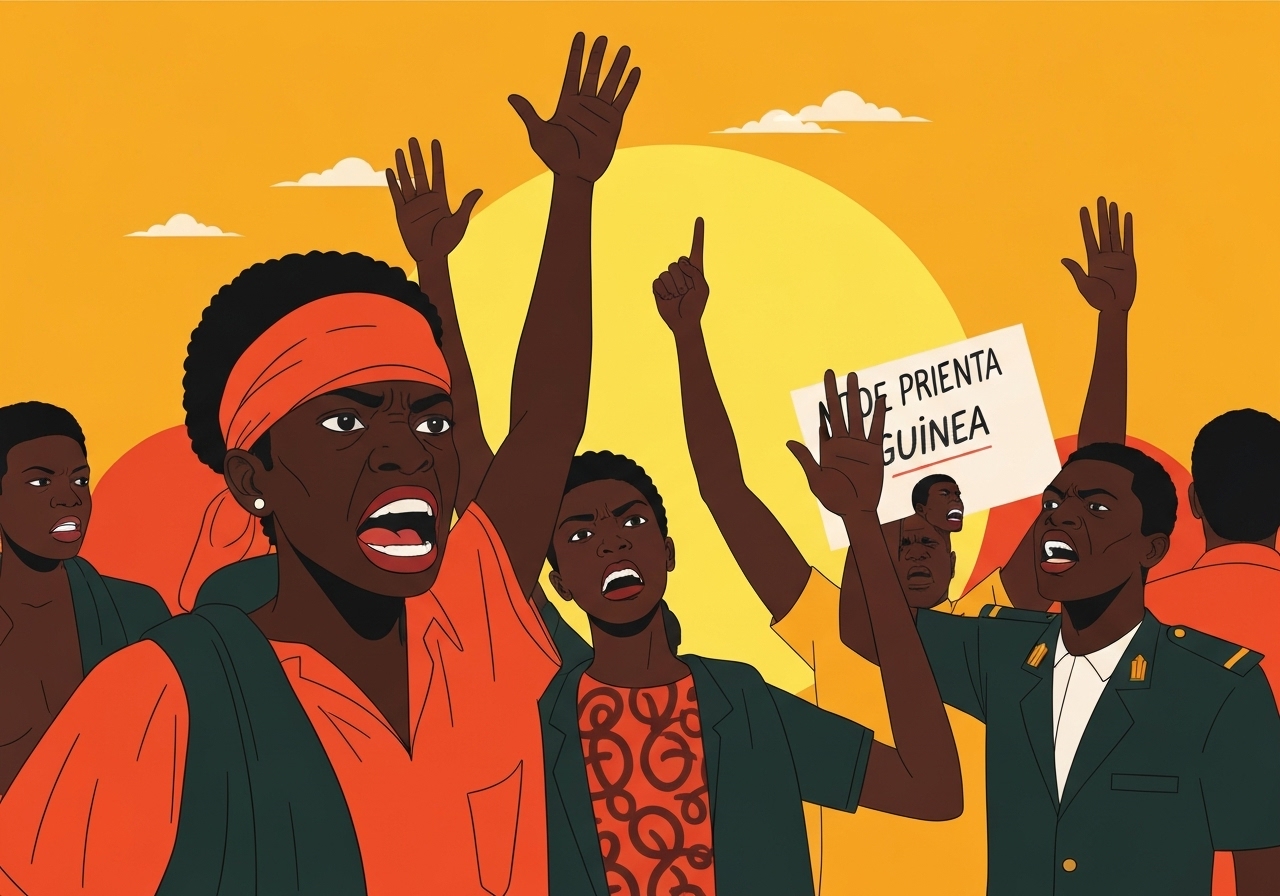
Lead: On Sunday, 6.7 million eligible Guineans were called to vote in the country’s first presidential election since the September 2021 coup. The clear frontrunner is coup leader Mamady Doumbouya, who has been allowed to stand after a September referendum that rewrote the constitution and extended presidential terms. Opposition groups have condemned his candidacy as a betrayal of the transitional promise of a return to civilian rule. The vote comes as the government highlights the launch of the Simandou iron-ore project as a sign of economic progress.
Key takeaways
- 6.7 million Guineans were eligible to vote in the presidential poll held on Sunday, the first since the 2021 coup.
- Junta leader Mamady Doumbouya is the frontrunner after a September referendum changed the constitution and allowed incumbents to run; presidential terms were extended from five to seven years.
- The opposition coalition Forces vives de Guinée called Doumbouya’s bid a betrayal and said the transition pledge was broken.
- Major opposition parties remain suspended; prominent figures are detained, barred or in exile, including Cellou Dalein Diallo.
- Doumbouya granted a pardon to former strongman Moussa Dadis Camara, who had been serving a 20-year sentence for the 2009 stadium massacre.
- The government opened the long-delayed Simandou iron-ore mine this month; the project includes ports and rail links that could reshape Guinea’s economy.
- Regional context: West Africa’s “coup belt” has seen seven successful coups since 2020; Burkina Faso, Mali and Niger have formed the Alliance of Sahel States, breaking with ECOWAS.
Background
In September 2021 a group of soldiers led by then-colonel Mamady Doumbouya seized power, removing president Alpha Condé. Doumbouya framed the takeover as a corrective action to restore popular will, and he announced a 36-month transition timeline to civilian rule, a timetable that drew criticism from ECOWAS, which urged a quicker handover. The transitional authority subsequently organized a referendum in September 2025 that adopted a new constitution and cleared the legal path for Doumbouya to stand for president.
Guinea is resource-rich but faces stark poverty: roughly half the population subsists on under $2 a day. Political instability has stalled investment for decades; the long-awaited Simandou iron-ore project has been delayed repeatedly by governance problems and corruption allegations. The mine’s launch this month is presented by the government as a potential economic turning point, even as opponents warn of opaque contracts and environmental and job-impact concerns.
Main event
The presidential ballot includes nine candidates, among them former minister Abdoulaye Yéro Baldé and ex-ally-turned-critic Faya Millimono. But the campaign unfolded with many leading opposition figures sidelined: key parties remain suspended, some leaders detained or barred from contesting, and others operating from exile. Critics say those restrictions have skewed the playing field in favor of the incumbent-backed candidate.
Doumbouya has consolidated state authority since 2021 and was promoted within the military hierarchy; his supporters present the election as a stabilization process and point to recent infrastructure milestones. The referendum that enabled his candidacy also extended presidential terms from five to seven years, a change opponents say entrenches power. Forces vives de Guinée described his candidacy as a reversal of the promise to return to civilian rule.
Security forces have been active in curtailing protests and dissent during the campaign period, according to opposition statements and human rights groups. Several dissidents have been detained; journalists and civil society actors report a climate of fear that complicates independent monitoring. At the same time, state media and government communications have emphasized economic projects, including the Simandou mine, to highlight potential gains from continuity.
Analysis & implications
Domestically, a Doumbouya victory would formalize the shift from coup leader to constitutional president and likely shape Guinea’s governance for years, given the extended seven-year presidential term. That trajectory raises questions about checks and balances, judicial independence, and the viability of a meaningful opposition if key parties remain suspended. International actors will weigh whether to engage with or isolate a government that rose to power via a coup but now claims electoral legitimacy.
Economically, the Simandou mine is a pivotal factor. If developed transparently, the multi-layered project—mining concessions plus port and rail construction—could boost state revenues and infrastructure. However, the risk of opaque contracts, limited local employment gains, environmental harm and concentrated rent capture is high. Observers note that the mine’s benefits depend on governance reforms that have not yet been secured.
Regionally, Guinea’s election is being watched as a test case in a West Africa fractured by multiple coups. ECOWAS has urged a return to democratic order since 2021, but several juntas have exited the bloc and formed the Alliance of Sahel States, aligning more closely with non-Western partners. A contested or non-inclusive outcome in Conakry could deepen regional fragmentation and complicate diplomatic and economic ties.
Comparison & data
| Country | Recent coup year | Outcome |
|---|---|---|
| Guinea | 2021 | Junta installed; presidential vote 2025 |
| Mali | 2020, 2021 | Junta in power; broken with ECOWAS |
| Burkina Faso | 2022 | Junta in power; AES member |
| Niger | 2023 | Junta in power; AES member |
These comparisons show a pattern of military intervention across the region that has altered diplomatic alignments and prompted new security and economic dynamics. Guinea’s election will be the first presidential contest in a junta-ruled state in the region since 2020 if the vote proceeds as scheduled, making Conakry a focal point for international observers.
Reactions & quotes
“The man who presented himself as the restorer of democracy chose to become its gravedigger.”
Forces vives de Guinée (opposition coalition)
Forces vives framed Doumbouya’s candidacy as a betrayal of the transitional pledge; the comment was issued after he formally filed to run with the supreme court. Opposition groups say the constitutional changes and the suspension of major parties have hollowed out the contest.
“Our salvation lies in a return to the [proper] constitutional order.”
Abdoulaye Koroma, presidential candidate, Rally for Renaissance and Development
Koroma used his campaign platform to stress a restoration of constitutional processes and to contrast his position with the junta leader’s path to the ballot. His remarks reflect broader appeals from smaller parties that a credible constitutional path is necessary for long-term stability.
“The will of the strongest has always supplanted the law,”
Mamady Doumbouya, 2021 announcement
Doumbouya invoked that phrase during the 2021 takeover as he defended the coup as corrective. The line remains emblematic of his justification for the intervention and has been recalled by critics who argue it signals a weakness in constitutionalism.
Unconfirmed
- Claims that the election outcome was predetermined by explicit vote-rigging remain unproven pending independent observation and official tallies.
- Allegations about the full scope of job losses and environmental harm from the Simandou project are reported but are still being independently quantified.
- Reports that all imprisoned opposition figures will be tried after the election are not independently verified at this time.
Bottom line
The presidential vote in Guinea is a pivotal moment that could either consolidate a coup leader’s transition into constitutional rule or deepen a crisis of legitimacy if the process is widely seen as unfair. Key indicators to watch are the conduct of electoral authorities, the presence and reports of independent observers, and the immediate post-election treatment of opposition figures.
Economically, the Simandou mine’s launch heightens stakes: revenues and infrastructure linked to the project could finance development if governance improves, but they could also reinforce elite capture without transparency safeguards. Regionally, the outcome will affect ECOWAS relations and the trajectory of the so-called coup belt in West Africa.
Sources
- The Guardian (international news outlet) — primary reporting on the election and political context.
- Economic Community of West African States (ECOWAS) (regional organization) — statements and regional policy context regarding transitions.
- Reuters (international news agency) — photographic coverage and reporting on campaign visuals and events.