
Lead
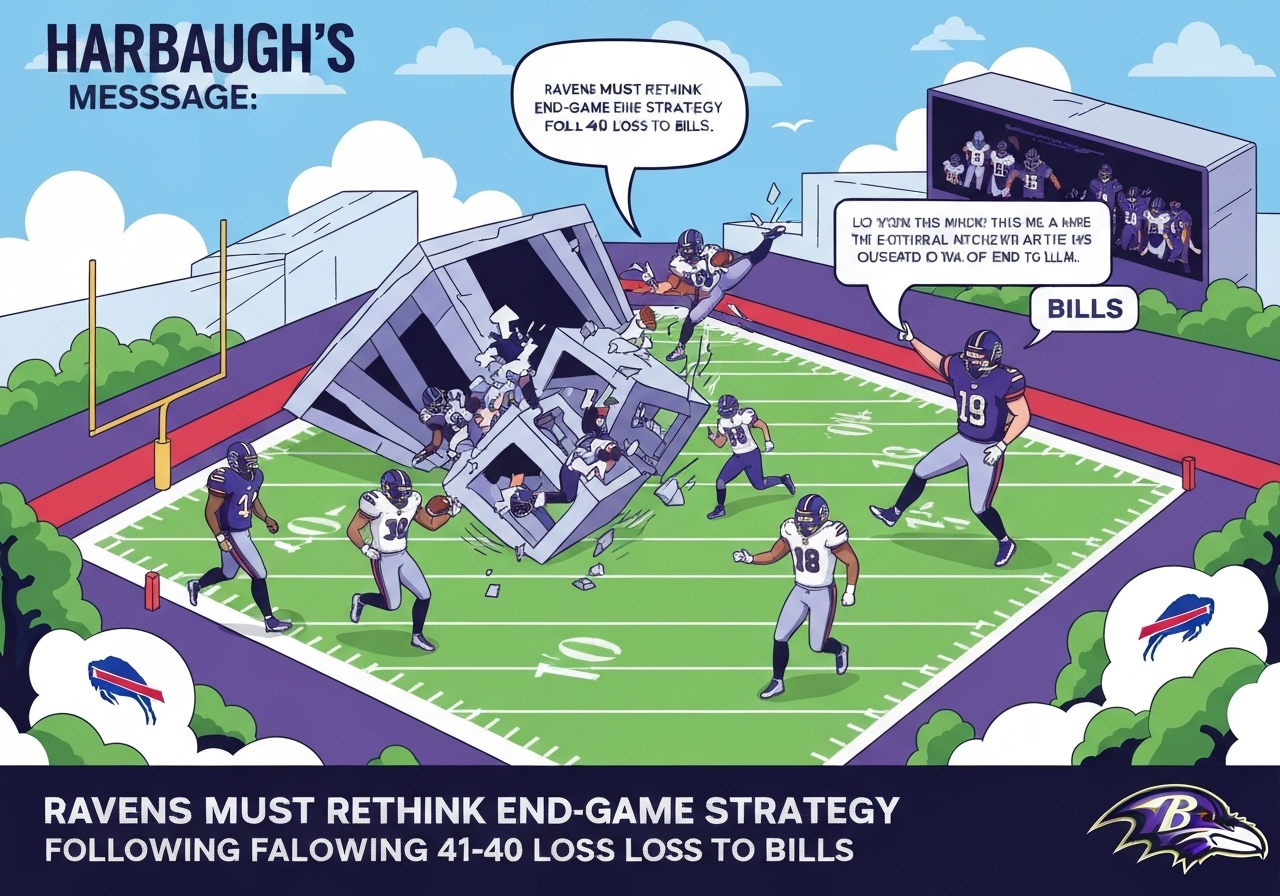
On Sunday night in Buffalo, the Baltimore Ravens surrendered a 41-40 lead and fell to the Buffalo Bills, prompting coach John Harbaugh to call for a deliberate reassessment of late-game strategy. The collapse — capped by a Derrick Henry fumble forced by Ed Oliver and a decisive fourth-quarter rally by Josh Allen — left the Ravens searching for answers about play-calling, sideline communication and situational planning. Harbaugh singled out end‑game decision-making as an area that must be “really thoughtful” going forward. The loss was notable not only for the scoreline but for how a powerful Baltimore offense and a porous late defense combined to produce an historic upset.
Key Takeaways
- The Ravens lost 41-40 to the Buffalo Bills on Sunday night in Orchard Park, allowing 22 fourth-quarter points.
- Baltimore led by as many as 15 points before Buffalo’s comeback; a three-and-out and then a Derrick Henry fumble (forced by Ed Oliver) swung momentum late.
- Facing fourth-and-3 at their own 38 with 1:33 remaining, the Ravens chose to punt rather than attempt a conversion; that sequence has become the focus of scrutiny.
- NFL Research noted that teams with 40+ points and 235+ rushing yards were 277-0 entering the game; the Ravens became the first to meet those thresholds and still lose.
- Harbaugh emphasized rethinking offensive and defensive play-calling, sideline communication, and situational mindset when protecting late leads.
Background
The Ravens entered the 2025 season opener viewed as one of the NFL’s most complete rosters, pairing an elite rushing attack with a high-scoring offense. Baltimore’s star running back Derrick Henry reached a milestone in the game, scoring his 107th career rushing touchdown, but his late fumble proved pivotal. Historically the franchise has both won and surrendered late leads at times, making end‑game management a recurring subject in team meetings and media coverage. League-wide, coaches face rising pressure to balance aggression and caution in fourth-quarter situations against top quarterbacks such as Buffalo’s Josh Allen.
John Harbaugh has a record of conservative and aggressive choices depending on context, but the Bills loss has placed his situational judgment under a microscope. The decision to punt from the Ravens’ 38 with 1:33 on the clock — following plays that failed to convert earlier downs — crystallized questions about play selection in high-leverage moments. Special teams, defensive matchups, and the health or readiness of key players factored into the call tree that night. The result has fueled debate among analysts, fans, and within the organization about how to construct a repeatable late-game plan.
Main Event
The sequence that clinched Buffalo’s comeback began late in the fourth quarter after Baltimore’s offense stalled on a three-and-out while leading by 15. Buffalo used the possession to chip away, and momentum shifted further when Ed Oliver forced a fumble on Derrick Henry, with the Bills recovering and converting to points. That turnover put Buffalo within striking distance and energized their two-minute offense.
A few minutes later, with 1:33 remaining and the Ravens holding a two-point lead, Baltimore faced fourth-and-3 at its own 38. Head coach John Harbaugh elected to punt rather than go for the first down or risk a failed attempt that would have given Buffalo immediate field-goal range. Prior to the fourth-down decision, three earlier play calls had failed to move the chains, leaving critics to question the game-plan sequencing in the game’s most critical window.
Buffalo’s final drive was aided by a contested pass that resulted in a touchdown after a deflection and catch by Keon Coleman, and Josh Allen engineered the late rally that produced 16 straight points in the closing minutes. The Bills’ comeback completed a sequence that exposed how quickly a large lead can evaporate when turnovers and situational miscues compound. Postgame, Harbaugh and his staff were candid about the need to review and adjust their late-game mode of operation.
Analysis & Implications
The loss spotlights a tactical crossroads for Baltimore. Offensively, the team must decide whether to default to conservative ball-control in late windows or to trust play designs that aim to extend drives even under aggressive coverage. Harbaugh himself weighed both options in his postgame remarks, noting the trade-offs between a quick pass against tight man coverage and giving the ball to a trusted ball-carrier like Henry or Lamar Jackson. The choice is not purely schematic; it depends on in-the-moment player availability and quarterback comfort.
Defensively, surrendering 22 fourth-quarter points raises questions about personnel matchups, halftime adjustments and the team’s ability to close out possessions. Harbaugh said he trusts the defense moving forward, but the statistical reality remains: a normally stout unit ceded multiple chunk plays when it mattered most. Opponents with dynamic quarterbacks expose communication breakdowns more readily, and that places a premium on pre-defined situational roles and sideline messaging.
From a roster and coaching-staff perspective, the episode may accelerate conversations about contingency planning — scripted plays for chaotic scenarios, clearer down-and-distance protocols, and rehearsed sideline language for defensive alignments. The front office must also weigh whether personnel tweaks at positions that determine late-game resilience (pass rush, slot coverage, special teams) are necessary. Public confidence can be restored by concrete changes: clearer fourth-down philosophies, more practice reps in two-minute and lead-protection drills, and transparent postgame analysis.
Comparison & Data
| Metric | Typical Result (pre-game) | Ravens vs. Bills |
|---|---|---|
| Points scored (team) | 40+ usually wins | Ravens 40 |
| Rushing yards (team) | 235+ usually wins | Ravens 235+ (met threshold) |
| Games with both marks (historical) | 277-0 record entering game | First loss after meeting both marks |
The table shows why the result is statistically anomalous: prior to this game, no team that posted 40-plus points while running for at least 235 yards had lost. That combination has historically correlated with both offensive dominance and control of clock and field position. Baltimore’s loss underscores how single turnovers and late defensive lapses can overturn otherwise overwhelming statistical advantages.
Reactions & Quotes
Coach Harbaugh addressed the team’s pattern of blown leads and emphasized intentional change in late-game preparation. He acknowledged missed opportunities on play selection and discussed the split-second nature of his fourth-down decision.
“We need to be really thoughtful of how we decide that we’re going to approach those situations going forward.”
John Harbaugh, Ravens head coach
Bills quarterback Josh Allen framed the comeback as a product of persistence and opportunism as his team capitalized on turnovers and pressure plays down the stretch.
“Our team didn’t quit — we kept fighting in the fourth quarter and found ways to score when it mattered.”
Josh Allen, Bills quarterback
Harbaugh also expressed confidence in his defense despite the setback, indicating that the coaching staff will continue to rely on that unit in high-leverage moments while addressing the communication gaps exposed.
“I trust our defense, and I’m going to trust our defense this year in a lot of big situations.”
John Harbaugh, Ravens head coach
Unconfirmed
- Some media reports speculate about miscommunication between offensive and special-teams coaches on the fourth-down sequence; the team has not publicly confirmed internal messaging errors.
- There are unverified accounts that Lamar Jackson showed signs of a minor injury late in the game; the Ravens have not released a medical update confirming this.
Bottom Line
The Ravens’ 41-40 defeat to the Bills is an outlier by historical metrics but a clear signal that end-game planning needs formal revision. A combination of turnover, failed short-yardage plays and defensive lapses produced a sequence that experts and fans will study for lessons rather than simply write off as fluke noise. Harbaugh has publicly committed to deliberate review of play-calling, sideline communication and situational responses; the next few games will reveal whether those reviews translate into changed behavior.
For Baltimore, the immediate priority is restoring confidence through practice-room fixes and sharper late-game scripts. For the league, the loss serves as a reminder that even dominant statistical performances can be overturned by a handful of high-leverage events. Close attention to fourth-down philosophy, two-minute offense reps and defensive communication protocols will determine whether the Ravens convert this setback into sustainable improvement.