
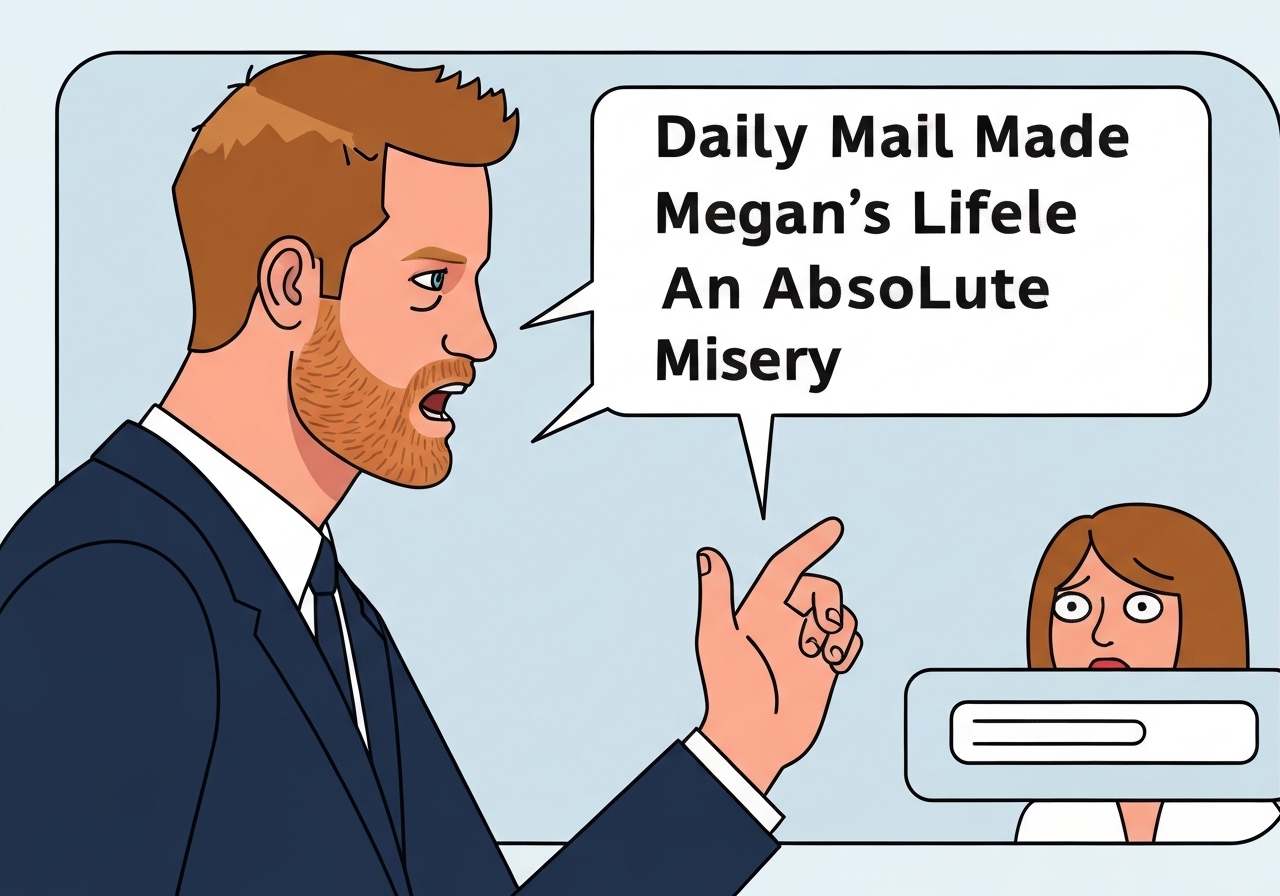
Prince Harry, 41, returned to London’s High Court on Wednesday as part of his civil claim against Associated Newspapers Limited, telling the judge that press coverage had left his wife, Meghan, in “an absolute misery.” The testimony, given on the third day of the hearing which began Monday and is scheduled to run about nine weeks, recounted 14 articles published between 2001 and 2013 that the duke says were based on unlawfully gathered material. He said he felt constrained from complaining at the time by the royal institution’s culture and described the process of bringing the case as repeatedly traumatic. The publisher denies wrongdoing and has argued some claims are time-barred.
Key Takeaways
- Prince Harry testified in London’s High Court on Wednesday and described press coverage as having made Meghan’s life “an absolute misery.”
- The suit targets Associated Newspapers Limited and focuses on 14 Daily Mail pieces from 2001–2013 that the duke alleges relied on unlawful information gathering.
- Harry, 41, returned from the United States to give evidence; the civil trial opened Monday and is expected to last roughly nine weeks.
- Seven high-profile claimants, including Elton John and Elizabeth Hurley, are pursuing related allegations against ANL involving voicemail interception, phone tapping and deceptive record requests, which ANL denies.
- Under cross-examination by ANL barrister Antony White, Harry disputed suggestions that information could have been obtained through normal social contacts or that he could have complained earlier.
- Previously, Harry successfully sued other British tabloid groups (NGN and MGN), obtaining apologies and damages after proven unlawful practices.
- ANL contends journalists relied on legitimate sources and has characterized parts of the group’s case as substantively weak and time-limited.
Background
The current case is one in a long-running conflict between senior royals and sections of the British tabloid press. Harry’s written submissions say 14 articles published between 2001 and 2013 caused him “great distress” and lacked meritorious public interest, and that some of the material was obtained through practices the claimants describe as unlawful. The group of claimants includes seven widely known figures who allege Associated Newspapers used private investigators and deceptive means to obtain private data.
Britain’s tabloid culture has a history of contested investigative techniques and high-profile legal battles. Harry has previously mounted successful actions against News Group Newspapers and Mirror Group Newspapers, resulting in apologies and payouts. Still, publishers often argue reporting relied on legitimate sourcing or that legal claims are out of time, creating repeated disputes over journalistic methods and accountability.
Main Event
On Wednesday the duke concluded his witness evidence after returning from the United States to appear in person. He arrived at the Royal Courts of Justice around 11 a.m. local time (6 a.m. ET), acknowledged crowds outside, and sat with other claimants before taking the stand. In court he described an “endless pursuit” by parts of the press and said he had been conditioned by royal life to accept intrusive coverage rather than complain.
Harry’s lawyers say the contested articles were primarily written by two journalists and that the content was generated by unlawful methods such as voicemail interception and “blagging” private records. Under cross-examination, ANL’s counsel Antony White suggested reporters could have legitimately gathered material by attending the same events as the duke or through contacts in his social circle. Harry pushed back, saying the kind of information that appeared in those stories was not something he would have discussed socially.
The duke described taking the case as “a recurring traumatic experience,” saying the worst consequence was the ongoing harm to his family. He told the court he hoped the litigation would secure accountability and, if possible, an apology rather than further reputational damage. Following the session Harry issued a brief statement saying the day had reminded the Mail Group “who is on trial and why.”
Analysis & Implications
The trial tests the boundaries between investigative journalism and illegal information-gathering in a media environment where speed and exclusivity are commercially valuable. If the claimants prove that material was acquired through unlawful means, the case could reinforce legal and editorial scrutiny across tabloid operations and encourage more claimants to litigate. It could also prompt publishers to tighten sourcing and vetting practices to avoid civil liability.
For the royal family and public figures more broadly, the proceedings highlight the limits of traditional conventions such as “Never complain, never explain,” which Harry said constrained his earlier responses. The litigation may shift public expectations about institutional protection versus individual recourse, particularly for those who feel subject to sustained media intrusion.
Economically, plaintiffs’ success could increase costs for publishers through damages and reputational harm, while also affecting the commercial incentives for sensational scoops. Internationally, high-profile rulings in the U.K. often influence press-regulation debates elsewhere, potentially shaping cross-border standards on privacy and newsgathering techniques.
Comparison & Data
| Item | Value |
|---|---|
| Articles cited by Harry | 14 (2001–2013) |
| Claimants in group action | 7 high-profile figures |
| Trial length (expected) | ~9 weeks |
This table summarizes the case’s most-cited figures: the 14 articles at the heart of Harry’s claim, the seven claimants joining related allegations against ANL, and the projected nine-week schedule for the civil trial. Those numbers frame the scope of evidence and the time the court will have to assess competing accounts of journalistic practice and alleged misconduct.
Reactions & Quotes
After his evidence, the duke and his team issued statements emphasizing the perceived weakness of the publisher’s cross-examination and the broader aim of accountability.
“Today we reminded the Mail Group who is on trial and why.”
Prince Harry (statement)
The duke’s spokesperson criticized ANL’s cross-examination as short and selective, saying it avoided detailed engagement with ten of the 14 articles at issue. ANL, through its legal team, has pressed that journalists provided a “compelling account of a pattern of legitimate sourcing.”
“The group’s claims are threadbare; journalists can show legitimate sourcing and the payments cited do not establish unlawful activity.”
Antony White (ANL barrister, cross-examination)
ANL has repeatedly denied allegations of illegal newsgathering and argued parts of the case are out of time. The exchange in court illustrated the adjudicative tension between testimonial accounts of distress and paper trails the publisher says are consistent with lawful reporting.
Unconfirmed
- Specific assertion that individual journalists directly ordered illegal interceptions remains subject to court proof and is not yet established in evidence.
- Claims that all payments to private investigators were for unlawful activity are not conclusively proven; some transactions may have legitimate explanations pending document review.
- Whether any alleged illegal activity directly targeted Meghan rather than reporting incidental personal details is still a matter the court must resolve.
Bottom Line
The hearing is a high-stakes test of allegations that a major British publisher crossed legal lines to obtain private material. Prince Harry framed his action as both personal redress and a public-interest effort to hold a powerful media group to account, while ANL maintains its reporting rested on lawful sourcing.
The outcome could have lasting consequences for press practices, claimant strategies and public expectations about privacy and accountability. For now, the court will sift documentary and testimonial evidence across a multi-week trial to resolve competing narratives about how those 14 articles were produced.