
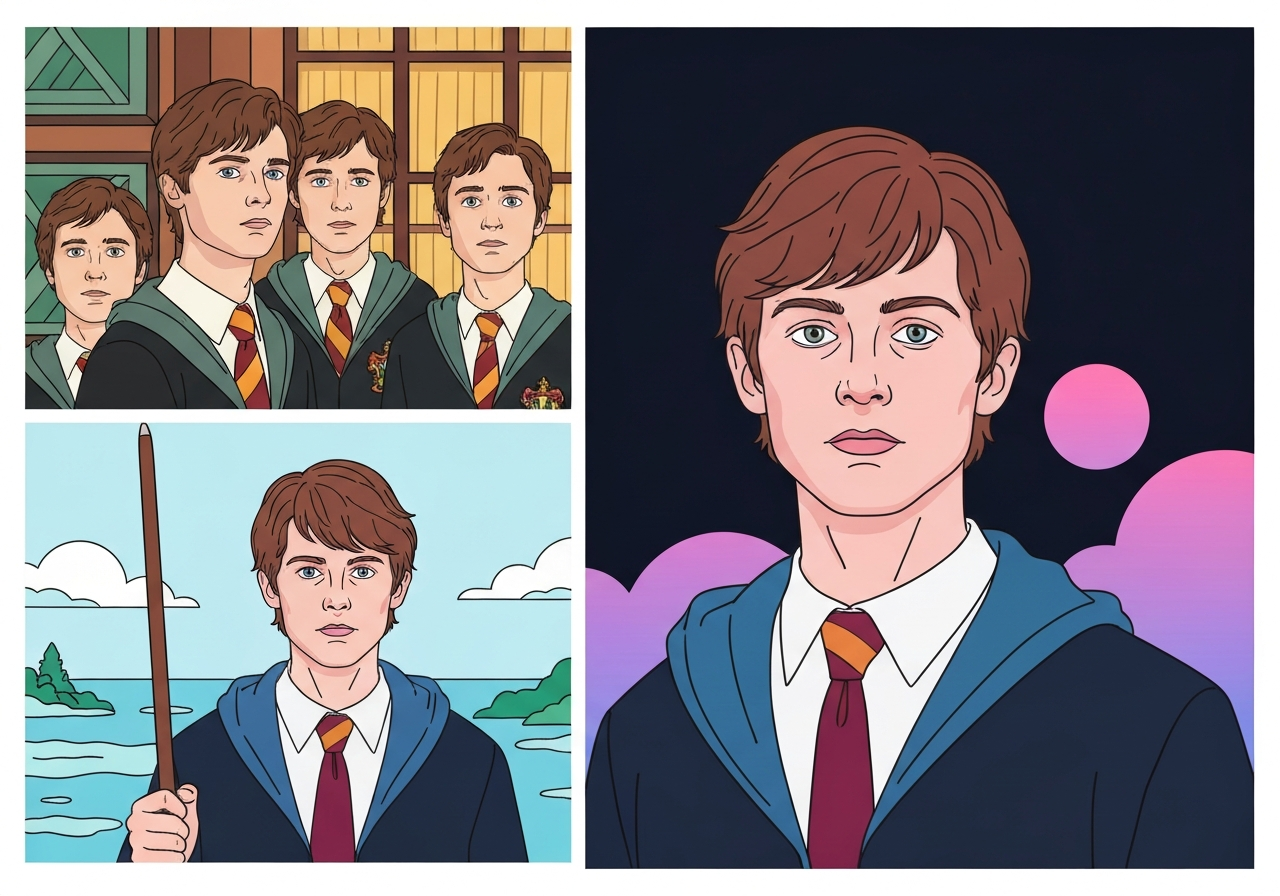
Actor Harry Melling, best known for playing Dudley Dursley in the Harry Potter series, reintroduces himself in Harry Lighton’s queer romantic comedy Pillion, which opened in theaters on Feb. 6, 2026. In the film Melling, 36, performs a physically and emotionally explicit role opposite a brooding biker, a contrast that has surprised many who remember him as a child actor. Speaking from his London Marylebone apartment while preparing a move, Melling described choosing parts that challenge him and invite new interpretations of familiar faces. The casting marks a deliberate shift in his career from supporting, often tragic or period roles to a provocative contemporary romantic lead.
Key takeaways
- Release: Pillion, directed by Harry Lighton and distributed by A24, opened in U.S. theaters on Feb. 6, 2026.
- Role shift: Harry Melling (age 36) plays a submissive partner in a queer BDSM-tinged romance, a marked departure from his Dudley Dursley role in Harry Potter.
- Career arc: Since Potter, Melling’s notable parts include The Ballad of Buster Scruggs (a exploited performer), Macbeth (Malcolm, Denzel Washington–led adaptation), and The Pale Blue Eye (young Edgar Allan Poe).
- Production note: Promotional images show Melling alongside Alexander Skarsgård; the film has drawn attention for its frank depiction of intimacy in a romantic-comedy framework.
- Public response: Early reactions range from surprise to praise for Melling’s willingness to take risks; critical consensus will form as reviews and box-office data accumulate.
- Personal context: Melling spoke to reporters from his Marylebone flat, noting a 15-year partnership and an imminent move to a home with a larger garden.
Background
Harry Melling rose to global recognition as Dudley Dursley in the Harry Potter films, a role that cemented him in the public imagination as a spoiled, imposing child. After that franchise, he pursued a string of character parts that showcased range—period pieces, literary adaptations and darkly comic turns—often distancing himself from his early typecasting. The actor has taken roles that test viewers’ sympathies: in The Ballad of Buster Scruggs he played a physically compromised entertainer, while in Macbeth and The Pale Blue Eye he inhabited cunning or historically resonant figures.
The decision to appear in Pillion follows a broader trend of former child stars seeking reinvention through challenging material that reframes their public persona. The film’s maker, Harry Lighton, and distributor A24 are both known for risky, art-minded projects that blend genre and intimacy. That production context made Pillion a natural home for an actor intent on stretching audience expectations, and it situates the film within contemporary conversations about queer representation and erotic storytelling in mainstream cinemas.
Main event
Pillion centers on a queer romance whose emotional arc is punctuated by BDSM-inflected encounters; Melling’s character submits to the demands of a leather-clad motorcyclist played opposite him. The film frames those dynamics within a romantic-comedy structure that foregrounds consent and evolving trust, rather than sensationalizing safety-compromised scenes. Promotional stills and early coverage emphasize Melling’s vulnerability onscreen—both physical and psychological—which critics and audiences have noted as central to the film’s emotional stakes.
In a recent video call from London, Melling said he looks for projects that puzzle him and make him ask whether he can inhabit and clarify them for viewers. He explained that he does not see a through line to his choices other than personal curiosity and a desire to explore characters that defy easy categorization. Production sources confirm the actor committed fully to the role, including physically demanding scenes, as part of a performance strategy meant to upend expectations tied to his early fame.
Industry observers point out that the casting of a familiar face in an explicitly sexualized queer role compounds audience surprise: viewers carry preconceptions from an actor’s past roles into new projects, and Pillion tests that inertia. The film’s release has already produced a flurry of commentary on social media and in early reviews, where responses range from admiration for Melling’s bravery to debates about the role of erotic content in mainstream romantic comedies.
Analysis & implications
Artistically, Melling’s turn in Pillion may broaden his range and the types of directors who will consider him for leading work. Successfully inhabiting a contentious, intimate role can recalibrate casting directors’ and audiences’ associations with an actor, opening doors to more varied, adult-centered narratives. For Melling specifically, moving from character parts in prestige adaptations to a headline role in an A24 film signals a strategic recalibration of his career trajectory.
From a cultural standpoint, Pillion contributes to discussions about authentic queer storytelling and how BDSM themes are portrayed onscreen. When handled with attention to consent and emotional realism, such narratives can expand mainstream exposure to marginalized sexualities; when mishandled, they risk reinforcing stereotypes or titillating audiences without nuance. Early indications from press screenings suggest Lighton emphasizes relationship development alongside erotic content, but long-term impact will depend on critical appraisal and audience uptake.
Commercially, Pillion’s performance will test market appetite for mature, kink-adjacent romance in theatrical windows. A24’s track record with adult-oriented indie films suggests potential for strong critical traction even if box-office returns are modest. Awards recognition is possible if critics coalesce around Melling’s performance and the film’s craft, but that outcome remains contingent on broader reception and campaigning cycles.
Comparison & data
| Role | Film/Year | Note |
|---|---|---|
| Dudley Dursley | Harry Potter series (2001–2010) | Child antagonist; first major public recognition |
| Performer | The Ballad of Buster Scruggs (2018) | Tragic, exploited character; vocal performance noted |
| Malcolm | Macbeth (2021 adaptation) | Supporting dramatic role in prestige adaptation |
| Edgar Allan Poe | The Pale Blue Eye (2022) | Period leading/supporting role emphasizing charm |
| Lead (submissive partner) | Pillion (2026) | Queer romantic comedy with BDSM themes |
The table highlights a shift from ensemble or supporting parts in period and literary projects toward a contemporary, lead performance that foregrounds sexuality. This trajectory mirrors a pattern among several former child actors who have chosen boundary-pushing independent films to reinvent their image. Box-office and critical data for Pillion will provide concrete measures of commercial viability and cultural resonance over the coming weeks.
Reactions & quotes
Producers and colleagues have framed Melling’s casting as a deliberate, creative gamble aimed at reframing his public image and attracting a different audience demographic. Representatives emphasize the actor’s commitment to authenticity and emotional clarity on set.
“I gravitate toward things that get me excited and that make me ask whether I can make sense of them.”
Harry Melling, actor (paraphrased)
Context: Melling made this remark during a video interview, describing his approach to selecting roles—an outlook that helps explain the eclectic mix of projects on his résumé. He also noted personal factors, such as his longtime partnership and a planned move to a larger London home, as background context to this career phase.
“We wanted to tell a queer love story that didn’t shy away from the erotic but always emphasized consent and character.”
Harry Lighton, director (paraphrased)
Context: The director summarized the film’s intent in press materials and interviews, underlining that Pillion aims to balance explicit material with emotional development. That positioning has been central to early critical debates about the film’s tone and ambitions.
Unconfirmed
- Long-term box-office performance and profitability for Pillion are not yet established; initial weekend tallies will clarify commercial reception.
- Any awards nominations tied to Melling’s performance or the film’s craft remain speculative until formal nomination announcements later in the season.
- Reports of on-set controversies or behind-the-scenes disputes are unverified and have not been substantiated by primary production sources.
Bottom line
Harry Melling’s role in Pillion represents a deliberate recalibration from his child-actor origins toward mature, risk-taking material that foregrounds intimacy and emotional complexity. Artistically, the move could broaden the range of parts he is offered and change how audiences interpret his previous work. Culturally, the film participates in ongoing debates about how queer desire and BDSM are portrayed in mainstream cinema; its ultimate contribution will depend on the balance it strikes between erotic frankness and narrative depth.
In the short term, attention will focus on critical reception, box-office results and whether Melling’s performance prompts renewed industry interest in him as a leading actor. For viewers, Pillion is likely to be read both as a provocative entertainment and as a test case for how contemporary cinema can handle erotic, consent-centered queer stories without reducing them to spectacle.
Sources
- The New York Times (News report and interview)
- A24 (Distributor—official site)