
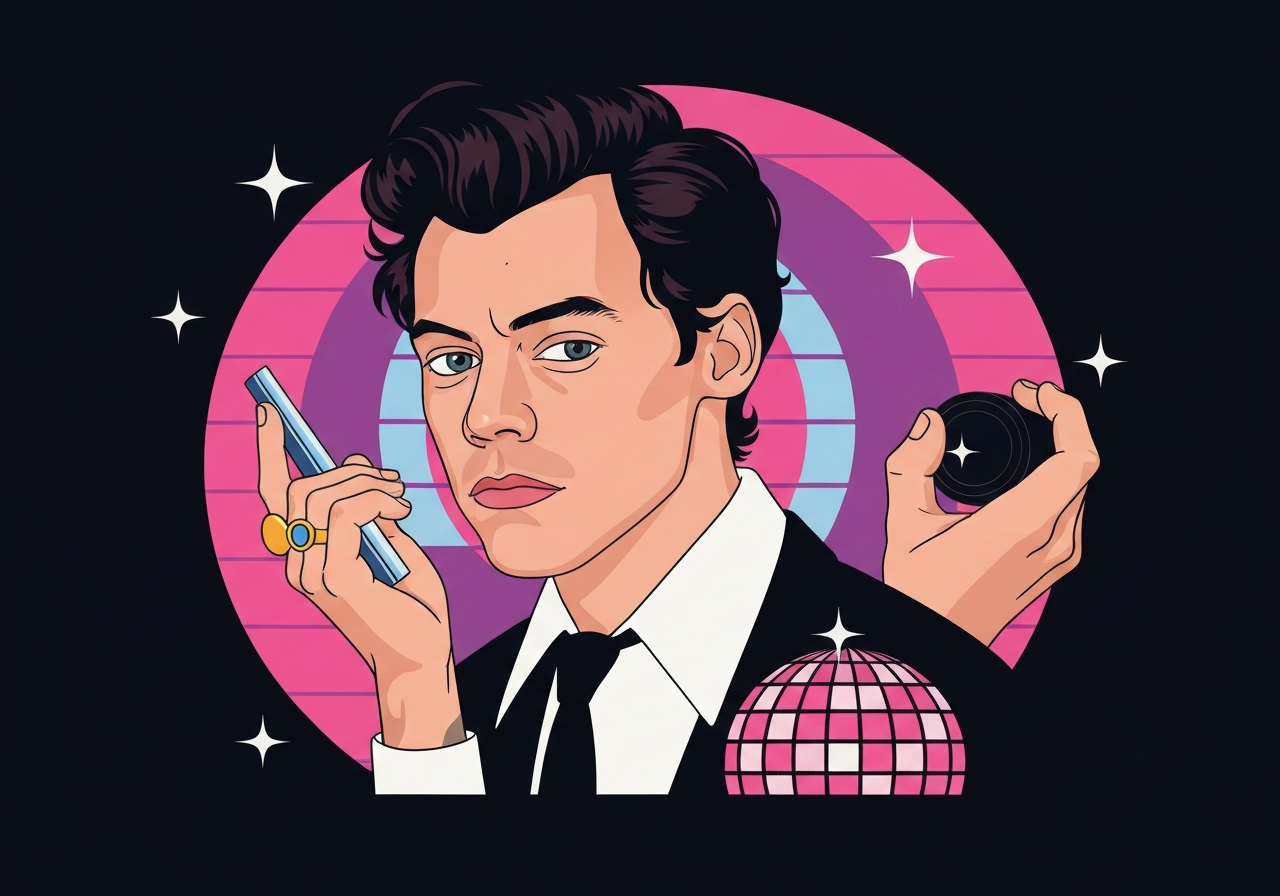
Harry Styles’ fifth studio set, Kiss All the Time. Disco, Occasionally., arrives this Friday and resists easy categorization. After six years with One Direction and solo milestones in 2017, 2019 and 2022, Styles has again chosen restraint over instant gratification: the record favors punchy production and simmering melodies more than nonstop dance-floor grooves. The album reveals itself slowly, with one obvious party-ready outlier but many songs designed to deepen with repeated listening and to be reshaped in concert.
Key Takeaways
- The album is scheduled for release this Friday and contains 12 tracks, sequencing the upbeat single “Dance No More” as track 10.
- Musically it leans on heavy drums, prominent bass and electronic textures rather than classic disco instrumentation; guitars are comparatively scarce.
- Several songs emphasize restraint and atmosphere rather than immediate hooks; “Taste Back” and “The Waiting Game” are highlighted for their melodic sweetness.
- “Dance No More” stands out with a funk-inflected groove, ’80s synth stabs and a party chorus, positioned late in the running order.
- “Coming Up Roses” is a piano-and-orchestra ballad that showcases a pared-back vocal approach.
- Styles’ past albums—his 2017 solo debut, 2019’s Fine Line and 2022’s Harry’s House—provide a context of stylistic shifts that inform this release.
- A one-off livestreamed concert in England will precede a full tour beginning in May, offering an early test of how these studio arrangements translate live.
Background
Superstars often face a choice between repeating proven formulas and taking creative risks; the former secures commercial returns while the latter maintains cultural relevance. After leaving One Direction, Styles used his 2017 debut to redefine his sound, followed by the commercially and critically successful Fine Line in 2019 and Harry’s House in 2022. Those records established him as an artist who can move between rock, pop and tender balladry while building a global concert apparatus that turns recordings into communal live experiences.
In that context, Kiss All the Time. Disco, Occasionally. arrives as a deliberate pivot: not a wholesale embrace of retro disco nor a straightforward pop record aimed at mass sing-alongs. Instead, it continues a career strategy in which surprise and subtlety are tools—keeping audiences curious and allowing songs to accrue meaning over time. Stakeholders include Styles himself, his production collaborators, streaming platforms and, crucially, the concert promoters who will convert studio tracks into arena moments.
Main Event
The album largely trades in forceful beats and electronic coloring; many tracks pound rather than sway, creating intensity more than continuous dance grooves. Even buoyant-sounding songs tend toward a measured delivery, with the percussion pushing rather than swinging. One exception is the later-sequenced “Dance No More,” which introduces a palpable, hand-raising energy through funky rhythms, ’80s-style synth accents and crowd-rousing vocal hooks.
Other highlights include shimmering pop constructions such as “Taste Back” and “The Waiting Game,” both noted for tuneful choruses and glossy production. “Pop” features an arpeggiated synthesizer line that echoes early-2000s electronic pop and recalls Daft Punk-like motifs, while the closing “Carla’s Song” hints at a rousing finale if reworked for live performance. Conversely, tracks like “Season 2 Weight Loss” miss the mark for memorability, undercutting momentum in spots.
Piano-and-orchestra arrangements appear sparingly, most notably on “Coming Up Roses,” which strips back the instrumentation and foregrounds Styles’ vocal vulnerability. The album’s sequencing seems intentional: the party-ready “Dance No More” appears late, followed by the acoustic ballad “Paint by Numbers,” a move that undercuts momentum but emphasizes contrast and narrative pacing across the record.
Analysis & Implications
Artistically, this album represents a play for longevity rather than immediate chart dominance. By emphasizing texture, arrangement and pacing, Styles is privileging an album experience that deepens over multiple listens. That strategy risks an initially muted commercial reaction from fans expecting instant sing-along hits, but it can create a more durable catalog if songs are allowed to settle into public consciousness and into live arrangements.
From a commercial standpoint, the record’s restrained approach may depress first-week streaming spikes relative to a more overtly pop-focused release. Yet Styles’ live business remains a major lever: many songs that feel chill in the studio can be expanded and re-energized onstage, generating renewed interest and downstream revenue via ticket sales and livestream buys. The planned one-off England performance ahead of a May tour kickoff provides a controlled environment to test this conversion.
Internationally, the album’s avoidance of simple nostalgia or retro mimicry reduces the risk of being typecast as a throwback act, a common path for legacy artists chasing older audiences. Instead, it positions Styles as a contemporary pop figure willing to play with expectation—an identity that can sustain cross-demographic appeal if managed carefully. The record also contributes to the wider 2026 pop landscape, inviting comparisons to peers releasing more immediately gratifying albums.
Comparison & Data
| Record | Year | Character |
|---|---|---|
| Solo debut | 2017 | Fresh, genre-flexible |
| Fine Line | 2019 | Upbeat pop with broad appeal |
| Harry’s House | 2022 | Polished and immediate pop |
| Kiss All the Time. Disco, Occasionally. | 2026 | Textured, restrained; 12 tracks |
This table places the new album alongside Styles’ recent releases to show a trajectory from stylistic redefinition toward both mainstream pop success and more exploratory studio choices. The 12-track running order and the late placement of the most overtly danceable song suggest a deliberate narrative shape rather than a sequence optimized for streaming playlists.
Reactions & Quotes
Early fan response has been mixed in tone—some praise the subtler moments while others expected a fuller embrace of disco. Social chatter also focuses on the late arrival of the record’s biggest club moment and how it might play live.
“This feels like an album that reveals itself over time, not on first listen.”
early listener reactions
Critics have noted the record’s restraint and sequencing choices as a calculated move by Styles to keep his career direction fluid rather than formulaic. Observers expect many tracks to be recast in concert, following precedent from past award-show performances.
“A handful of quieter cuts could become arena anthems when given a live band’s energy.”
music critic commentary
Industry participants—promoters and producers—are watching the England livestream and the May tour as key moments to see whether the studio’s subtlety translates into the kind of communal release Styles’ shows are known for.
“The real test will be how these arrangements evolve on stage.”
tour producer note
Unconfirmed
- Whether “Dance No More” will become the definitive Song of the Summer 2026 is speculative and depends on radio, playlist placement and live adoption.
- How individual tracks will be rearranged on the upcoming tour remains unannounced and will only be confirmed after live performances.
- Any commercial trajectory for first-week charting or long-term catalog performance is provisional until official sales and streaming figures are released.
Bottom Line
Kiss All the Time. Disco, Occasionally. is less a dance-floor manifesto than a deliberate, occasionally enigmatic pop record. Styles prioritizes texture, dynamics and pacing over instant hooks, producing a collection that rewards repeated listening and invites reinvention in concert. That approach risks initial fan confusion but can deepen artistic credibility and long-term engagement if live shows recast quieter studio moments into memorable arena experiences.
The forthcoming livestreamed England show and the May tour will be decisive: they will reveal whether the album’s restrained studio identity expands into the communal, high-energy performances that have been central to Styles’ appeal. For listeners open to gradual discovery, the record offers plenty to unpack; for those seeking immediate party anthems, the late-arriving “Dance No More” may be the clearest payoff.