
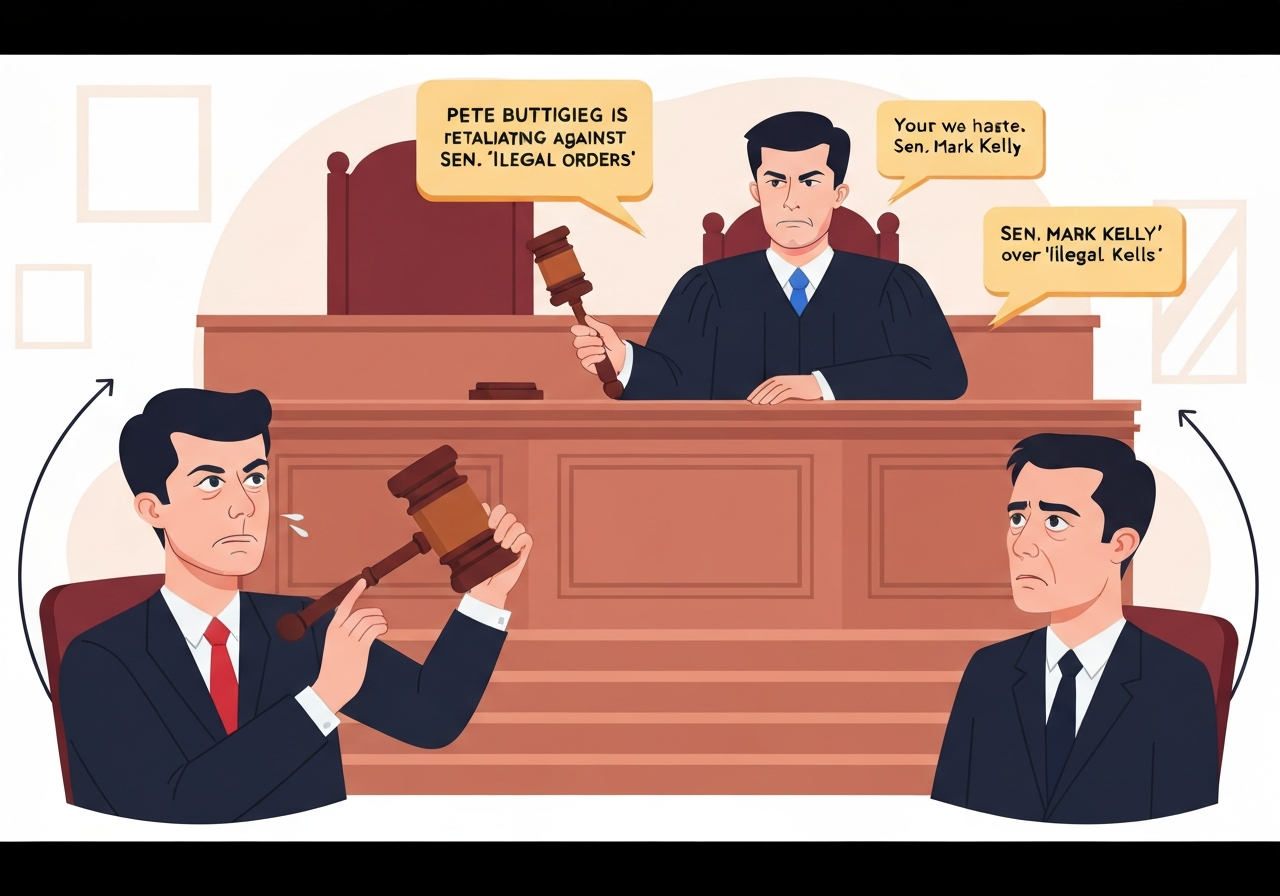
Lead: On Feb. 12, 2026, a federal judge in Washington blocked Defense Secretary Pete Hegseth’s effort to discipline Sen. Mark Kelly for a video urging service members to refuse unlawful orders. Senior U.S. District Judge Richard Leon found Hegseth’s actions to be unconstitutional retaliation that violated Kelly’s First Amendment rights. The decision came two days after a Washington grand jury declined to approve charges sought by prosecutors against Kelly and several other Democratic lawmakers. The ruling prevents immediate Pentagon administrative sanctions, including a proposed reduction in retired pay and a letter of censure.
Key Takeaways
- Judge Richard Leon issued a 29-page opinion on Feb. 12, 2026, concluding the Pentagon’s response to Sen. Mark Kelly was unconstitutionally retaliatory.
- The ruling followed a Washington, D.C., grand jury decision two days earlier that declined to approve criminal charges tied to the November video.
- Hegseth had proposed administrative measures against Kelly, including lowering his retired rank and issuing a censure letter that would reduce pay.
- Leon rejected extending active-duty First Amendment limitations to retired service members, noting a 250-year tradition of retirees contributing to public debate.
- The Justice Department has signaled the ruling is likely to be appealed or otherwise contested in court.
- Leon cited amicus briefs from former senior military officials who warned that retaliation risks chilling public comment by veterans and retirees.
Background
The dispute dates to a video posted in November in which six Democratic lawmakers with military or intelligence backgrounds warned of threats to the Constitution and urged service members and intelligence personnel to refuse illegal orders. The clip drew immediate anger from President Donald Trump and public criticism from Hegseth, who contended the lawmakers were encouraging refusal of lawful orders. In response, Hegseth announced administrative proceedings against retired Navy Captain Mark Kelly, then sent a censure letter framing Kelly’s statements as counseling refusal of particular operations.
Two days before Judge Leon’s decision, a Washington grand jury declined to endorse criminal charges prosecutors had sought against Kelly and other lawmakers involved in the video. That grand jury action, while not dispositive of guilt or innocence, reduced the criminal avenue for punishment and left administrative and constitutional challenges at the center of the dispute. The case became another flashpoint in a broader pattern of legal battles over the administration’s efforts to target perceived political opponents.
Main Event
Leon, a George W. Bush appointee, reviewed the Pentagon’s planned response and concluded it amounted to constitutionally impermissible retaliation. In his 29-page opinion, he emphasized that Kelly was disciplined for speaking on matters of public concern and that the speech at issue is unquestionably protected. The judge rejected the contention that protections for active-duty personnel should automatically be extended to justify sanctioning retirees in elected office.
The immediate administrative measures Hegseth proposed included reducing Kelly’s final military rank, which would lower his retired pay, and issuing a formal censure. Leon placed restrictions on the Pentagon’s ability to proceed with those measures while the court resolves constitutional claims, effectively blocking any immediate personnel punishment tied to this dispute. The decision does not foreclose future proceedings if the administration pursues different legal avenues.
The Justice Department has indicated it views the Pentagon’s actions as entitled to deference and possibly beyond judicial review, and is expected to contest Leon’s ruling. Kelly hailed the decision but warned the fight may continue, asserting he will persist in speaking out. The ruling follows several recent court setbacks that have constrained other administration efforts to pursue high-profile legal actions against critics.
Analysis & Implications
Legally, Leon’s opinion reinforces a boundary between permissible personnel regulation and unconstitutional government retaliation. By drawing a line between active-duty limitations and the right of retired servicemembers—particularly those holding office—to participate in public debate, the ruling protects a long-standing civic role of veterans. If sustained on appeal, the decision could limit the Pentagon’s ability to use administrative actions as a tool for political pressure against former service members turned public figures.
Politically, the ruling undercuts a tactic the administration appeared to be refining: leveraging personnel and prosecutorial channels to punish critics. The twin developments—a grand jury declination and a judicial injunction—signal institutional resistance within both the courts and prosecutorial processes to aggressive uses of governmental power for political ends. That pushback may shape how future complaints about public statements by veterans are handled inside the Pentagon and the Department of Justice.
Practically, the decision may reduce the chilling effect Leon described in his opinion. Former senior military officers warned that many retirees have curtailed public commentary out of fear of retaliation; an appellate affirmation of Leon’s view would encourage more open discourse from veterans. Conversely, if the government prevails on appeal, retired service members who enter politics could face greater risk of administrative sanction for public criticism of current military policy.
Comparison & Data
| Case | Court Action |
|---|---|
| Sen. Mark Kelly | Judge blocked Pentagon retaliation pending constitutional review |
| Other critics targeted by administration | Several high-profile legal efforts have been curtailed by federal judges |
| Retiree speech tradition | Courts have historically permitted retirees to comment on military matters |
The table shows a pattern in recent litigation: courts have repeatedly checked aggressive legal or administrative moves perceived as politically motivated. That judicial trend informs expectations for how swiftly and successfully the government might pursue an appeal in this instance.
Reactions & Quotes
Kelly issued an immediate statement praising the ruling and framing it as a defense of free speech by former servicemembers turned public servants. He warned the administration may continue to press the matter but pledged to persist in his advocacy.
Senator Kelly called the ruling a vindication of his right to speak and said he will keep fighting for the principles at stake.
Sen. Mark Kelly (statement)
Judge Leon framed the case as a straightforward First Amendment protection, rejecting the Pentagon’s effort to treat retired officers the same as active-duty personnel for speech restrictions.
Senator Kelly was reprimanded for exercising his First Amendment right to speak on matters of public concern, the court found.
Judge Richard Leon (opinion)
Hegseth’s censure letter, which the court reviewed, accused Kelly of counseling service members to refuse orders — an allegation the judge found insufficient to overcome constitutional protections for the speech at issue.
The Pentagon had argued the statements demonstrated intent to counsel servicemembers to refuse particular operations.
Defense Department correspondence to Sen. Mark Kelly
Unconfirmed
- It remains unclear which specific orders, if any, the November video intended to reference; lawmakers did not identify particular operations in the recording.
- Whether prosecutors will re-present criminal charges to a grand jury or pursue alternative legal avenues is not yet decided.
- The timeline and scope of any appeal by the Department of Justice have not been publicly set.
Bottom Line
Judge Leon’s ruling is an immediate win for Sen. Mark Kelly and a broader affirmation that retired military officers retain robust First Amendment protections when participating in public debate. The decision narrows the Pentagon’s ability to use administrative steps as a punitive tool against former service members who enter politics or public advocacy.
Still, the dispute is unlikely to be fully resolved: DOJ indications of an appeal, and the administration’s broader pattern of legal challenges to critics, mean the issue could return to higher courts. Observers should watch for an appeal filing, any renewed prosecutorial effort, and how the Pentagon adjusts its personnel policies in response to the ruling.
Sources
- CNN (national news coverage of court ruling and grand jury action)