
Lead
Researchers at the University of Colorado Boulder have identified a previously unrecognized mechanism that explains why Antarctica’s Hektoria Glacier retreated roughly 15.5 miles between January 2022 and March 2023 and lost about half of its mass over a two‑month interval within that period. The team says the process can trigger rapid grounding‑line retreat on glaciers that sit on sloping bedrock, producing faster loss than previously observed for any grounded glacier. The finding, announced alongside satellite and field data, reframes how some Antarctic outlets may respond to ocean and climate forcing.
Key Takeaways
- Hektoria Glacier retreated approximately 15.5 miles (25.0 km) between January 2022 and March 2023, based on CU Boulder analysis of satellite imagery and field observations.
- The glacier shed about 50% of its grounded ice mass over a two‑month interval during that period, a loss rate unprecedented for a grounded Antarctic glacier in recorded observations.
- CU Boulder researchers identified a specific sequence of bed‑geometry and ice‑ocean interactions that produced rapid grounding‑line collapse on Hektoria.
- The process is tied to a retrograde bed slope (bed deepening inland) and transient ocean‑driven thinning rather than only surface melting or long‑term atmospheric warming.
- Modeling suggests similar mechanisms could accelerate retreat at other outlet glaciers that share Hektoria’s bed and geometry characteristics, but the effect depends on local seabed shape and ocean conditions.
- This discovery may require updates to near‑term regional ice‑loss projections and short‑term sea‑level rise risk assessments where comparable bed configurations exist.
Background
Hektoria Glacier, located on the eastern side of the Antarctic Peninsula, is one of several outlet glaciers that drain the peninsula’s ice into the Weddell Sea. Outlet glaciers are held in place where their grounded ice meets bedrock; when that grounding line retreats onto deeper bedrock that slopes inland (a retrograde bed), dynamic instability can follow. Past decades have seen accelerating change across parts of the Antarctic Peninsula, driven by ocean warming, ice‑shelf weakening and atmospheric trends that affect snow and melt.
Prior studies of Antarctic glacier retreat emphasized processes such as warm water undercutting of ice shelves, iceberg calving, and atmospheric surface melt. Hektoria’s 15.5‑mile retreat in just over a year stands out against typical grounded‑glacier changes, prompting a focused investigation by CU Boulder researchers who combined satellite time series, high‑resolution imagery and numerical simulations to trace the sequence of events that produced the rapid loss.
Main Event
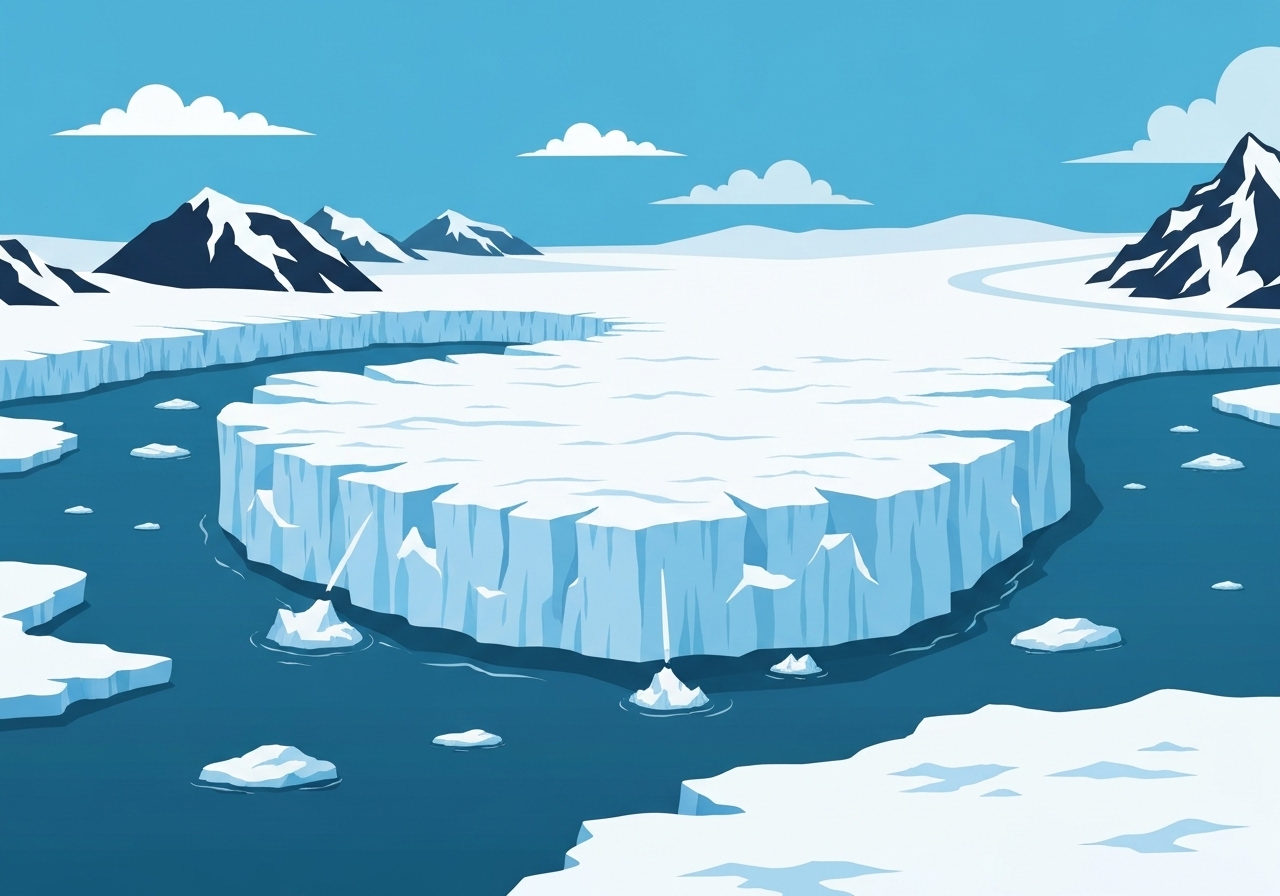
The team reconstructed Hektoria’s evolution from January 2022 through March 2023 using multispectral satellite imagery and interferometric techniques that reveal ice‑front position and grounding‑line migration. They found a phase in which the glacier’s grounding line retreated rapidly across a patch of bedrock that deepened inland, allowing ocean access to previously protected ice. That access produced swift basal thinning and collapse of the grounded trunk.
According to the study, the critical interval—a roughly two‑month window—saw the glacier lose about half of its grounded mass as the grounding line stepped back and large sections ungrounded and floated or calved. The researchers emphasize that the triggering sequence combined ocean‑forced thinning with bed geometry that amplified retreat, rather than a single, dominant surface melt event.
Field checks and remote sensing both recorded large calving events and rapid changes in ice velocity concurrent with the mass loss. The team’s numerical models reproduced the observed rapid retreat only when they included the discovered process: ocean thinning that induces grounding‑line migration across a retrograde bed with minimal buttressing upstream.
Analysis & Implications
The practical implication is that some grounded glaciers are more sensitive to short‑term ocean and basal perturbations than steady atmospheric warming alone would suggest. For glaciers with interior bed slopes that deepen inland, relatively brief ocean‑driven thinning episodes can trigger a cascade of ungrounding and mass loss. That nonlinearity complicates projections that assume gradual ice retreat tied primarily to long‑term temperature trends.
Regionally, the Antarctic Peninsula has warmed and experienced ice‑shelf changes that set the stage for such episodes. If the Hektoria mechanism operates elsewhere, it could produce pulses of ice discharge into the ocean that elevate sea‑level contributions on decadal timescales beyond current median projections. However, the spatial extent of risk depends on how many outlets share comparable bed geometries and are exposed to similar ocean forcing.
For modelling and policy, the finding argues for improved bed mapping, higher‑frequency ocean observations near grounding zones, and incorporation of short‑term ocean variability into ice‑sheet projection frameworks. Investments in these observing capabilities would reduce uncertainty about where and when rapid retreats like Hektoria’s could recur.
Comparison & Data
| Metric | Hektoria Glacier (Jan 2022–Mar 2023) | Typical Grounded Glacier (observed range) |
|---|---|---|
| Retreat distance | ~15.5 miles (25.0 km) | meters to a few kilometers per year (varies widely) |
| Mass loss rate | ~50% of grounded mass within ~2 months (during event) | generally slower, distributed over years to decades |
| Primary driver (event) | ocean‑driven basal thinning + retrograde bed geometry | mixed: calving, shelf weakening, atmospheric melt, ocean forcing |
The table highlights that Hektoria’s observed retreat and mass loss occurred far faster than typical recorded changes for many grounded glaciers, underscoring the role of local bed shape and ocean episodes. While other glaciers have experienced rapid events, CU Boulder’s analysis identifies a distinct mechanism that produced the record pace for a grounded Antarctic glacier.
Reactions & Quotes
“The sequence we reconstructed shows how a brief ocean‑forcing episode can cascade into rapid grounding‑line retreat when bed geometry allows it,”
CU Boulder research team (institutional comment)
The research team framed the result as a process‑level explanation that links observed field and satellite signals to modelled ice dynamics. They caution that not all glaciers will respond the same way; local bathymetry is decisive.
“If similar bed configurations exist elsewhere, we could see pulses of ice loss that are not captured by projections focused on gradual warming,”
Independent glaciologist (expert comment)
External experts welcomed the mechanistic clarity while urging broader bed mapping and ocean monitoring to determine how widespread the vulnerability is across Antarctica.
Unconfirmed
- Whether the exact mechanism observed at Hektoria has already driven similar unseen rapid retreats at other Antarctic outlets remains unconfirmed without targeted bed and ocean data.
- The frequency with which short ocean‑forcing episodes will recur in the Weddell Sea region and their precise contribution to near‑term sea‑level rise are not yet established.
- Attribution of the trigger to a single ocean event versus a combination of longer‑term shelf weakening and transient forcing requires further observational confirmation.
Bottom Line
CU Boulder’s work identifies a process that can produce exceptionally rapid retreat and mass loss in grounded Antarctic glaciers when ocean thinning and bed geometry align. Hektoria’s ~15.5‑mile retreat and the roughly two‑month interval that saw about half of its grounded mass lost demonstrate that ice‑sheet response can include sudden, high‑magnitude pulses as well as slower trends.
For scientists and policymakers, the priority is to map vulnerable bed topography, monitor grounding zones with higher temporal resolution, and incorporate such rapid‑response mechanisms into regional ice‑loss scenarios. Doing so will sharpen near‑term sea‑level risk assessments and help target observations where the next rapid retreat might occur.