
Lead
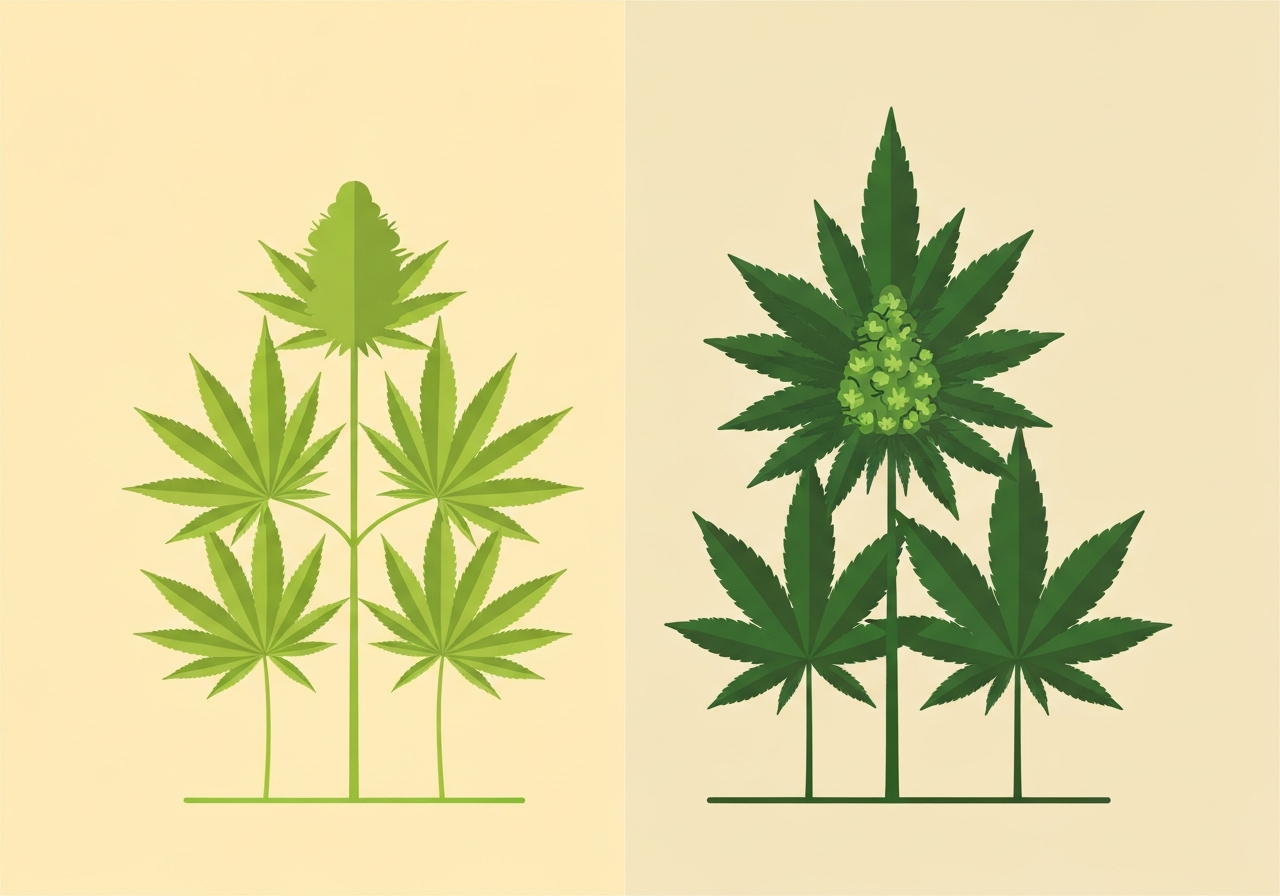
Botanically, hemp and marijuana are both Cannabis sativa, but U.S. law treats them very differently according to THC content. Federal rules have long set a plant-level threshold—0.3% delta-9 THC—to define hemp, while marijuana remains a controlled substance. A new federal rule scheduled to take effect in November 2026 will instead cap total THC in finished products (0.4 milligrams per container), a change that could pull many hemp-derived beverages and CBD goods out of the legal market. The shift has triggered legal, commercial and scientific debates over classification, enforcement and research access.
Key Takeaways
- Botanical fact: Hemp and marijuana are generally classified as subspecies of Cannabis sativa; they share the same biosynthetic pathway for cannabinoids.
- Current legal plant threshold: U.S. federal law has treated plants with under 0.3% delta-9 THC as hemp, not a controlled substance.
- New product cap: A federal rule effective November 2026 will treat finished products with more than 0.4 mg of any form of THC or similar cannabinoids as non-hemp and therefore illegal.
- Market impact: Hemp-derived THC beverages currently sold at about 2–10 mg THC per container would exceed the new 0.4 mg cap and likely be removed from market.
- Research friction: Marijuana’s recent rescheduling discussions and lingering federal controls continue to complicate clinical and agricultural research.
- Historical context: Hemp was cultivated in New England as early as 1629 and became widely used for fiber and seed long before recreational use spread globally.
- Regulatory gap: The 2018 Farm Bill created a pathway for hemp products that some lawmakers and regulators say left a loophole now being closed by the November rule.
Background
Hemp was a staple crop in colonial and early America, used for rope, sailcloth and coarse textiles; records note cultivation in New England by 1629. Governments and colonial authorities often encouraged hemp farming because its long fibers were vital to shipping and domestic manufacturing. Those industrial uses stand in contrast to the plant varieties bred for psychoactive effects, which evolved elsewhere and were selected for dense, resinous flowers rich in THC.
Cannabis with high THC has a distinct history: varieties optimized for intoxication trace to regions such as the Hindu Kush, where high-altitude sunlight favored plants that produced resinous, THC-rich buds. By the 19th century cannabis extracts were included in medical compendia in the United States, but legal attitudes shifted in the 20th century. The Marihuana Tax Act of 1937 began federal restrictions, and in the early 1970s cannabis was placed on Schedule I, a status that has since been controversial and politically charged.
Main Event
Since the 2018 Farm Bill federally legalized hemp defined by a 0.3% delta-9 THC plant threshold, an industry producing hemp-derived foods, supplements and beverages has grown rapidly. Some producers exploited the plant-focused definition to market finished products with appreciable levels of intoxicating cannabinoids, prompting regulators to reconsider whether a plant-only standard still makes sense. In response, federal authorities finalized a rule that shifts the test from the plant to the finished product, limiting total THC to 0.4 milligrams per container when it takes effect in November 2026.
Industry groups warn the change will outlaw many lawful products now sold on shelves. Hemp beverage manufacturers, for example, commonly sell drinks with 2–10 mg of THC per container; under the new cap those beverages would be noncompliant. Companies that rely on nonintoxicating cannabinoids, such as CBD, also fear collateral damage because trace THC in finished goods could push them over the new limit.
Lawmakers and advocates remain split. Some members of Congress argue for clearer statutory language to protect hemp farmers and ancillary industries, while others say tighter product-level rules are necessary to curb an unintended intoxicating-product market that the 2018 Farm Bill did not foresee. Legal challenges and potential congressional fixes are likely before November, but outcomes remain uncertain.
Analysis & Implications
Economically, the product-level cap could shrink a nascent multibillion-dollar segment built after 2018. Retailers and producers selling low- and moderate-strength THC beverages may face recalls, reformulation costs or market exits. Small processors and farmers who rely on hemp byproducts could lose demand if finished goods are restricted more tightly than raw-plant tests indicate.
From a public-health and safety perspective, regulators argue the change closes a gap that allowed intoxicating products to proliferate without the labeling, testing and age-restrictions that accompany state-legal marijuana markets. Opponents counter that the cap is arbitrary relative to dose-response evidence and will push consumers to unregulated black markets where safety standards are absent.
Scientifically, moving the regulatory focus to finished products complicates agricultural research and cultivar development. Plant breeders and geneticists studying low-THC varieties now must consider downstream processing, metabolites and how minor cannabinoids convert during manufacturing. Researchers also say lingering federal scheduling of marijuana hampers clinical studies even as rescheduling discussions continue.
Politically, the shift highlights a recurring U.S. pattern: statutory changes intended to liberalize use (2018 Farm Bill) can create unforeseen commercial pathways that prompt further regulation. The November rule will test whether regulators, courts or Congress will be the primary arbiter of cannabis policy going forward.
Comparison & Data
| Threshold | Measure | Value |
|---|---|---|
| Plant-level hemp definition | Delta-9 THC (percentage) | 0.3% |
| Proposed/Final product cap | Total THC per finished container (milligrams) | 0.4 mg |
| Typical hemp beverage | Total THC per container (milligrams) | 2–10 mg |
The table shows the disconnect between a plant percentage and an absolute dose in a finished item. A 0.3% plant threshold does not map directly to milligram doses after extraction, concentration or infusion into food and beverages; regulators cite that gap in arguing for product-level limits. Producers say accurate conversion depends on processing methods, serving sizes and consumer use patterns, complicating simple equivalence between plant tests and product safety.
Reactions & Quotes
Advocates for historical and botanical context emphasize the shared biology of cannabis plants, noting centuries of distinct breeding paths for fiber versus psychoactivity. Industry and policy actors frame the debate in terms of public safety, commerce and scientific access.
“Cannabis is one of the world’s oldest domesticated crops, but its biology remains surprisingly complex,”
Nick Johnson, author of Grass Roots (author/ historian)
“Politically, the 2018 change opened markets that lawmakers never clearly intended — now regulators are trying to close that gap,”
Adam Smith, Marijuana Policy Project (policy director)
Unconfirmed
- Exact enforcement protocols that federal and state agencies will use after November 2026 have not been publicly finalized and may vary by jurisdiction.
- Estimates of the total economic losses to hemp beverage makers from the new rule vary widely and lack a single verified industry-wide figure.
- Whether Congress will pass clarifying legislation before the rule’s effective date remains unresolved.
Bottom Line
Botany and law are speaking different languages: science groups describe hemp and marijuana as parts of a single species with overlapping chemistry, while U.S. policymakers have adopted bright-line rules to separate legal markets. The new product-level limit set to take effect in November 2026 reframes that separation, prioritizing finished-product dose over raw-plant percentages and risking major disruption for producers and retailers built around the 2018 Farm Bill framework.
Expect legal challenges, congressional proposals and further regulatory guidance in the months ahead. For readers and stakeholders, the key questions are whether lawmakers will act to protect established hemp markets, how regulators will implement enforcement, and how researchers will adapt studies to the evolving legal landscape.