
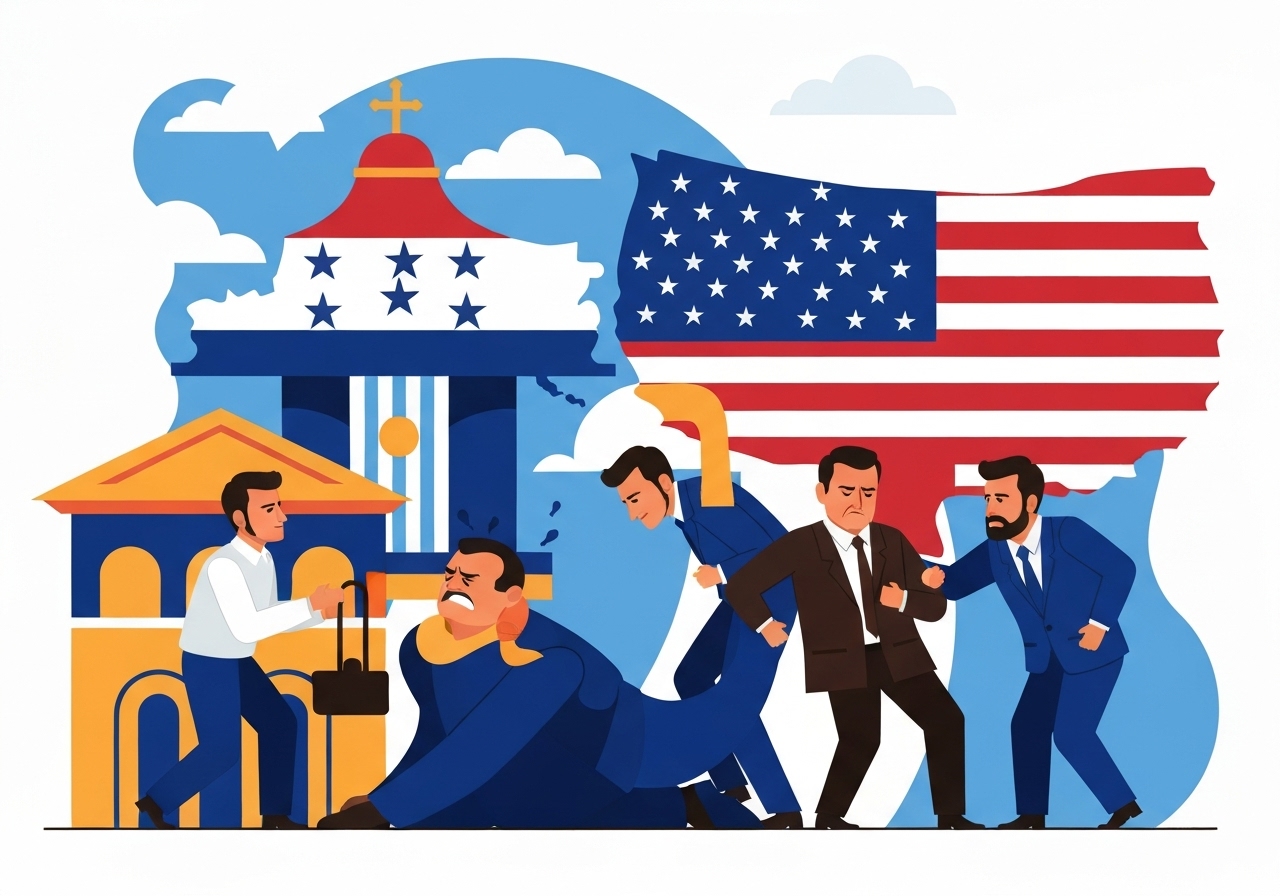
Honduras’ attorney general on Dec. 9, 2025 said he has ordered domestic authorities and asked Interpol to execute a 2023 arrest warrant for former president Juan Orlando Hernández after Hernández was pardoned and released from U.S. federal custody last week. The warrant, signed by a Supreme Court magistrate two years earlier, accuses Hernández of fraud and money laundering and instructs that it be enforced “in the case that the accused is freed by United States authorities.” The move intensifies a political crisis in Tegucigalpa as national election results remain close and the pardon has reignited public protests and debate about impunity.
Key Takeaways
- Honduras Attorney General Johel Zelaya on Dec. 9, 2025 said he ordered local forces and Interpol to carry out a 2023 arrest order for Juan Orlando Hernández.
- Hernández was released from U.S. federal prison last week after a pardon by former U.S. President Donald Trump; he had been sentenced in 2024 to 45 years for facilitating large cocaine shipments to the United States.
- The 2023 Honduran warrant charges Hernández with fraud and money laundering and specifically directs execution if U.S. authorities free him.
- Dozens of officials were implicated in the Pandora case, which alleges diversion of government funds through NGOs to political parties, including Hernández’s 2013 campaign.
- Trump said Hondurans requested the pardon and that Hernández had been treated unfairly by prosecutors; Honduran prosecutors say they will pursue domestic charges regardless.
- Nationwide protests occurred in Tegucigalpa after the pardon; Hernández’s family says he is in a secure, undisclosed location for safety.
- The political context is volatile: Nasry Asfura (National Party), endorsed by Trump, was narrowly leading Salvador Nasralla (Liberal Party) as vote counting progressed.
Background
Juan Orlando Hernández served two presidential terms and was once seen by U.S. officials as an anti‑drug ally. After leaving office in 2022, Honduran authorities detained him and President Xiomara Castro’s administration extradited him to the United States to face drug‑trafficking charges. In 2024 a U.S. federal jury convicted Hernández and a judge later imposed a 45‑year sentence for his role in facilitating large shipments of cocaine into the United States.
Separately, Honduran prosecutors opened the Pandora investigation, alleging that state funds were routed through nongovernmental organizations to finance political parties and campaigns, implicating dozens of officials and associates tied to Hernández’s 2013 presidential bid. In 2023 a Honduran Supreme Court magistrate signed an arrest order charging Hernández with fraud and money laundering; that order contains a clause to be executed if U.S. authorities release him.
Main Event
On Dec. 9, 2025 Attorney General Johel Zelaya announced he had asked domestic law enforcement and Interpol to enforce the 2023 warrant now that Hernández is free from U.S. custody. Zelaya posted a photo of the two‑year‑old order; the document explicitly contemplates enforcement should U.S. authorities free the accused. The announcement came amid public demonstrations in Tegucigalpa and elsewhere, where farmers and other groups protested the U.S. pardon.
Hernández’s release followed a presidential pardon from Donald Trump delivered last week; Hernández had been serving a 45‑year federal sentence for drug trafficking-related convictions. After his return to Honduran soil, Hernández’s family said he was being kept in an undisclosed, secure location for his safety. The former president has consistently denied wrongdoing and has insisted throughout his political career that he cooperated with counter‑narcotics efforts.
Political leaders immediately positioned themselves around the development. Trump publicly framed the pardon as a response to Honduran appeals and a belief that Hernández had been mistreated by prosecutors. In Honduras, Zelaya framed his office’s response as a necessary step to prevent impunity; Hernández’s lawyer, Renato Stabile, called the domestic action a political stunt aimed at intimidating the former president’s allies.
Analysis & Implications
The arrest order and the U.S. pardon create a rare conflict of jurisdictions: a foreign head of state with a domestic arrest warrant who has just been released by U.S. authorities. Honduran prosecutors are signaling they will pursue national charges despite the U.S. decision, which raises practical and legal questions about custody, extradition and the role of Interpol notices in politically charged cases. If Interpol accepts and acts on the request, Hernández could face detention at international borders or upon return to Honduras.
Politically, the timing is explosive. The pardon arrived days before a tightly contested national election, and Zelaya’s move will be interpreted through partisan lenses. If the leading presidential candidate aligned with Hernández’s National Party wins, that could ease Hernández’s return and reduce the likelihood of domestic prosecution being carried through; a victory for the opposition candidate focused on anti‑corruption could intensify prosecutions and judicial scrutiny.
Internationally, the case could strain U.S.‑Honduras relations. The U.S. pardon—framed by Trump as responding to Honduran requests—may be questioned by regional partners and anti‑corruption advocates who see it as undermining rule‑of‑law efforts. It also sets a precedent where clemency by a foreign power can directly undercut ongoing or potential prosecutions in the subject’s home country.
Comparison & Data
| Year | Event |
|---|---|
| 2013 | Hernández runs presidential campaign (implicated in Pandora allegations) |
| 2017 | Accusations by rivals that Hernández’s government irregularities affected elections |
| 2022 | Hernández leaves office; detained and extradited to U.S. by President Xiomara Castro’s administration |
| 2024 | U.S. conviction and 45‑year federal sentence for drug trafficking |
| Dec. 2025 | Donald Trump pardons Hernández; Honduran AG seeks execution of 2023 warrant |
The table summarizes key milestones relevant to the current legal and political crisis. These markers show how allegations of corruption and narcotics trafficking moved from domestic controversy to international prosecution and back to domestic judicial questions after the pardon.
Reactions & Quotes
“This is obviously a strictly political move on behalf of the defeated Libre party to try to intimidate President Hernandez…these charges are completely baseless.”
Renato Stabile, Hernández lawyer (email)
Stabile framed the arrest effort as partisan and lacking merit, a position echoed by Hernández allies. His statement was distributed via email and has been repeated by National Party figures to argue the action is politically motivated.
“We will take steps to end impunity,”
Johel Zelaya, Honduras Attorney General (statement)
Zelaya described the enforcement request and the Interpol appeal as part of an obligation to pursue alleged domestic crimes regardless of foreign clemency. His office released the image of the 2023 warrant to show legal basis for enforcement.
“Hondurans asked for this; after reviewing the case, I believed he was treated unfairly by prosecutors,”
Donald Trump (public statement)
Trump defended the pardon as responsive to Honduran pleas and a judgment about prosecutorial fairness, which supporters of Hernández have used to justify his release and return.
Unconfirmed
- Whether Interpol has issued a provisional notice or accepted the Honduran request has not been independently confirmed.
- The precise location and security arrangements for Hernández after his release are publicly described only as “undisclosed” by his family and remain unverified.
- How quickly Honduran courts will act to detain or try Hernández if he returns to Honduras is uncertain and depends on pending legal procedures and political developments.
Bottom Line
The convergence of a U.S. presidential pardon and a standing Honduran arrest warrant has plunged Honduras into renewed legal and political turmoil. Prosecutors in Tegucigalpa assert a clear legal basis—the 2023 warrant signed by a Supreme Court magistrate—while Hernández’s defenders call the move politically motivated.
How the situation unfolds will hinge on three variables: whether Interpol acts on the Honduran request, the outcome of the near‑term Honduran election, and practical decisions about Hernández’s travel or surrender. Each outcome carries significant implications for rule‑of‑law perceptions in Honduras and for the region’s handling of high‑level corruption and narcotics cases.
Sources
- NPR — news report summarizing statements from Honduran officials, legal background and political context.
- Associated Press (photo agency) — photo coverage credited to Moises Castillo/AP used in visual reporting of Tegucigalpa protests and public scenes.