
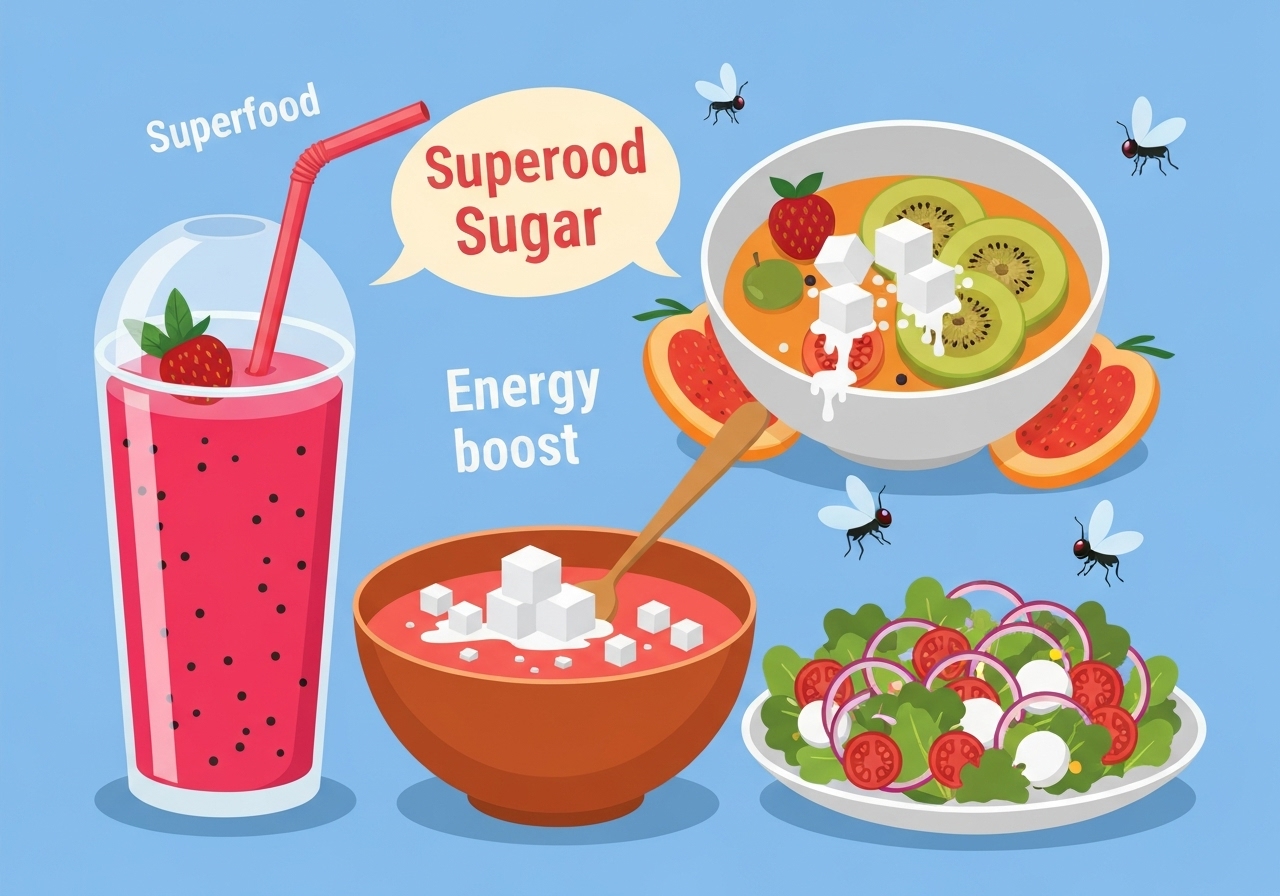
Many shoppers who swap glazed pastries for ‘all natural’ granola or choose low-fat yogurts, organic plant milks and bottled smoothies often believe they are making a healthier choice. But those health-forward labels can mask substantial amounts of added sugar, experts warn, a problem made harder to spot by marketing and shifting ingredient lists since the FDA required added-sugar disclosure in 2021. Nutrition researchers and clinicians say the result is that average Americans still consume surprisingly high amounts of added sugar, with beverages accounting for about half of intake. Consumers are advised to read labels closely and prefer plain or unsweetened versions where possible.
Key Takeaways
- Average intake: The typical American consumes about 17 grams of added sugar per day, roughly 57 pounds (26 kilograms) per year, according to the American Heart Association.
- Label change, unintended result: Since 2021 the FDA required added-sugar amounts on Nutrition Facts panels, but some manufacturers replaced traditional sweeteners with alternatives not counted as “added sugar” under current rules.
- Common surprises: Products marketed as healthful — granola, plant-based milks, flavored Greek yogurts and bottled smoothies — frequently contain single-serve amounts of added sugar comparable to treats.
- Product examples: A Chobani black cherry yogurt contains about 9 grams of added sugar; some Silk almond milk varieties list about 7 grams per cup.
- Guideline vs preference: The FDA-aligned guidance allows up to 10% of calories from added sugar (about 50 grams on a 2,000-calorie diet); some clinicians advocate for 5% or less for many people, especially those with diabetes or prediabetes.
- Sweetener substitutions: Brands have increasingly used nonnutritive sweeteners and sugar alcohols (e.g., monk fruit, erythritol), which can keep sweetness but are not always counted as ‘added sugars’ on labels.
Background
For decades, food makers have used health-oriented language — “real fruit,” “all natural,” “organic,” “high protein,” or “low-fat” — to position processed items as better choices. That shift coincides with consumer demand for cleaner labels and plant-based alternatives, creating a market advantage for products that appear wholesome on the front of pack. Regulatory pressure to make Nutrition Facts panels more informative led the FDA in 2021 to require manufacturers to list added sugars separately from total sugar, intending to help shoppers quantify sugar added during manufacturing rather than sugar naturally present in foods.
However, the label change interacted with industry reformulation in ways regulators had not fully anticipated. Some companies reduced familiar sweeteners like refined cane or high-fructose corn syrup but increased the use of alternative sweeteners or sugar alcohols that are not always categorized as added sugars under current definitions. The result is that many items now taste as sweet or sweeter than before, while their ingredient lists and marketing lean into health claims that can mislead time-pressed buyers.
Main Event
Researchers and clinicians who study diet and metabolism are documenting how marketing and reformulation have created new blind spots for consumers. Nicole Avena, a neuroscience and psychiatry researcher with Mount Sinai and Princeton affiliations who studies added sugars, notes that many companies exploit front-of-package cues to signal health without reducing overall sweetness. Meanwhile, dietitians like Collin Popp at NYU Langone Health emphasize that even products positioned as healthy can contain several teaspoons of added sugar per serving.
Common grocery items where sugars hide include flavored Greek yogurts, some granolas marketed as ‘all natural’ but sweetened, plant-based milks with added sweeteners, bottled smoothies labeled as ‘superfood’ blends, sauces, and prepared sandwiches. Beverage consumption still accounts for about half of added-sugar intake overall, but packaged foods account for much of the remainder and are often overlooked at the point of purchase.
Manufacturers have also turned to nontraditional sweeteners such as monk fruit or erythritol and sugar substitutes like stevia, which do not always fall under the same labeling rules as traditional added sugars. That has produced a trade-off: calories may drop, and listed ‘added sugars’ may decline, but sweetness — and the behavioral drive to consume sweet foods — often remains.
Analysis & Implications
Health impacts: Excess added sugar is linked in population studies to higher risks of obesity, type 2 diabetes and heart disease. Even modest daily differences in sugar intake accumulate over time; public-health guidance aims to limit chronic risk exposure rather than target single meals. The American Heart Association estimate of roughly 17 grams per day for the average American highlights a continuing gap between recommendations and consumption.
Regulatory and industry implications: The 2021 Nutrition Facts change improved transparency but left definitional gaps that companies can exploit by reformulating with sweeteners not covered by the added-sugar category. Closing those gaps would require additional rulemaking or clearer guidance on how alternative sweeteners are disclosed. Policymakers must balance technical labeling precision with practical readability for consumers.
Behavioral and market effects: Noncaloric and low-calorie sweeteners reduce measured calories but may sustain a preference for sweet tastes, which some researchers argue can perpetuate overconsumption or undermine efforts to lower overall sugar preference. For consumers, the practical implication is that reading ingredient lists and choosing unsweetened or plain versions of products remains the most reliable strategy.
Clinical guidance: For people with diabetes or prediabetes, clinicians often recommend stricter limits on added sugars than general-population targets. For the broader public, shifting dietary patterns away from persistently sweet packaged foods toward minimally processed items can support both metabolic health and reduced reliance on sweetness cues.
Comparison & Data
| Measure | Value |
|---|---|
| Average added sugar (daily) | 17 g |
| Average added sugar (annual) | 57 lb (26 kg) |
| FDA guidance (10% of 2,000 kcal) | ≈50 g/day |
| Chobani black cherry yogurt (example) | 9 g added sugar per serving |
| Some Silk almond milk varieties | 7 g added sugar per cup |
The table places typical product examples alongside population-level averages and dietary guidance to illustrate scale: single servings of flavored dairy or plant milks can supply a substantial fraction of daily advised limits. Because beverages contribute about half of added-sugar intake, liquid forms are a key intervention point, but packaged solid foods often slip under consumers’ attention.
Reactions & Quotes
Many large brands are less responsive to public-health concerns and prioritize taste and sales when reformulating products.
Nicole Avena, neuroscience researcher (context: industry behavior)
The current 10% recommendation allows flexibility, but individuals with diabetes or prediabetes may benefit from much tighter limits.
Collin Popp, dietitian, NYU Langone Health (context: dietary guidance)
Label reading is the practical defense: choosing plain or unsweetened versions or adding fruit yourself reduces added sugar and restores control.
Dietitian guidance (context: consumer action)
Unconfirmed
- Whether some brands intentionally reformulate primarily to exploit labeling definitions rather than to improve health is asserted in some industry analyses but not conclusively proven for all manufacturers.
- Long-term behavioral effects of widespread substitution with sugar alcohols and low-calorie sweeteners on population-level calorie intake and weight remain an active area of research.
Bottom Line
Front-of-package buzzwords and cleaner-sounding ingredient lists can mask meaningful amounts of added sugar. The FDA’s 2021 labeling change improved transparency but has not eliminated ways manufacturers can preserve sweetness while reducing listed added sugars. Consumers should prioritize unsweetened or plain varieties, compare the ‘added sugars’ line on Nutrition Facts, and inspect ingredient lists for alternative sweeteners when evaluating products marketed as healthy.
Clinicians and policymakers face complementary tasks: clinicians must tailor sugar guidance to patient risk, and regulators should consider whether labeling rules need further refinement to capture contemporary reformulation strategies. For shoppers, the most actionable steps are simple and immediate: choose whole foods when possible, prefer plain dairy and plant-milk options, and add natural flavors such as fruit, spices or citrus instead of relying on packaged products labeled with health buzzwords.
Sources
- NBC News — media report summarizing expert interviews and examples (original article)
- American Heart Association — health organization guidance and population estimates (public-health guidance)
- U.S. Food and Drug Administration (FDA) — official guidance on Nutrition Facts labeling and added sugar disclosure (regulatory)
- NYU Langone Health — clinical/academic institution (expert commentary context)