
Lead
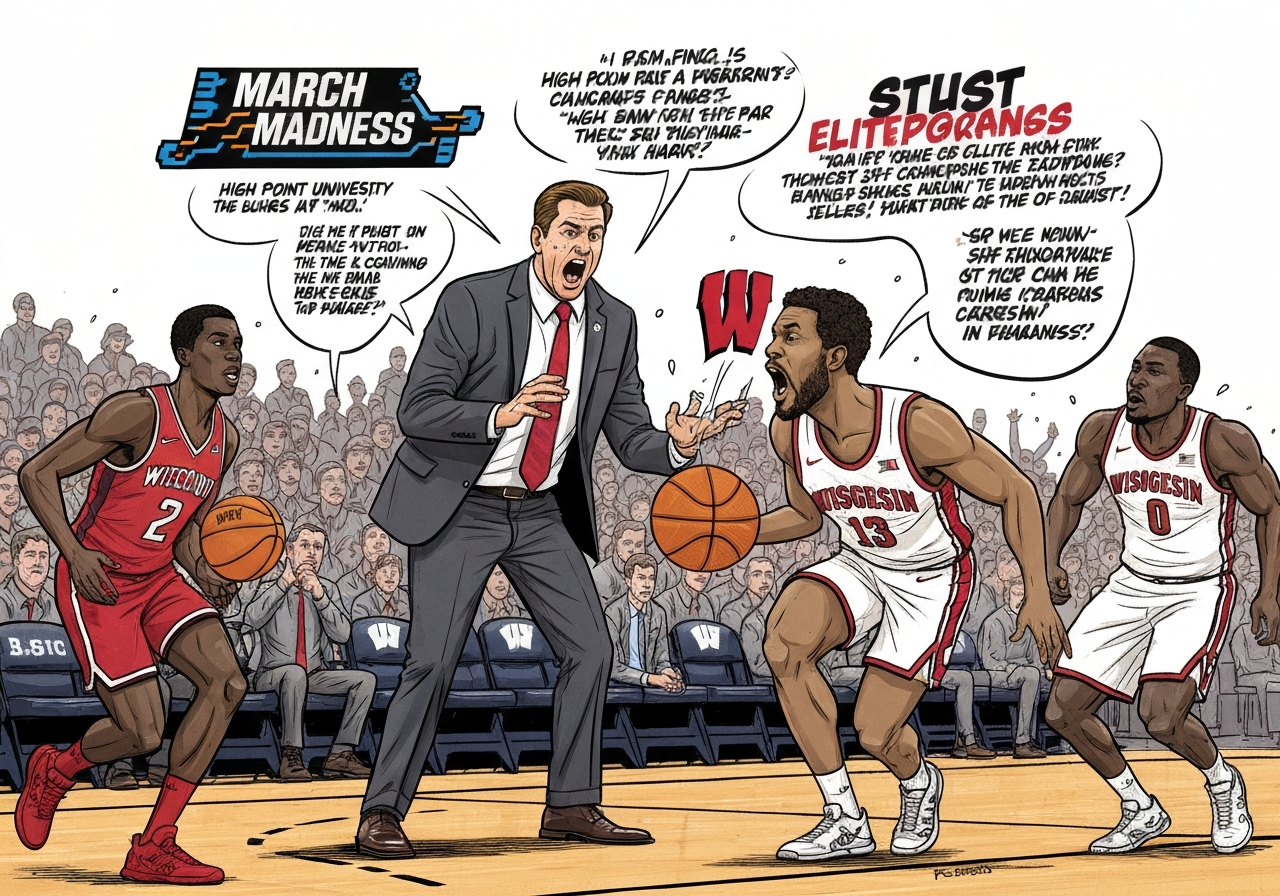
On Thursday in the first round of the 2026 NCAA Tournament, No. 12 seed High Point edged No. 5 Wisconsin 83-82 after a late fast-break layup by Chase Johnston with 11.7 seconds left. Johnston finished with 14 points — including four made three-pointers — and the Panthers, 10.5-point underdogs, secured the program’s first March Madness victory. First-year High Point coach Flynn Clayman used his postgame interview to criticize power-conference teams for avoiding games against mid-major programs during the regular season. High Point advances to face the winner of 13th-seeded Hawaii vs. No. 4 Arkansas in the Midwest Region second round on Saturday.
Key Takeaways
- Final score: High Point (No. 12) 83, Wisconsin (No. 5) 82; the Panthers were 10.5-point underdogs coming in.
- Chase Johnston: 14 points, 4 made three-pointers; his only two-point field goal was the game-winner with 11.7 seconds remaining.
- Rob Martin recorded a double-double with 23 points and 10 assists for High Point.
- Wisconsin leaders: Nick Boyd 27 points; John Blackwell 22 points and 10 rebounds.
- High Point earned its NCAA berth by winning the Big South title for the second straight year; this is the program’s first tournament win after last year’s first-round loss to Purdue.
- Coach Flynn Clayman publicly urged high-major programs to schedule mid-majors, saying the tournament forces such matchups anyway.
- Other first-round results included No. 1 Duke 71, Siena 65; No. 4 Nebraska 76, Troy 47; No. 9 TCU 66, No. 8 Ohio State 64; No. 3 Michigan State 92, No. 14 North Dakota State 67.
Background
High Point reached the 2026 NCAA Tournament by capturing the Big South Conference title for the second consecutive season, building on a program that had only once before won a tournament game — they had none until this victory in the first round. Last season the Panthers fell to Purdue in their opening matchup; this year’s result marks a milestone for coach Flynn Clayman in his first season at the helm after Alan Huss departed to join Creighton’s staff with a succession plan in place.
Wisconsin entered the tournament as a No. 5 seed and the Badgers were making their 29th NCAA Tournament appearance, having lost in the Big Ten Tournament semifinals to Michigan. Wisconsin relied heavily on its backcourt all season; both Nick Boyd and John Blackwell averaged better than 19 points per game and led the Badgers’ scoring attack in Columbus. The matchup was framed as a classic mid-major vs. power-conference clash — a recurring storyline in bracket discourse about seeding, scheduling and strength-of-schedule assessments.
Main Event
The game’s decisive sequence began after Johnston’s fourth three-pointer put High Point within a point with 55 seconds remaining. Johnston then drove in late and scored the layup that proved to be his first two-point basket of the season, giving the Panthers an 83-82 edge with 11.7 ticks left on the clock. Wisconsin immediately pushed to answer: Nick Boyd attempted a driving layup that was rejected by Owen Aquino, preserving the one-point margin.
On the ensuing possession High Point’s Cam’Ron Fletcher was fouled on a trip to the hoop and missed a free throw, leaving Wisconsin with a final chance. Andrew Rohde attempted a long pass into the backcourt with one second remaining, but Terry Anderson intercepted it to effectively end the Badgers’ comeback bid and spark jubilant scenes for High Point and its fans.
Statistically the Panthers were led by Rob Martin’s 23 points and 10 assists. Johnston’s four three-pointers were critical to High Point erasing deficits, while Wisconsin’s Nick Boyd finished with a game-high 27 points and John Blackwell added a double-double (22 points, 10 rebounds). High Point had trailed and trailed again in the second half but used key baskets and defensive plays to stay within striking range.
The win capped a tense finish for the Panthers, who had been written off by oddsmakers who favored Wisconsin by double digits. High Point’s defense at the rim in the final possessions and timely perimeter shooting gave them the edge in a game that swung possession by possession in the final five minutes.
Analysis & Implications
Clayman’s postgame critique — that so-called high-majors decline to schedule mid-majors — speaks to a broader debate in college basketball about competitive opportunity and strength-of-schedule metrics used in seeding and selection. Mid-major programs argue that regular-season scheduling limits the chances to prove themselves against top opponents, which in turn affects national perception and NCAA seeding. An upset like this one becomes an empirical counterargument: the Panthers beat a top power-conference team on the biggest stage.
For Wisconsin, the loss underscores vulnerability when an opponent controls tempo and connects from deep. Despite strong scoring from Boyd and Blackwell, the Badgers were unable to close out late possessions, and a critical turnover on the final sequence sealed their exit. The defeat will likely prompt internal review of late-game execution and roster matchups when preparing for future postseason runs.
High Point’s path forward presents a tougher test: the Panthers will face the winner of Hawaii (No. 13) vs. Arkansas (No. 4), a matchup that could require continued three-point accuracy and disciplined defense to advance. Beyond the court, the upset adds visibility to High Point’s program for recruiting and scheduling discussions; mid-majors frequently cite single marquee tournament wins as leverage when seeking non-conference games.
Comparison & Data
| Match | Seeds | Score | Notable stat |
|---|---|---|---|
| High Point v Wisconsin | 12 v 5 | 83-82 | Johnston 4 threes; Martin 23 pts, 10 ast |
| Duke v Siena | 1 v 16 | 71-65 | Boozer 22 pts, 13 rebs (Duke) |
| Nebraska v Troy | 4 v 13 | 76-47 | Sandfort 23 pts, 7 threes |
| TCU v Ohio State | 9 v 8 | 66-64 | Punch: 16 pts, 13 rebs |
| Michigan State v ND State | 3 v 14 | 92-67 | Cooper 20 pts, 10 rebs |
The table highlights seed differentials and standout individual performances from the same first-round session. Several results reinforced the tournament’s unpredictability: a narrow escape for a No. 1 seed (Duke), comfortable wins by seeded favorites (Nebraska, Michigan State), and a mid-major upset (High Point). These contrasts illustrate why single-elimination play generates late-game priorities like possession management, foul avoidance and three-point efficiency.
Reactions & Quotes
“It looks pretty obvious to me that high majors need to play mid-majors during the season…we played somebody now.”
Flynn Clayman, High Point head coach (on-court interview)
“We were resilient and hit shots when it mattered; this is a landmark win for our program.”
Rob Martin, High Point (postgame summary of team effort)
“A chaotic finish and a reminder that seeding can only predict so much in March.”
College basketball analyst (postgame commentary)
Unconfirmed
- Whether specific power-conference programs intentionally avoided scheduling High Point this season for RPI or net-rank reasons remains unverified and was not supported by direct admissions from those schools.
- Any immediate, formal scheduling changes among power programs in response to this upset are speculative until institutional announcements are made.
- The long-term recruiting impact for High Point from this single win is possible but will depend on follow-up victories and program visibility; that causal link is not yet established.
Bottom Line
High Point’s 83-82 victory over Wisconsin is both a milestone for the Panthers and a flashpoint in an ongoing discussion about scheduling equity in college basketball. The late-game sequence — a rare two-point basket from Johnston, a game-saving block, and a decisive steal — exemplified how single possessions determine tournament fates.
Coach Flynn Clayman’s postgame criticism of high-major scheduling practices reframes the upset as more than a surprising result: it is an argument for opportunities. As the tournament progresses, the practical effect will be measured by whether High Point can sustain its run against stronger-seeded opposition and whether the upset influences future non-conference scheduling conversations.