
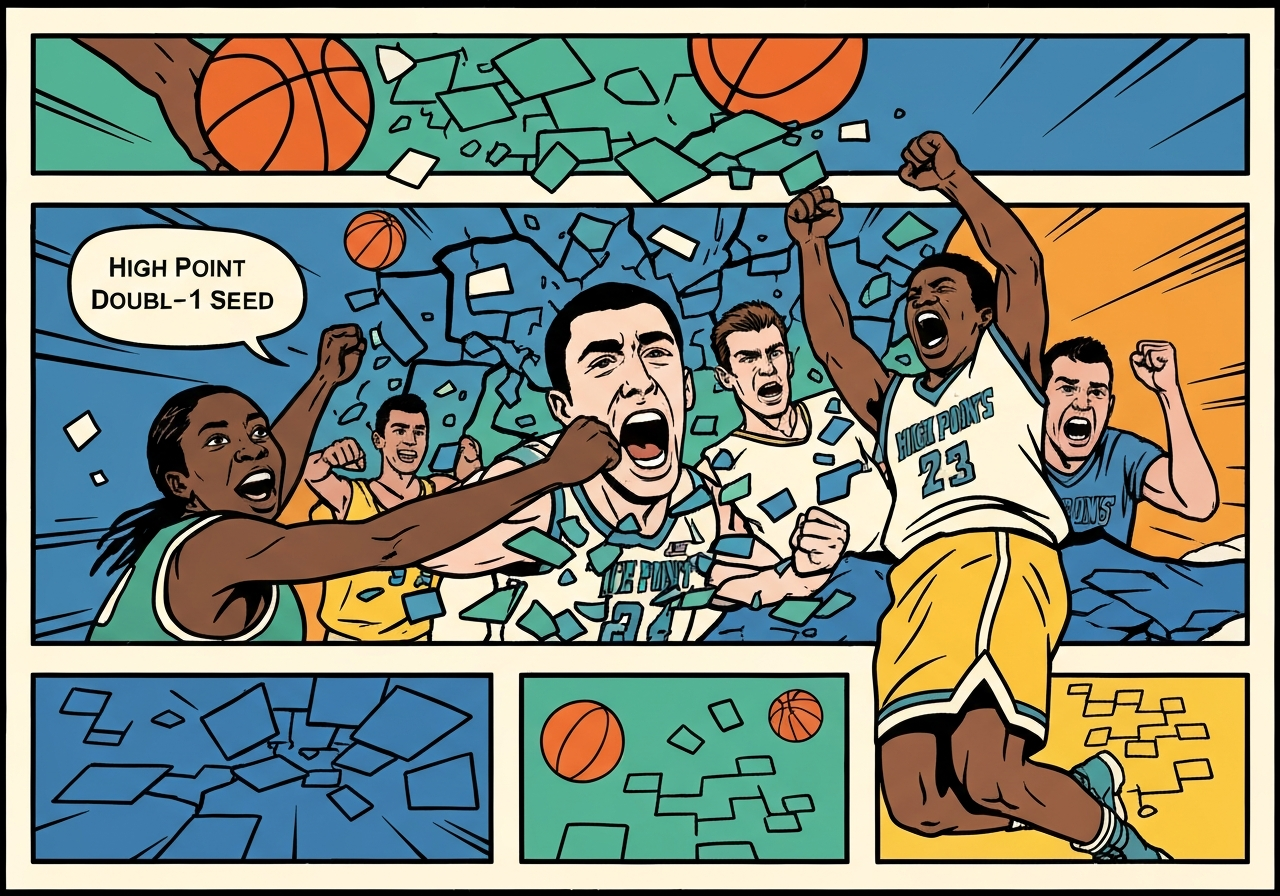
Lead: On Thursday afternoon, 12th-seeded High Point stunned No. 5 Wisconsin, kicking off a day in which four double-digit seeds advanced and millions of NCAA Tournament brackets were ruined. The upset came in the first round of the men’s tournament and was followed by victories from No. 11 VCU, No. 11 Texas and No. 10 Texas A&M. By the close of the opening slate, fewer than 1% of entries in major bracket challenges remained perfect, underscoring how quickly March Madness can unravel expectations. The results reshuffled early narratives about favorite teams and left pool entrants scrambling to reassess picks.
Key Takeaways
- High Point, a No. 12 seed, beat No. 5 Wisconsin in a first-round upset that helped bust millions of brackets nationwide.
- Four double-digit seeds advanced on the opening day: No. 12 High Point, No. 11 VCU, No. 11 Texas and No. 10 Texas A&M.
- ESPN reported just over 24,000 of its 26.5 million brackets were perfect through the first 12 games, roughly 0.09% of entries.
- VCU defeated North Carolina 82-78 in overtime; North Carolina’s freshman Caleb Williams was sidelined with a broken thumb.
- Texas beat BYU 79-71 despite BYU missing Richie Saunders (torn ACL) earlier this season; the Longhorns overcame a 17-point deficit.
- Texas A&M topped Saint Mary’s 63-50 while Saint Mary’s leading scorer Paulius Murauskas was limited by illness to four points in 23 minutes.
- The NCAA says the mathematical odds of a perfect bracket range from about 1 in 9.2 quintillion (coin flips) to roughly 1 in 120 billion with educated picks.
Background
The NCAA Tournament’s appeal rests on its single-elimination format and the frequent upset—an outcome that makes bracket pools both wildly popular and notoriously brittle. Upsets by seeds in the double digits have become a recurring March phenomenon: 12-over-5 surprises are part of bracket lore and drive much of the event’s unpredictability. Millions of casual and serious fans fill out brackets each March; estimates put the total number of brackets filled annually between 60 million and 100 million, a mix of office pools, automated entries and online contests.
Seeding is intended to reflect regular-season performance, strength of schedule and conference tournament results, but matchups and injuries can quickly alter expected outcomes. This year several contenders entered the tournament with key absences or recent form issues—factors that can amplify upset risk. Tournament organizers and analysts frequently remind fans that even small statistical edges rarely translate to guaranteed results in a single-game elimination format.
Main Event
High Point’s victory over Wisconsin was the day’s signature upset and an early catalyst for bracket chaos. The Panthers’ late three-pointer by Chase Johnston was emblematic of the kind of single-possession plays that swing first-round games, and Wisconsin’s favored status did not insulate it from the volatility of March basketball. That game set the tone for a first day in which conventional seeding expectations were repeatedly challenged.
VCU’s 82-78 overtime win over North Carolina was another headline-grabbing result. North Carolina entered the game without freshman scorer Caleb Williams (broken thumb), a factor the program acknowledged, but the Tar Heels also surrendered a 19-point lead in the second half—an outcome that combined personnel loss with on-court collapse. VCU’s resilience in regulation and clutch execution in overtime underscored how momentum swings decide many early-round contests.
Texas rallied past BYU 79-71 after overcoming a large deficit; BYU had been hampered all season by the earlier loss of Richie Saunders (torn ACL) and entered the tournament on a wobbly run. Meanwhile, Texas A&M’s 63-50 win over Saint Mary’s was influenced by Saint Mary’s illness-limited leading scorer Paulius Murauskas, who managed only four points in 23 minutes. Several other near-upsets, including 16th-seeded Siena nearly holding a double-digit lead against top-seeded Duke, suggested this opening day was unusually fertile ground for surprises.
Analysis & Implications
Bracket breakdowns on Thursday highlighted the razor-thin margins that separate a perfect entry from an early bust. With millions of brackets in play, even a handful of high-profile upsets can eliminate vast swaths of entries; ESPN’s tally—about 24,000 perfect brackets left from 26.5 million—illustrates that effect numerically. For pools with large fields, a single unexpected result often decides the top prizes.
At the team level, these results raise questions about seeding reliability and the evaluation of mid-major programs. High Point and other lower-seeded winners will gain visibility and momentum, potentially altering scouting and preparation for higher-seeded opponents in later rounds. For favored teams, early exits or shaky performances will prompt scrutiny of rotation depth, injury management and game-closing strategy.
For broadcasters, advertisers and sportsbooks, early volatility can increase audience engagement and betting volume but also complicate modeling and liability. Upsets shift public attention and betting lines quickly; sportsbooks adjust odds game by game and may see increased action on underdogs after surprise results. Media narratives will likely emphasize Cinderella storylines, placing added spotlight on programs such as High Point and VCU.
Comparison & Data
| Game | Seed Winners | Seed Losers | Score |
|---|---|---|---|
| High Point vs. Wisconsin | No. 12 High Point | No. 5 Wisconsin | – |
| VCU vs. North Carolina | No. 11 VCU | North Carolina | 82-78 (OT) |
| Texas vs. BYU | No. 11 Texas | BYU | 79-71 |
| Texas A&M vs. Saint Mary’s | No. 10 Texas A&M | Saint Mary’s | 63-50 |
The table summarizes the prominent double-digit seed wins from the opening day; where exact scores were reported they are shown. Comparing these outcomes to historical upset rates shows that while upsets always occur, clusters of multiple double-digit seeds winning on a single opening day are especially consequential for bracket competitions. The numeric odds cited by the NCAA—ranging from 1 in 9.2 quintillion for random picks to about 1 in 120 billion for educated guesses—illustrate why even the most statistically savvy brackets are unlikely to survive intact through the first weekend.
Reactions & Quotes
Officials running major bracket contests and the NCAA framed the results in statistical and cultural terms, highlighting how rare a perfect bracket is and how quickly it can disappear.
“Just over 24,000 of its 26.5 million brackets remained perfect through the first 12 games.”
ESPN (sports media report)
ESPN’s snapshot offered an immediate, quantifiable measure of bracket attrition and was widely circulated among tournament coverage. Observers used that figure to convey how many entrants lost perfection in only the tournament’s opening sequence.
“The NCAA estimates the chances of ending the tournament with a zero in the loss column range anywhere from one in 9.2 quintillion (if you flip a coin for every game).”
NCAA (official estimate)
The NCAA’s probabilistic framing is intended to temper expectations for perfection and to explain mathematically why perfect brackets are essentially mythical. These official statistics are repeatedly cited in media coverage to contextualize the scale of bracket challenges.
Unconfirmed
- Whether any single injury (for example, Caleb Williams’ broken thumb) fully explains a favored team’s loss remains unconfirmed; in-game factors and opponent performance also contributed.
- Details about Siena’s near-upset over Duke (specific lead and final sequence) were widely reported but some play-by-play elements remain to be corroborated in official box scores.
Bottom Line
The opening day of this NCAA Tournament reinforced why March Madness is the country’s premier single-elimination spectacle: unexpected results can cascade quickly, toppling millions of carefully constructed brackets in a matter of hours. Four double-digit seeds advancing on the first day is a notable pattern that will reshape storylines, from Cinderella runs to questions about higher seeds’ form and depth.
For bracket players, the early carnage is a reminder that variance dominates single-game outcomes and that resilience and matchup planning matter for teams that hope to advance. Fans and analysts should expect the narrative to keep shifting—upsets can create new favorites and force favorites to reframe their path to later rounds.