
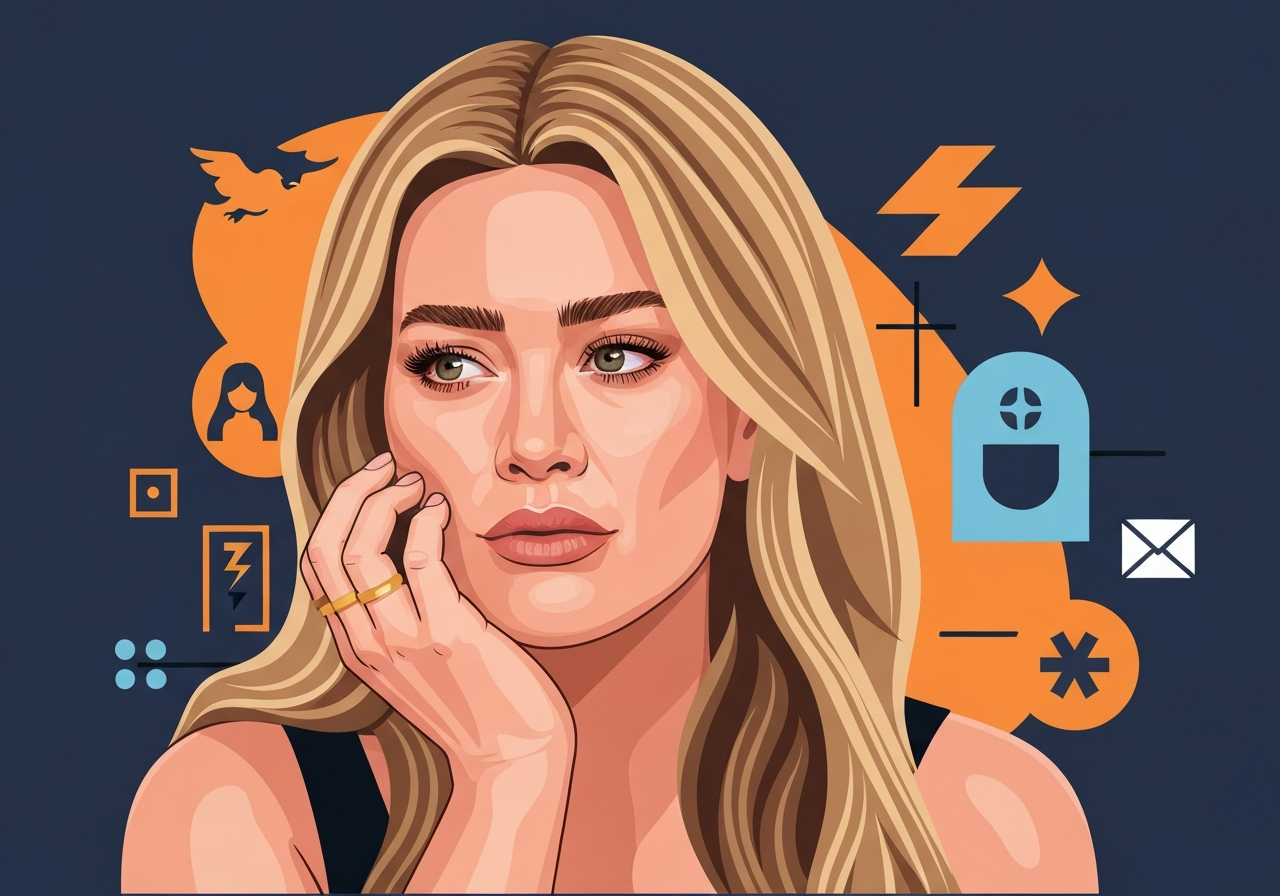
In a Glamour interview published Feb. 17, 2026, Hilary Duff said her forthcoming album is the first time she feels ready to record the private contours of her life — including what she calls a “very complicated” family dynamic and a strained relationship with sister Haylie. The actress‑singer singled out the track “We Don’t Talk” as a direct reckoning with that rift and said the record reflects events and emotions from roughly the past decade. Duff framed the album as a way to connect with listeners who have faced similar family fractures.
- Release context: Interview with Glamour revealed Feb. 17, 2026, that Duff’s new album addresses family tensions, including a song titled “We Don’t Talk.”
- Family history: Duff described her parents, Bob and Susan Duff, as having had a “very complicated” situation; their divorce dates to 2008.
- Legal note: Bob Duff was jailed in 2008 for contempt of court related to allegations he sold family assets without approval.
- Sisterly estrangement: Hilary and Haylie Duff have not been photographed together since before the COVID‑19 pandemic (pre‑2020) and show little public interaction on social media.
- Thematic reach: Duff said the record draws on “large strokes” from the past 10 to 15 years, signaling both personal and creative turning points.
- Artist intent: She framed the album as an invitation to listeners to recognize shared experiences rather than as a public airing of private disputes.
- Public reaction risk: The record’s candid focus on family could renew media scrutiny of long‑running personal matters tied to family and past legal troubles.
The background to Duff’s comments stretches back well over a decade. Hilary and Haylie Duff rose to public attention together in the 2000s; their family life has been a recurring topic of tabloid and mainstream coverage. Their parents, Bob and Susan Duff, divorced in 2008 after about two decades of marriage, and that year also saw legal action involving Bob Duff related to family assets. Those events have periodically reemerged in reporting about the sisters’ relationship and individual careers.
The broader cultural context includes a music industry trend toward confessional albums, where artists use personal narratives to deepen audience engagement. For performers who built careers as child or teen stars, revisiting family dynamics in adulthood can reshape public perception and commercial positioning. Duff’s statement that she “felt ready” to share now fits a wider pattern of established artists using mid‑career records to reinterpret earlier life chapters.
In the interview, Duff described specific motivation for writing songs about her family: the people you are born into tend to take up outsized emotional space, and that presence doesn’t guarantee long‑term cohesion. She framed the album as an attempt to translate those complicated attachments into music rather than an effort to settle scores publicly. The Glamour piece positions the record as both personal therapy and audience outreach.
Onstage and in publicity surrounding the release, the album’s rollout appears to prioritize the music and emotional honesty rather than tabloid confrontation. Duff emphasized connection with listeners, saying many have gone through comparable upheavals over the last 10 to 15 years. Industry observers note that such framing can broaden an artist’s audience beyond longtime fans and create renewed critical interest.
Recording the family material also carries potential legal and reputational considerations. Public discussion of family disputes sometimes prompts statements from other involved parties or their representatives; Duff’s choice to name specific relationships in songs increases the likelihood of follow‑up coverage. For now, Duff has offered her perspective through the interview, while other family members have not issued parallel public comment in response to the Glamour piece.
| Year / Period | Event |
|---|---|
| 2008 | Bob and Susan Duff divorced; Bob Duff jailed for contempt of court over alleged asset sales. |
| Pre‑2020 | Last reported public photographs of Hilary and Haylie together (before COVID‑19 pandemic). |
| Feb. 17, 2026 | Glamour interview in which Hilary says the new album addresses family tensions and the song “We Don’t Talk.” |
The table above distills the public timeline that Duff referenced and that has appeared in reporting. It is meant to clarify which milestones are on the public record and which details remain stylistic or interpretive elements of the new album.
“That’s my family. Those are the people that affect you the most, take up the most space naturally as a human who’s born into something,”
Hilary Duff, Glamour interview (Feb. 17, 2026)
The quote above captures Duff’s rationale for turning family experience into songwriting. She positioned the material as personal observation rather than a public indictment, adding that being born into a family does not ensure its permanence.
“I felt like people have definitely gone through some of the similar large strokes that I have in the past 10 to 15 years,”
Hilary Duff, Glamour interview (Feb. 17, 2026)
This second excerpt summarizes Duff’s stated belief that her experiences will resonate widely; she frames the record as part of a shared cultural conversation about family, loss and reconciliation.
- No independent confirmation of any private conversations between Hilary and Haylie about the album is available at publication.
- Details about the alleged sale of family assets in 2008 and the full court record are not reproduced here; reporting notes the allegation and the contempt sentence but does not substitute for court documents.
- There is no public statement from Haylie Duff responding to Hilary’s Glamour interview as of Feb. 17, 2026.
Bottom line: Hilary Duff’s new album deliberately engages with personal family history and a reported estrangement from her sister, presented as a creative choice rather than a legal or tabloid campaign. The record’s candid tone aligns with a broader industry trend of confessional mid‑career albums and is likely to reframe public conversation about Duff’s past. Readers should expect further coverage if other family members issue responses or if Duff releases more songs that name or clearly reference individuals.
Looking ahead, the album may expand Duff’s audience by tapping into universal themes of family fracture and reconciliation, even as it raises questions about privacy and public narrative. For fans and observers, the key developments to watch are formal release dates, any official statements from Haylie or other relatives, and how critics contextualize the record within Duff’s career trajectory.