
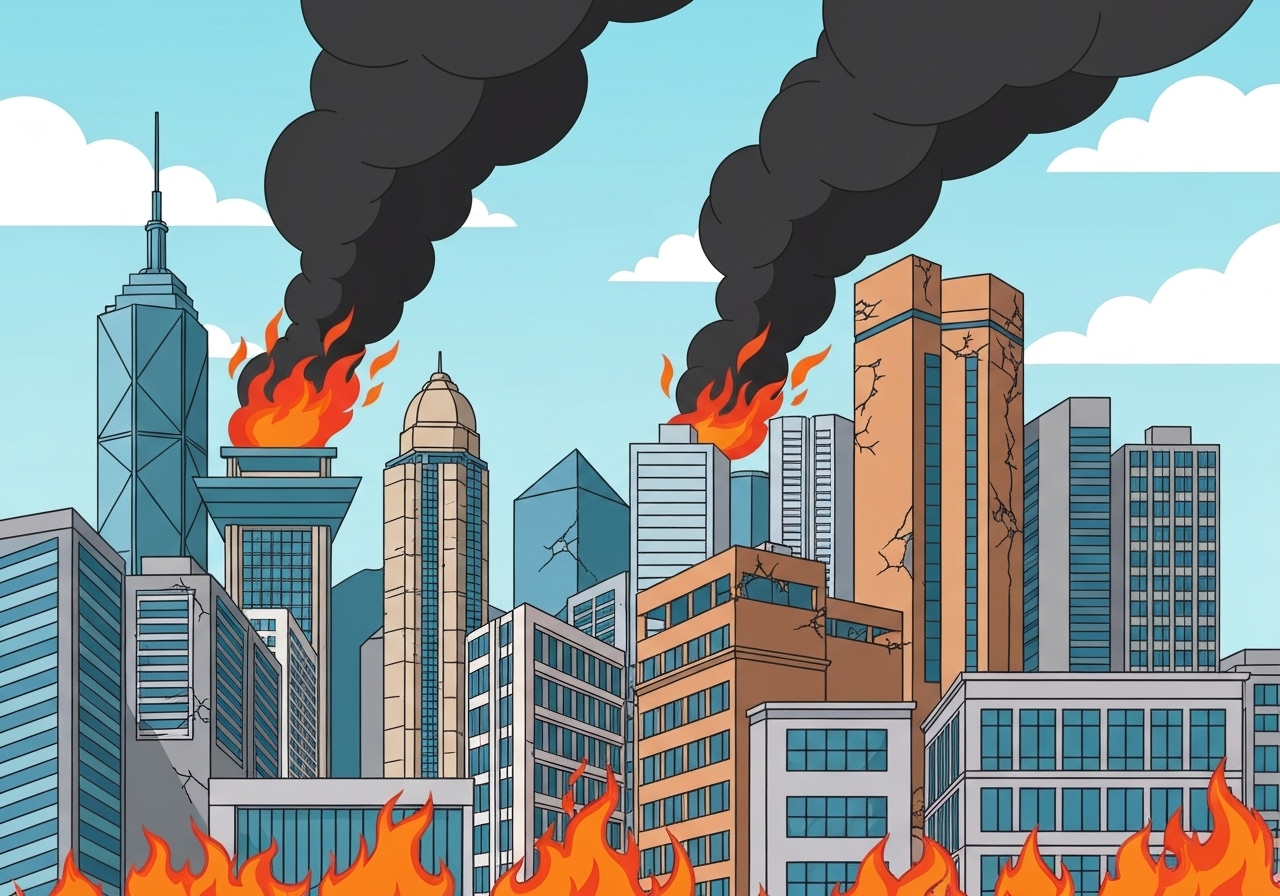
Deadly Hong Kong Fire Tests Beijing’s Rule Over the City
— A fast-moving blaze that gutted residential towers in northern Hong Kong has left at least 128 people dead and dozens injured, posing an early and high‑stakes crisis for the city’s Beijing‑backed administration. The fire, centered on the Wang Fuk Court complex, burned for more than a day and exposed operational and political strains as mainland fire engines were filmed waiting at the border but never crossing into the territory. Chief Executive John Lee has said his government is bringing the fire under control and publicly thanked China’s leader, Xi Jinping, for his concern. The episode has become a test of whether the post‑overhaul Hong Kong administration can manage large-scale emergencies without mainland intervention.
Key Takeaways
- At least 128 people died and dozens more were injured after a fire spread through the Wang Fuk Court towers in northern Hong Kong on Nov. 29, 2025.
- Chinese fire engines were recorded at the border with their lights on, but they did not enter Hong Kong to assist; Hong Kong officials say no mainland assistance was requested.
- Chief Executive John Lee said authorities were gradually getting the blaze under control and publicly acknowledged Xi Jinping’s concern.
- The incident raises political sensitivity because mainland involvement could be seen as inconsistent with Hong Kong’s autonomy under the city’s governance arrangements.
- Local rescue crews worked for more than 24 hours in difficult conditions, and questions are emerging about building safety, emergency coordination and resource readiness.
- Public social media posts and overseas commentary amplified controversy about cross‑border aid and whether officials acted quickly enough.
Background
Hong Kong’s political landscape was reshaped in recent years by measures that tightened Beijing’s oversight of the city’s institutions and political life. The leadership changes and new security and electoral rules have consolidated authority around a Beijing‑aligned administration and its chief executive, John Lee, who faces expectations to demonstrate competence and stability in crises.
Past emergencies in Hong Kong have tested municipal services and prompted public scrutiny of building code enforcement, emergency response times and coordination among agencies. The Wang Fuk Court fire arrived against that backdrop, reviving debates over civil service capacity and the balance between asserting local management and accepting cross‑border assistance when disaster strikes.
Main Event
On Nov. 29, 2025, a fire broke out in the Wang Fuk Court residential towers in northern Hong Kong and spread through multiple floors, requiring a prolonged firefighting and rescue operation. Local firefighters battled flames for more than a day; footage on social platforms showed smoke and flames pouring from upper stories and emergency teams conducting evacuations and retrievals.
Near the border, Chinese fire trucks were filmed with lights flashing as they waited to be dispatched toward the blaze eight miles away inside Hong Kong, but the vehicles did not cross into the city. Hong Kong authorities later stated they had not requested mainland firefighting assistance, and the city’s emergency services continued to lead operations on scene.
Chief Executive John Lee, who has overseen sweeping political changes since taking office, addressed the city and international observers, saying the government was gradually bringing the fire under control and expressing gratitude for expressions of concern from mainland leadership. Officials also described sustained rescue and recovery efforts amid challenging access and smoke conditions in affected towers.
Analysis & Implications
The incident puts pressure on the Hong Kong administration to show it can manage complex disasters independently while avoiding the perception that mainland resources have to step in. For a leadership that has emphasized stability and direct ties to Beijing, visibly handling the response is politically important: accepting mainland crews could be framed as a loss of face for the local government, while refusing aid risks practical criticism if capacity gaps are exposed.
Operationally, the episode raises questions about emergency preparedness and interagency coordination. Observers will scrutinize response times, the availability of specialized equipment for high‑rise rescues and whether building safety standards or enforcement lapses contributed to the scale of the tragedy. Any findings of systemic weakness could trigger reforms and new resource allocations for the Fire Services Department and related agencies.
Diplomatically, the event may affect how Beijing manages its image in Hong Kong and beyond. Beijing has sought to portray its approach as restoring order and competence, so a high‑profile failure by a city administration it backs could complicate that narrative. Conversely, a competent local response could be used to validate the governance changes enacted in recent years.
Comparison & Data
| Year | Location | Reported Deaths |
|---|---|---|
| 2025 | Wang Fuk Court, Hong Kong | 128 |
| 2017 | Grenfell Tower, London | 72 |
| 1996 | Garley Building, Hong Kong | 41 |
The comparative table highlights that the Wang Fuk Court fire is among the deadliest recent high‑rise residential disasters in modern memory. Differences in building design, fire safety retrofits, evacuation procedures and emergency response protocols mean direct comparisons have limits, but the table frames the scale of the loss.
Reactions & Quotes
“People should be sensitive to the image that may arise that the Hong Kong people are unable to deal with matters within Hong Kong.”
Ronny Tong, senior adviser to Chief Executive John Lee
Ronny Tong framed the political optics of accepting mainland assistance as potentially damaging to Hong Kong’s image of self‑administration. His comment reflects internal counsel about preserving perceptions of local competence.
“We are gradually getting the fire under control,”
John Lee, Chief Executive (official statement)
John Lee’s brief public remarks emphasized containment and thanked mainland leadership for concern, a combination aimed at reassuring residents while acknowledging ties with Beijing.
“The rescue teams have been working in very difficult conditions to retrieve victims and search the upper floors.”
Fire Services official (on‑scene briefing)
Operational officials highlighted the challenges faced during prolonged firefighting and search operations, underscoring demands on personnel and equipment in high‑rise incidents.
Unconfirmed
- Reports that mainland crews were formally offered assistance and explicitly refused by Hong Kong authorities remain unverified by an official transfer of requests or diplomatic notes.
- Claims circulating on social media that delayed response times directly caused a specific portion of the death toll have not been independently corroborated and require formal investigation.
Bottom Line
The Wang Fuk Court blaze is simultaneously a human tragedy and a political stress test. Beyond the immediate need for recovery and accountability, the incident will be measured for how it reflects on the capabilities of a Hong Kong administration that has been reshaped to align more closely with Beijing.
Investigations into building safety, emergency preparedness and the decision‑making around cross‑border assistance will be closely watched. The outcomes may prompt administrative and technical reforms, influence public confidence in local institutions and shape Beijing’s messaging about governance in the territory.
Sources
- The New York Times — news report summarizing events and official statements (media).
- Hong Kong Fire Services Department — official emergency services site (official).