
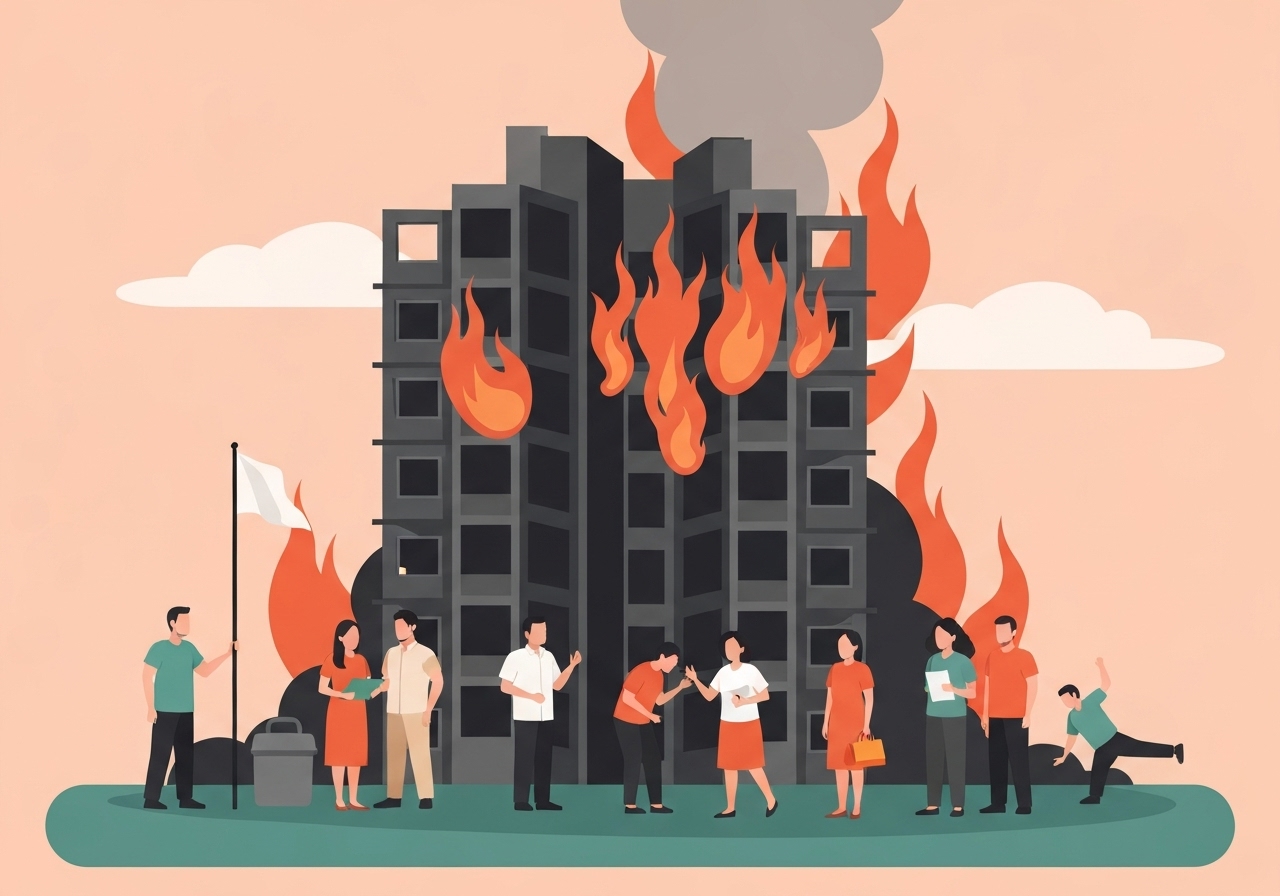
On Nov. 28, 2025, a devastating fire tore through the Wang Fuk Court apartment complex in Tai Po, Hong Kong, leaving 128 confirmed dead and roughly 200 people unaccounted for. Fire crews worked through smoldering floors and pockets of embers while authorities suspended nonessential activities to concentrate on rescue and recovery. More than 70 residents were hospitalized, several in critical condition, and the city mourned the loss of a 37-year-old firefighter, Ho Wai-ho, who collapsed at the scene and later died. Families gathered at a nearby community center where officials showed photographs as part of the identification process.
Key Takeaways
- Fatalities: Authorities reported 128 confirmed deaths linked to the Wang Fuk Court fire as of Nov. 28, 2025.
- Missing: Hong Kong Secretary for Security Chris Tang said about 200 people were unaccounted for and officials expected the toll to rise.
- Injuries: More than 70 people were hospitalized after the blaze, with several in critical condition.
- Firefighter casualty: The deceased firefighter was identified as Ho Wai-ho, 37, a nine-year veteran who collapsed at the scene and later died in hospital.
- Operational status: Deputy Fire Director Derek Armstrong Chan said the firefighting operation was “almost complete,” while crews continued to douse embers.
- Site conditions: The complex displayed extensive charring and had bamboo scaffolding in poor repair around several towers, complicating access and recovery work.
- Family response: Relatives assembled at a community center to view photographs and seek information about missing loved ones.
Background
Wang Fuk Court is a densely occupied public housing cluster in the northern district of Tai Po. High-rise residential fires pose particular risks in Hong Kong because of building density, vertical evacuation challenges, and the prevalence of external scaffolding on older structures. Over recent decades city officials have tightened fire-safety regulations, but aging housing stock and informal repairs remain persistent vulnerabilities.
The social context includes an aging population in many public estates and cramped living spaces that can accelerate smoke spread and hamper rescue. Emergency services in Hong Kong are well-equipped and experienced with vertical-rescue operations, yet large-scale blazes still strain resources and require coordinated responses across departments. Public anxiety often rises quickly in the aftermath of mass-casualty events, driving demands for rapid answers on cause and accountability.
Main Event
The fire broke out on the morning of Nov. 28 and rapidly engulfed multiple levels of one or more towers within Wang Fuk Court. Firefighters entered the complex and worked floor by floor amid heavy smoke and structural damage, focusing first on search-and-rescue before shifting to recovery as survivors became less likely. Smoke and lingering embers were visible even as crews said suppression efforts were nearing completion.
Officials provided rolling updates: Chris Tang, the secretary for security, announced the latest casualty figures and warned that the number of deceased could rise as searches continued. Derek Armstrong Chan, a deputy director at the Fire Services Department, told reporters the department had nearly finished active firefighting operations but that recovery and investigation would continue. On-site responders also faced the practical challenge of bamboo scaffolding around the buildings, some of which was in disrepair and impeded safe access.
Family members and neighbors gathered outside the complex and at a nearby community facility, where authorities displayed photographs to help with identification. Hospitals reported dozens of admissions; several patients were being treated for severe burns or smoke inhalation. Emergency management officials said they had canceled nonessential governmental activities to free personnel and resources for the crisis response.
Analysis & Implications
The human toll of 128 confirmed dead marks this as one of Hong Kong’s deadliest residential fires in decades and will intensify scrutiny of building maintenance, fire prevention enforcement, and evacuation protocols. Investigators will likely examine electrical systems, combustible materials in common areas, and the role — if any — of external scaffolding in how flames and smoke spread. The presence of large numbers unaccounted for suggests either incomplete resident registries or rapid displacement, complicating immediate accounting efforts.
Politically, the incident may prompt calls for accelerated inspections of older housing estates and renewed investment in fire-proofing upgrades, particularly in estates with bamboo scaffolding or informal alterations. Administratively, resource allocation for emergency medical care and mortuary services will be under pressure, and authorities must balance speed of recovery with accurate identification and respectful handling of remains.
Economically, affected households face displacement, potential loss of personal property and documents, and short-term needs for shelter and support services. The municipal government will need to mobilize social services and potentially financial assistance for survivors and bereaved families, and insurers and housing authorities will be closely involved in the coming weeks.
Comparison & Data
While exact historical comparisons vary by incident, officials described this blaze as the deadliest in Hong Kong for decades, an assessment that underscores both the scale of the loss and the rarity of such mass-casualty residential fires in the city. The combination of high occupancy, vertical construction and external scaffolding creates a risk profile distinct from lower-rise or single-family home blazes. Analysts will compare case details — cause, spread pattern, response times and building condition — to prior incidents to identify systemic changes that could reduce future risk.
Reactions & Quotes
“About 200 people are unaccounted for and the government expects to find more bodies,”
Chris Tang, Hong Kong Secretary for Security (official statement)
Chris Tang provided the latest casualty figures and warned families and the public that the official death toll could increase as recovery continued. His statement framed the scale of the crisis and the uncertainty facing authorities conducting searches within damaged towers.
“Our firefighting operation is almost complete,”
Derek Armstrong Chan, Deputy Director, Fire Services Department (agency update)
Derek Armstrong Chan described the operational transition from active suppression toward recovery and investigation, while noting crews continued to extinguish embers and secure the scene. His remarks signaled that while visible flames had been contained, hazards and recovery tasks persisted.
Unconfirmed
- The precise cause and ignition point of the fire remain under investigation and have not been publicly confirmed.
- The final count of missing or deceased residents is expected to change as searches continue and identifications are completed.
- Reports about the scaffolding’s direct role in accelerating the fire’s spread are not yet verified and await forensic findings.
Bottom Line
The Wang Fuk Court blaze is a catastrophic event for Tai Po and for Hong Kong, combining heavy loss of life with substantial uncertainty about the final toll and the fire’s origin. Immediate priorities are completing searches, identifying victims respectfully, treating the injured, and supporting displaced residents with shelter and essential services.
In the medium term, expect intensified regulatory and public scrutiny of maintenance practices in older estates, external scaffolding safety, and emergency preparedness for high-rise communities. Accurate, transparent updates from investigators and authorities will be essential to restore public confidence and to guide any policy responses aimed at preventing a recurrence.
Sources
- The New York Times — news report: coverage of the Wang Fuk Court fire, casualty figures and on-scene reporting.