
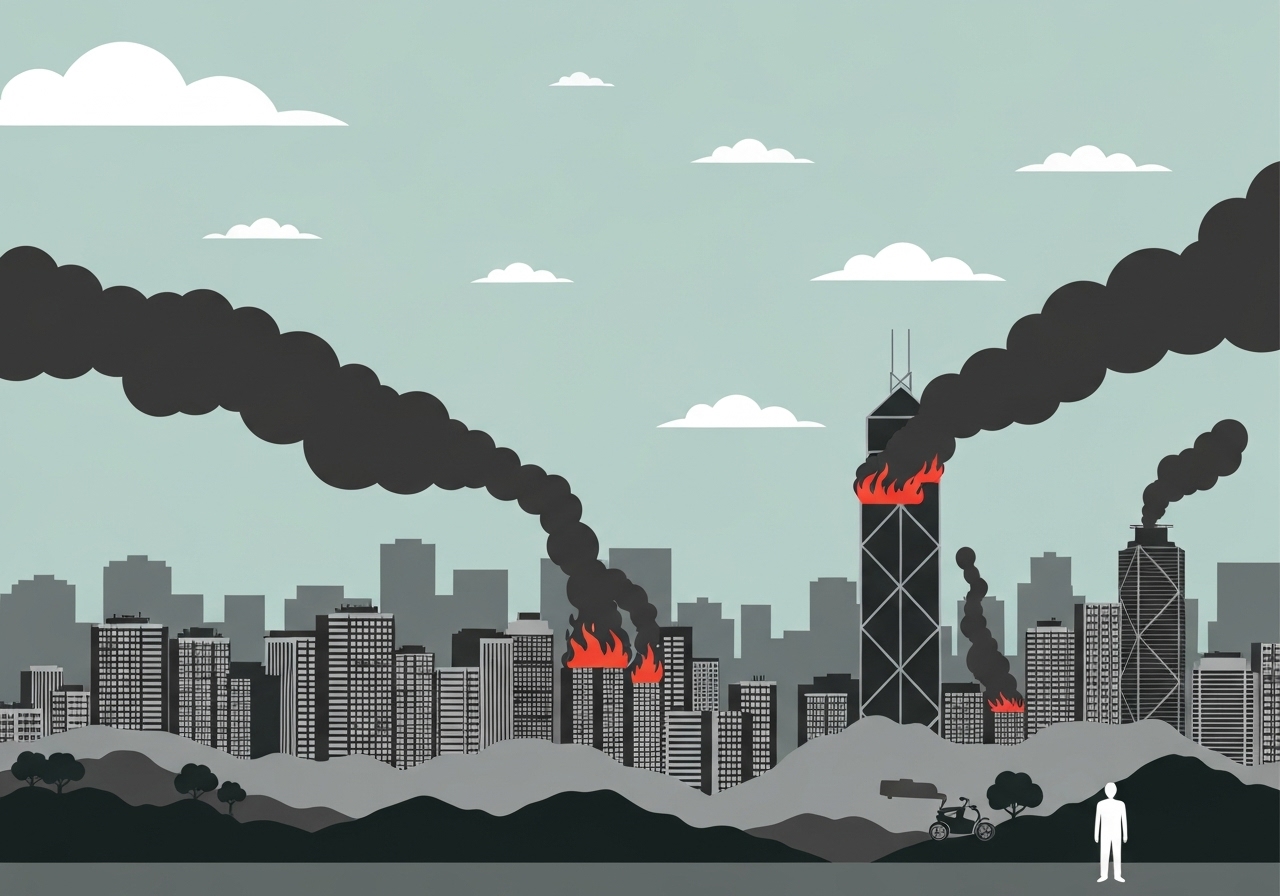
Hong Kong begins three days of mourning after deadly apartment fires
Hong Kong entered a formal three-day mourning period on Saturday after a fire at the Wang Fuk Court housing estate in Tai Po killed 128 people. City leader John Lee, senior ministers and dozens of top officials observed a three-minute silence outside government headquarters while flags were lowered to half-mast. The blaze, which burned for more than 40 hours, consumed seven of the eight high-rise blocks in the dense complex and left hundreds displaced. Authorities have launched multiple investigations and made arrests as families continue searches at hospitals and victim identification centres.
Key takeaways
- Death toll stands at 128 confirmed fatalities, making this the citys deadliest residential fire in decades.
- About 200 people remain listed as missing and 89 recovered bodies have not yet been identified.
- The fire spread through seven of eight towers in the Wang Fuk Court complex and burned for over 40 hours.
- Eight people were arrested by the citys anti-corruption watchdog on Friday in connection with the blaze; separate arrests were made on suspicion of leaving foam packaging at the scene.
- Investigators reported malfunctioning alarm systems across all eight blocks and preliminary evidence points to highly flammable foam boards, protective netting and bamboo scaffolding as factors in rapid spread.
- Authorities found temporary housing for around 800 displaced residents and ran nine emergency shelters that held roughly 720 people overnight.
- Dozens remain hospitalised, including 11 in critical condition and 21 described as serious.
- Community donation and support stations quickly organised clothes, food, medical and psychological care, but organisers later asked for no more supplies because of oversupply.
Background
Wang Fuk Court is a dense public housing estate in Tai Po, in Hong Kongs northern New Territories. The complex comprises multiple high-rise residential blocks that house large multi-generational families, a configuration that concentrates vulnerability when a major fire occurs. Hong Kong has a history of deadly fires in tightly packed neighbourhoods, although stronger building regulations and safety measures had reduced the frequency of such disasters in recent decades.
Large-scale residential fires were more common in the mid 20th century; officials note the last incident with a comparable death toll dates back to 1948 when an explosion followed by a fire killed at least 135 people. Contemporary building techniques, scaffolding practices and facade materials vary widely across developments, and enforcement of retrofits or repairs can be complex, involving contractors, subcontractors and government oversight bodies.
Main event
The blaze began on a Wednesday afternoon and quickly accelerated, engulfing multiple towers within minutes. Authorities said flames appeared to start on protective netting on lower floors of one block, then spread upward and laterally, fed by highly flammable foam boards used on external surfaces and by bamboo scaffolding. Firefighters battled flames for more than 40 hours as crews worked to protect adjacent blocks and evacuate residents.
On Saturday morning, government leaders stood at the headquarters for three minutes of silence while flags flew at half-mast, marking the start of the official mourning. Rescue and identification teams continued careful, time consuming searches inside charred apartments; officials warned they may discover further remains as forensic work advances. Hospitals and temporary identification centres received relatives, many of whom are still seeking missing family members.
Emergency services reported that alarm systems in all eight blocks were malfunctioning, a finding that has focused attention on contractors responsible for maintenance and on the adequacy of building inspections. The citys anti-corruption commission has arrested eight people described as consultants, scaffolding subcontractors and a project middleman, and police detained other individuals in connection with foam packaging found at the site.
Analysis & implications
The scale of this disaster will intensify scrutiny of building safety governance in Hong Kong, including maintenance contracting, inspection regimes and the materials permitted for external cladding and temporary works. If investigators confirm that foam boards and bamboo scaffolding materially accelerated the fire, regulators may face pressure to tighten approvals and enforcement for facade repairs and renovation projects, especially on older estates.
Alarm failures reported across all eight blocks highlight systemic risks where life safety systems depend on coherent maintenance and timely repairs. For residents of ageing estates this raises urgent policy questions about funding and accountability for retrofits, the role of district councils and social housing managers, and the transparency of maintenance records held by contractors and authorities.
The arrests by the anti-corruption watchdog suggest prosecutors will explore both criminal negligence and potential graft or regulatory lapses. A sustained criminal and regulatory response could lead to stronger compliance measures but also heighten community distrust if investigations are perceived as slow or partial. The incident may also accelerate calls for clearer disaster preparedness and community-based evacuation planning in high density residential zones.
Comparison & data
| Metric | Number |
|---|---|
| Confirmed fatalities | 128 |
| Persons listed as missing | ~200 |
| Bodies not yet identified | 89 |
| Blocks affected | 7 of 8 towers |
| Duration of major burning | More than 40 hours |
| Displaced people with temporary housing | ~800 |
| People sheltered overnight | ~720 |
| Arrests by anti-corruption watchdog | 8 |
| Hospitalised (critical) | 11 |
| Hospitalised (serious) | 21 |
The table summarises core figures released by authorities and reported by media outlets. These numbers show both the human scale of the catastrophe and the operational burden on emergency, medical and identification teams. Over the coming weeks investigators will refine counts as missing cases are resolved and forensic identifications proceed.
Reactions & quotes
Officials, emergency responders and residents have all expressed grief, outrage and calls for accountability. Senior officials pledged rigorous investigations and legal follow up.
We found alarm systems in all eight blocks to be malfunctioning, and we will pursue action against responsible contractors
Andy Yeung, Fire Services Chief
Law enforcement stressed that searches may reveal further human remains and that the inquiry will be painstaking.
We do not rule out the possibility that police will find more charred remains when entering the building for detailed investigation
Chris Tang, Security Chief
Residents and relatives described the chaos of the evacuation and the ongoing anguish of searching hospitals and registers.
One building went up in flames and it spread to two more blocks in less than 15 minutes. It was burning red, I shudder to think about it
Mui, 77, eyewitness
Unconfirmed
- Final cause of the fire has not been officially determined and remains under investigation.
- Exact responsibility for alarm system failures is being probed; contractor culpability has not been legally established.
- Police warned they may find additional human remains during further searches, but numbers are not confirmed.
Bottom line
The Wang Fuk Court fire is a human tragedy that has exposed vulnerabilities in building safety, maintenance oversight and emergency readiness in one of the city’s older housing estates. With 128 confirmed deaths, roughly 200 still listed as missing and dozens injured, families and communities face a prolonged period of grieving and forensic work. Authorities have moved quickly to open criminal and corruption probes, but public confidence will hinge on the transparency and speed of investigations and on tangible policy reforms to prevent recurrence.
In the near term Hong Kong will need to reconcile immediate humanitarian needs with forensic and legal processes, while policymakers face pressure to update safety rules for cladding, scaffolding and alarm maintenance. The scale of the loss is likely to reshape discussions about housing safety, contractor accountability and emergency preparedness across the city and beyond.
Sources
- The Guardian (international news)
- Government of the Hong Kong Special Administrative Region (official government website)
- Hong Kong Police Force (official law enforcement site)
- Agence France-Presse (international news agency)