
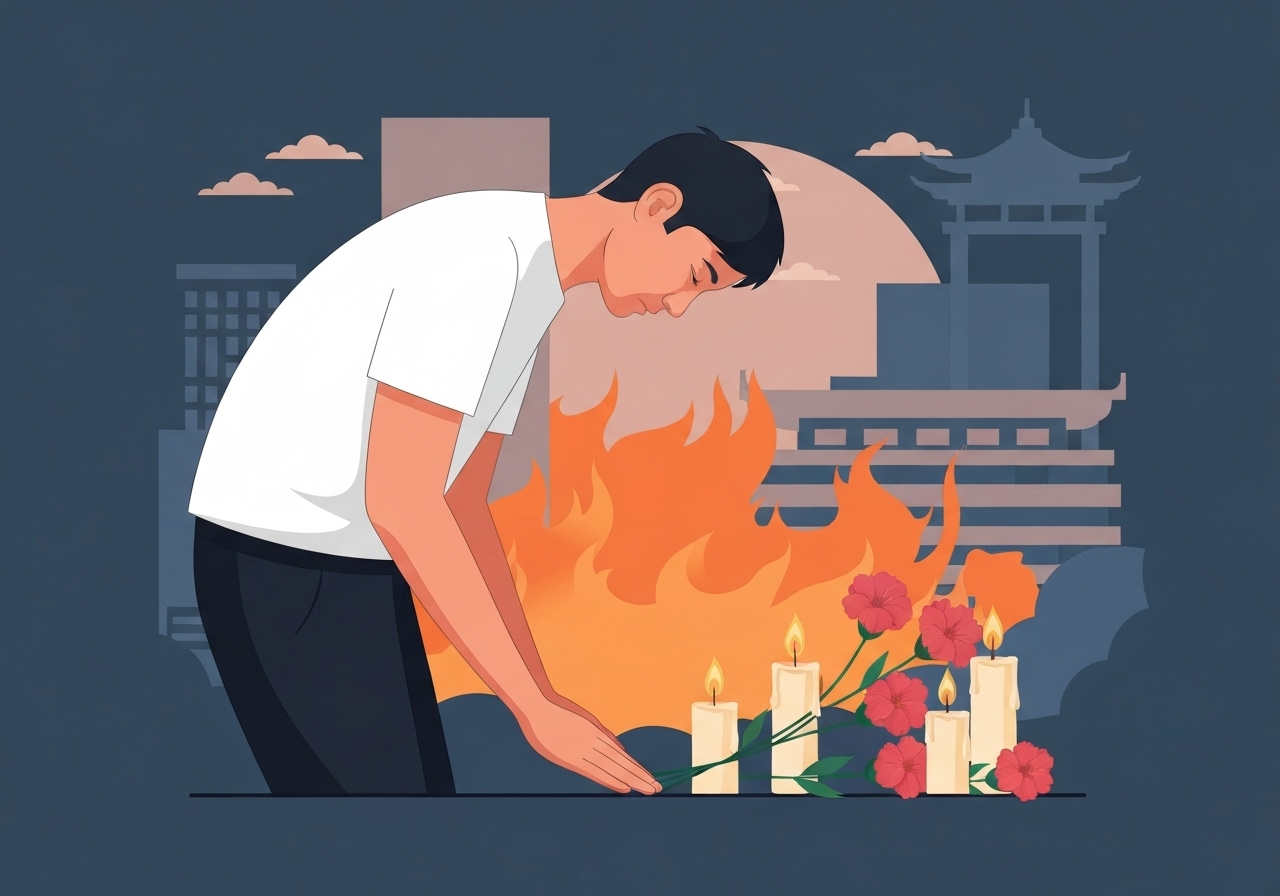
Hong Kong began three days of official mourning on Saturday after a devastating fire at the Wang Fuk Court estate in Tai Po left 128 people dead, including a firefighter. Authorities say rescue operations continued into a fourth day as officials opened condolence books across all 18 districts and flew the national and Hong Kong flags at half-mast until Monday. At least 79 people are reported injured, including 12 firefighters, while the status of roughly 200 residents remains unclear. The government has launched criminal inquiries and made multiple arrests as investigators probe renovation practices at the site.
Key Takeaways
- Death toll stands at 128 confirmed fatalities, among them a member of the Fire Services Department.
- Seventy-nine people have been treated for injuries; 12 of the injured are firefighters.
- Status of about 200 residents remains uncertain as search and casualty confirmation continue.
- The Wang Fuk Court complex comprised eight residential blocks that were undergoing renovation from July 2024, using bamboo scaffolding and green mesh.
- Authorities say highly flammable expanded polystyrene (styrofoam) materials used in renovation works are believed to have accelerated the blaze.
- Criminal probes are underway; 11 people arrested so far—eight by the Independent Commission Against Corruption (ICAC) and three by police on manslaughter-related suspicion.
- Fire was first reported at 2:51pm on Wednesday and escalated quickly to a No. 5 fire alarm, with flames spreading to seven of eight blocks.
- Hotlines have been set up: Police casualty inquiry 1878 999; Health Bureau mental health support 18111; Tai Po District help desk at Alice Ho Miu Ling Nethersole Hospital 2658 4040.
Background
The fire struck Wang Fuk Court, a multi-block residential estate in Tai Po, during renovation work that began in July 2024. The exterior of the blocks had been cloaked in traditional bamboo scaffolding and green safety mesh while contractors carried out upgrades. Local officials and the Fire Services Department say combustible insulation or decorative materials reportedly used in the refurbishing helped the flames jump between units and up building facades.
Hong Kong’s housing stock includes many older walk-up estates where combustible retrofit materials and densely packed units can complicate evacuation and firefighting. Following earlier high-profile fires and building-safety debates, the city has tightened some inspection regimes, but critics argue oversight of private renovation work remains fragmented. The incident has therefore highlighted long-standing tensions between renovation demand, cost pressures and enforcement capacity.
Main Event
The first emergency call arrived at 14:51 on Wednesday; within minutes the situation escalated to the Fire Services Department’s highest alarm level, No. 5. Thick dark smoke and intense flames spread rapidly, affecting seven of the estate’s eight blocks and prompting large-scale rescue and medical responses. Firefighters, ambulances and police units converged on the area, and residents were evacuated to temporary reception centers.
Over the following days crews worked to bring the blaze under control and to search damaged units for survivors and victims. Authorities reported that sections of the estate suffered severe external burning consistent with a fast-spreading, façade-fed fire. Rescue teams continued methodical searches inside apartments and communal areas as casualty identification proceeded.
In parallel to rescue work, law-enforcement agencies opened criminal investigations to determine cause and culpability. The Independent Commission Against Corruption (ICAC) has arrested eight people, and police investigators have charged three individuals with offences related to manslaughter allegations. Officials said forensic and structural examinations are ongoing to establish how materials and renovation methods influenced spread.
Analysis & Implications
The scale of the death toll—128 confirmed—makes this the deadliest residential fire in Hong Kong in roughly seven decades, prompting urgent questions about building-safety rules and renovation oversight. If investigators confirm that highly flammable foam or similar materials were used improperly, regulatory gaps governing exterior refurbishment and temporary cladding could become a central policy focus. Authorities may face pressure to tighten licensing, inspection and material-approval processes for renovation contractors.
Beyond regulation, the tragedy underscores risks in rapid, often informal renovation markets where cost, speed and inconsistent standards can lead to dangerous choices. For emergency services, the incident will likely prompt reviews of access to narrow estates, ladder and aerial deployment in dense neighbourhoods, and inter-agency coordination during multi-block emergencies. Training and equipment assessments for high-rise façade fires are also probable outcomes.
Economically and socially, the event will reverberate through housing policy debates. Tens or hundreds of households have been displaced or suffered loss; mental-health and social-welfare demand is likely to rise in the short term. Politically, the government’s handling of investigations, transparency of findings and any follow-on enforcement will shape public confidence in official oversight of building safety.
Comparison & Data
| Metric | Value |
|---|---|
| Confirmed fatalities | 128 |
| Injured | 79 (including 12 firefighters) |
| Status uncertain | ~200 people |
| Blocks affected | 7 of 8 |
| Renovations started | July 2024 |
| Arrests | 11 (8 ICAC, 3 police) |
The table summarizes confirmed counts and actions as reported by authorities. While casualty tallies are official as of Friday, investigators cautioned that numbers could change as searches and formal identifications proceed. Comparisons to previous major incidents highlight the exceptional human cost of this blaze and frame the scale of expected policy responses.
Reactions & Quotes
Government leaders and community groups offered condolences while promising investigations and support for affected families. Officials led by Chief Executive John Lee Ka-chiu observed a three-minute silence at the government headquarters on Saturday as part of the citywide mourning.
We extend our deepest condolences to the victims and their families and will spare no effort in the investigation, officials said during public briefings.
Chief Executive’s Office / Government statement
Law-enforcement agencies emphasized a criminal dimension to the probe and the need for careful forensic work before assigning legal responsibility.
Investigators are treating the matter as a complex criminal inquiry and will coordinate forensic and structural assessments, the police noted.
Hong Kong Police Force
Civil-society groups and district volunteers set up condolence points across all 18 districts and urged authorities to provide clear assistance to displaced residents and families tracing missing loved ones.
Community volunteers are focused on providing support and information to families while urging transparent updates from officials.
Local relief organizations
Unconfirmed
- The precise ignition source and sequence that started the fire remain under forensic examination and have not been publicly confirmed.
- The final numbers for missing or unaccounted residents may change pending formal identification and family notifications.
- The full legal culpability of specific contractors or material suppliers has not been established and remains the subject of ongoing investigation.
Bottom Line
The Tai Po blaze that killed 128 people has become a defining public-safety crisis for Hong Kong, prompting citywide mourning and a robust criminal response. Beyond immediate rescue and forensic work, the tragedy will likely accelerate reviews of renovation practices, material approvals and enforcement mechanisms across the city’s ageing housing stock.
Families and communities will require sustained practical and mental-health support as the city moves from rescue to recovery and accountability. How quickly investigators can determine causes and whether policymakers act on identified gaps will shape public trust and regulatory outcomes in the months ahead.
Sources
- South China Morning Post — Media report with incident details and on-the-ground coverage.
- The Government of the Hong Kong Special Administrative Region — Official statements and directives (government source).
- Hong Kong Fire Services Department — Operational updates and fire-alarm information (official emergency services).
- Independent Commission Against Corruption (ICAC) — Law-enforcement body involved in arrests (official investigative authority).